News
Michael Hansmeyer Presents Digital Grotesque: Additive Art Made From Sand
There are already a large number of different art installations in which artists have turned to additive manufacturing in different forms. Whether it be different technologies or materials, this list includes works by artists such as Julia Körner and her…
- 3 min read
- News
- Six more stories
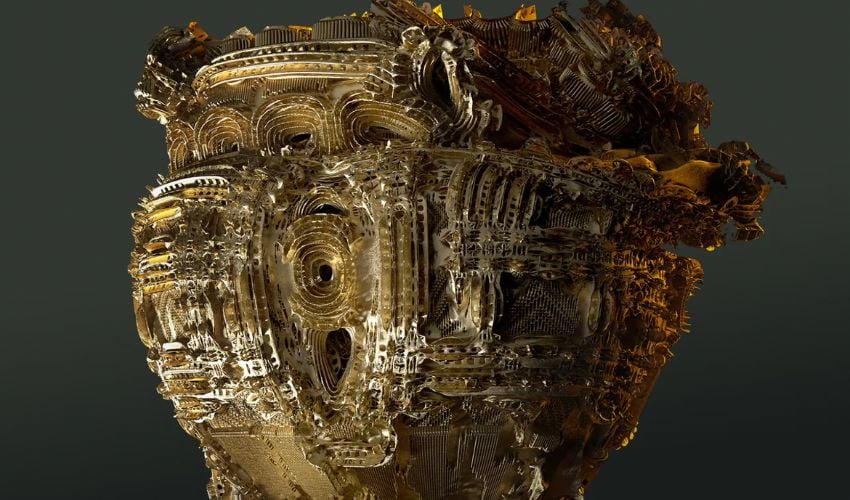
There are already a large number of different art installations in which artists have turned to additive manufacturing in different forms. Whether it be different technologies or materials, this list includes works by artists such as Julia Körner and her 3D-printed installations in the Palazzo Gritti in Venice or Peter Lang, who used AM to create futuristic works. Now Michael Hansmeyer also joins this list with his creations. Hansmeyer, who is both an architect and a programmer, recently showed his latest works, called Digital Grotesque I and Digital Grotesque II. These are designs inspired and produced by algorithms. Overall, according to the artist, the goal of the installations is to create an architecture that “defies classification and reductionism.”
Michael Hansmeyer can already sign his name to a variety of 3D-printed artworks. In addition to Digital Grotesque I and II, he also counts works such as The Magic Flute, White Tower, and Maquarnas. But the reason why Digital Grotesque is worth mentioning is quite simple: the form created by algorithms is both synthetic and organic, which, according to his own statements, gives an expected as well as unexpected appearance to the overall image of the artwork. Even if algorithms are attributed a certain determinacy, the artwork as a whole seems rather surprising, not least due to the use of 3D printing as a manufacturing method.
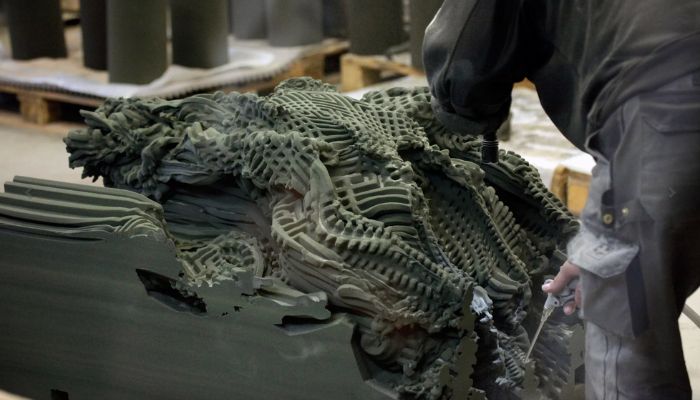
Photo Credits: Michael Hansmeyer
The Role of 3D Printing in the Production of Digital Grotesque
Thanks to 3D printing, Digital Grotesque is made entirely of sandstone and has a complex geometry, which in turn consists of millions of individual small facets. The reason Hansmeyer opted for sand printing technology here relates to special properties that are of great importance for the creation of architectural components, such as the production of large-format elements that can currently be printed up to eight cubic meters in size with high resolution and accuracy. Of course, components such as price and printing time were also key factors. Among other things, there is no need for additional costs when it comes to embellishments and free-form geometries.
More from the desk
Six other notes from the rest of the bench.
 SoftwareUltimaker Unveils its New Software StrategyFDM 3D printing specialist Ultimaker has announced that its Ultimaker Essentials platform will now be integrated into all of its 3D printers, allowing all customers to take full advantage of its benefits. Through this tool, launched last summer, users can…
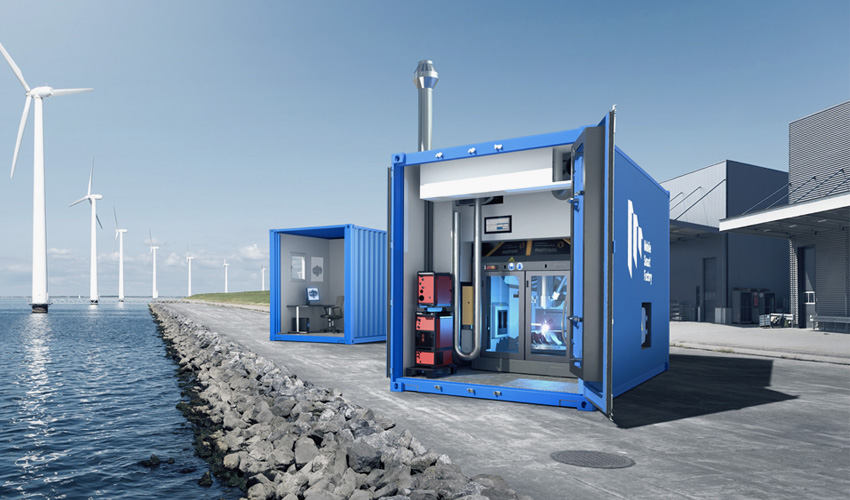 PrintersAn intelligent production module to 3D print parts on siteCan you imagine a parts factory inside a container? The so-called Mobile Smart Factory is a practical solution to bring the production process with 3D printing closer to anyone, anywhere. It is a factory inside modular containers equipped with devices…
 Printers3Dnatives Lab: EinScan-S 3D Scanner by Shining3D TestToday the 3Dnatives lab will be embarking on a test of the Einscan-S model from Shining 3D. This 3D scanner was born thanks to a Kickstarter campaign in early 2015, where they were able to scrape together a whopping $123,000 USD to…
 NewsTop 5 Videos: the New Xerox ElemX, 3D Printed Bone, and Artec ScannersThis week’s selection of top 5 videos features additive manufacturing innovations from leading research institutions and manufacturing companies. Our top 1 looks into Xerox’s new liquid metal 3D printer, the ElemX, purposed to circumvent the risks associated with 3D p
 ApplicationsLightForce Orthodontics 3D prints customisable ceramic bracesThe dental sector has kept reinventing itself since the introduction of 3D printing technologies! And one company that caught our eye is LightForce Orthodontics. Based in Boston, it provides a digital platform to orthodontists to fully personalise 3D printed dental…
 ApplicationsCzinger’s 21C V MAX Turns 3D Printing into Hypercar IdentityHypercars are often defined by their speed, styling, and scarcity. Czinger recently announced the unveiling of its 21C V MAX, showcasing how 3D printing can be just as central to a vehicle’s identity. The specific Liquid Silver finish is more…