News
New Technology From Carbon Co-Founder Promises Faster Multi-Material Resin Printing
3D printing just keeps on evolving. Most recently, Stanford engineers, including Joseph DeSimone, have designed a new 3D printing method that they claim is 5 to 10 times faster than the quickest high-resolution printer currently available. Not only that, but…
- 3 min read
- News
- Six more stories
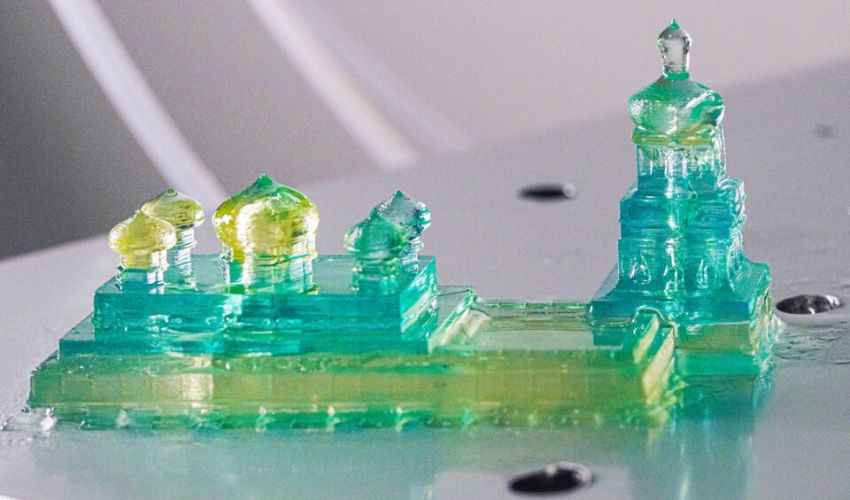
3D printing just keeps on evolving. Most recently, Stanford engineers, including Joseph DeSimone, have designed a new 3D printing method that they claim is 5 to 10 times faster than the quickest high-resolution printer currently available. Not only that, but with this injection continuous liquid interface technology (iCLIP), users would be able to use multiple types of resin in a single part.
If the name CLIP rings a bell, you are not alone. Continuous liquid interface production was first invented by Joseph DeSimone (one of the creators of this newest technology) and colleagues back in 2015 and is the technology that Carbon was founded upon. Of course, their technology has since been renamed to Digital Light Synthesis, and Joseph DeSimone stepped down from his CEO position in 2019 to serve as a Chairman of the Board of the Directors at Carbon, but the basis of the technology is the same. This latest innovation serves to allow for multi-material, resin printing as it combines traditional clip with active injection of resins where needed.
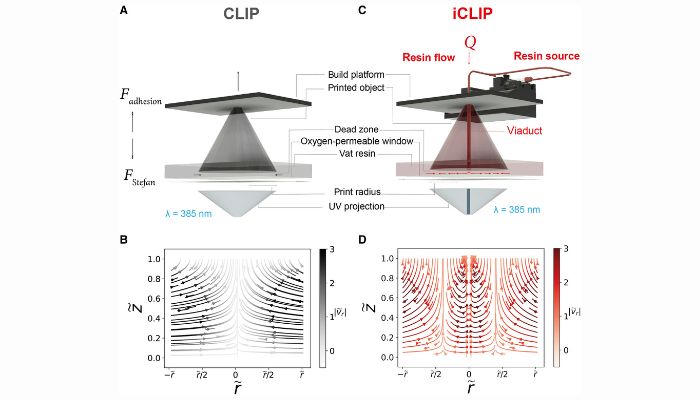
Photo Credits: Stanford University
How Does iCLIP Work?
iCLIP is a vat polymerization method using UV-light, but it seeks to improve on some of the perceived limitations of CLIP while still benefiting from the advantages of the technology. Notably, it will continue integrate a so-called “dead zone” or layer of oxygen which serves to greatly decrease adhesion forces during the photopolymerization stage. These forces are common in resin 3D printing, and by eliminating them, it is possible to significantly increase printing speed. Indeed, in the research paper, the engineers note that CLIP itself could belong to a “third generation” of vat photopolymerization thanks to its speed and other benefits. However, the original technology still has drawbacks including being limited to relatively low-viscosity resins and not enabling multi-material printing.
More from the desk
Six other notes from the rest of the bench.
 News#3DExpress: A 3D Printed Möbius Strip Play Structure in JapanIn this week’s 3DExpress series, we review some of the most important news in the 3D printing sector. This time, we will talk about a 3D printed play structure in the shape of a Möbius Strip that has been installed…
 NewsPrintables – The Online 3D Printing Database from Prusa ResearchIn the world of desktop FDM 3D printing, one of the most important resources at your disposal is the means to search for printable 3D files such as STLs. Today, the industry has become home to a whole host of…
 ApplicationsAngstrom Fuels Automotive Growth Through Mantle AcquisitionThe Angstrom Group, a major Tier 1 supplier in the automotive and industrial sectors, has announced the acquisition of San Francisco-based metal 3D printing company Mantle. The move marks a major step toward integrating additive manufacturing into automotive production, signaling
 NewsAdditive and Subtractive Manufacturing: Complementary or Rivals?While more and more companies are opting for additive manufacturing, subtractive manufacturing is still the most widely used method in industry. Meanwhile, 3D printing is currently mainly used to complement subtractive manufacturing methods. However, as the name suggests, unlike
  GuidesTop 10 3D Printed Lamps Shaping the Future of Design3D printing is transforming the world of lighting design. Once seen as experimental, it is now a practical tool for creating complex shapes, reducing waste and enabling sustainable, on-demand production. From organic, nature-inspired forms to lamps made from recycled or…
 NewsTop 5 Videos: 3D printing against COVID-19This week we found the top 5 videos about 3D printing and the way additive manufacturing is changing production. The technology has infiltrated many sectors, from medical to automotive – check our selection of the week to keep up with the innovations! If you enjoy these, you&hell