News
HEXR creates safer 3D printed helmets
Helmets as we know them might not be the most efficient at absorbing shock. This is the realization Jamie Cook had when he started investigating materials and structures with leading material scientist, Prof Mark Miodownik at University College London (UCL).…
- 3 min read
- News
- Six more stories
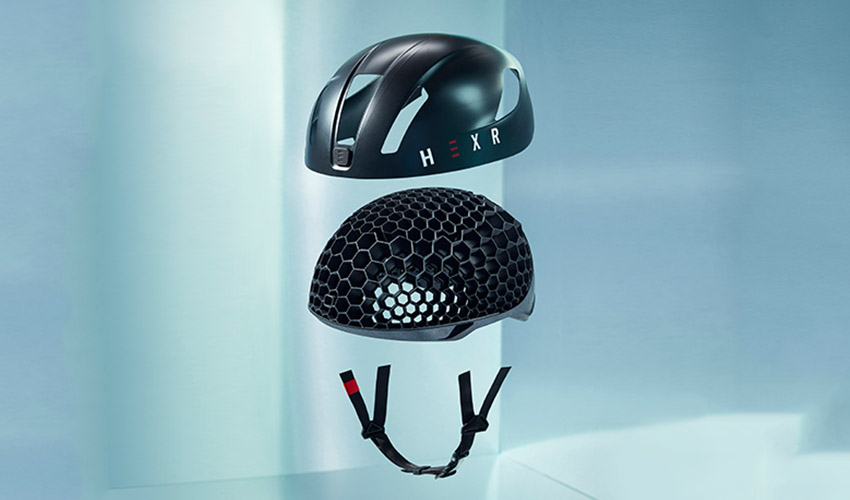
Helmets as we know them might not be the most efficient at absorbing shock. This is the realization Jamie Cook had when he started investigating materials and structures with leading material scientist, Prof Mark Miodownik at University College London (UCL). It soon became evident that cellular structures had the highest crush strength to weight ratio – a property perfect for helmets, which need to be both safe and lightweight.
In general, the average helmet relies on foam to absorb shock. Jamie Cook explains: “Foam’s pressure response is limited. There are only a few variables to play with: it’s quite basic in that sense. We’re 60 years down the road with foam helmets – and even though they’re only 30% efficient at absorbing energy, we’ve pretty much done everything we can do.” This is what led him to launch HEXR, a new type of helmet made from Polyamide 11 (PA 11) and 3D printed! He adds: “With 3D printing we’re starting on a new road which has got incredible opportunities for further optimisation, design and change. What we’re developing now is a real synergy between material science, manufacturing and technology – coming together to unlock things that were never possible before.”
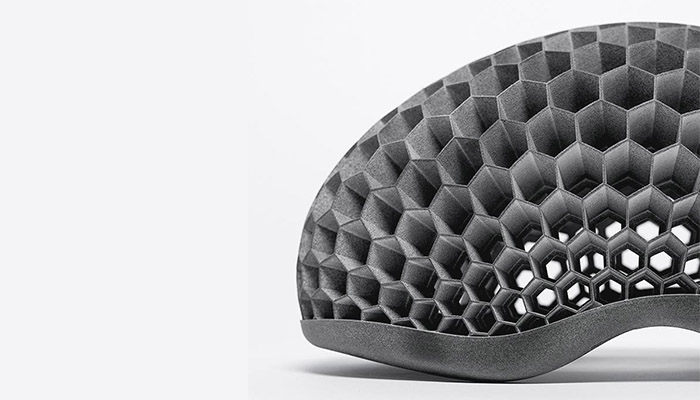
Credits: HEXR
3D printing a safer helmet
The helmet industry has been relying on foam for a long time. However, as stated by Jamie Cook the foam market hasn’t progressed much in the last decades. This also explains initiatives such as EOS’ to bring new capabilities to foam by merging it with 3D printing. For example, the manufacturer is working on its Digital Foam program to enable applications such as 3D printed protective headgear, individualized orthotics, and performance footwear using this material.
More from the desk
Six other notes from the rest of the bench.
 NewsInternational Women’s Day: we discuss with four experts 3D printing predictions & trendsToday is International Women’s Day! In order to celebrate such a day we wanted to talk about some of the influential women currently working in the field of 3D printing. The field of additive manufacturing is expanding every day and…
 ApplicationsADDITIV Medical World Puts a Focus on Different Applications for 3D Printing in HealthcareADDITIV Medical World is nearly here! The half-day event will be dedicated to exploring the intersection of medical 3D printing and healthcare in a series of panel discussions and workshops. Taking place on June 6th, 2023, it will be an…
 GuidesThe 3D Printing Books to Read This YearWorld Book Day is celebrated annually on April 23rd (except in the UK and Ireland where a similar event is observed in March). And as it is coming up fast, so we thought there was no better occasion to present…
 NewsxTool S1 Diode Laser Enables Efficient Implementation of Creative IdeasIf you like to do handicrafts at home or run a small craft business, laser cutters are key to efficiently implementing creative ideas and giving free rein to your creative freedom. There is a wide range of machines on the…
 NewsUS Army studies how to predict when metal AM parts will degrade or failAs you may know, the US Army has been investing in additive manufacturing technologies to leverage the benefits of increased design freedom, shorter lead times, lower costs for unique parts, and increased performance. In fact, US Army researchers from the…
 ApplicationsYoYo, a 3D printed electric car for less than €8,000Do you remember the small 3D printed electric car project by the Italian company XEV? When we told you about the latest developments of the project earlier this year, we had our doubts as to its relevance. However, it seems…