Printers
Ginger Additive Talks Making Pellet 3D Printing More Accessible
The use of pellets as a material for extrusion 3D printing is proving to be an increasingly viable technology. Already it is offered by a number of players in the market, particularly for large-format 3D printing. In fact, the benefits…
- 3 min read
- Printers
- Six more stories
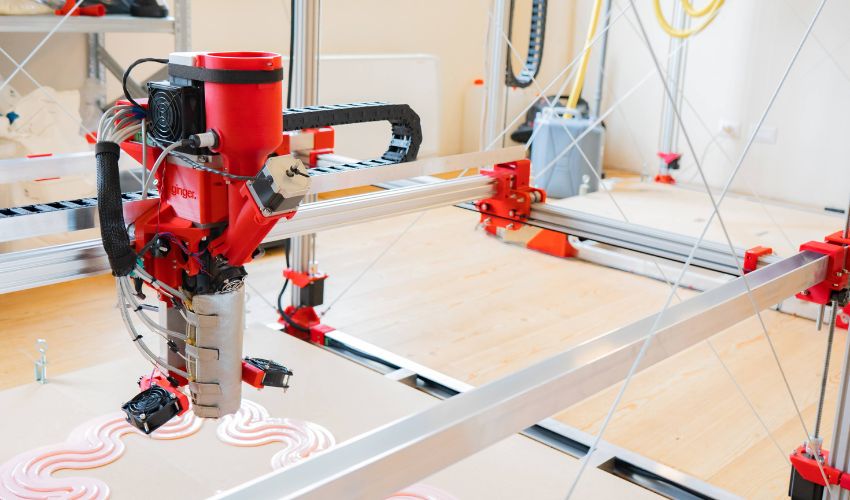
The use of pellets as a material for extrusion 3D printing is proving to be an increasingly viable technology. Already it is offered by a number of players in the market, particularly for large-format 3D printing. In fact, the benefits of using pellets for 3D printing are many: from the use of a wide variety of plastics, to increased sustainability due to the potential to use recycled material and even the ability to power large robotic arms, making works possible that were until recently unfeasible with additive manufacturing. We discussed this and more with Ginger Additive, a young Italian startup that has decided to focus on this very technology to make it increasingly accessible.
3DN: Could you introduce yourself and tell us about your connection with 3D printing?
Hi everyone, we are Umberto Bisotti and Davide Malnati, founders of Ginger Additive. We are two under-30 engineers who studied together at Politecnico di Milano. Almost 3 years ago, we made our first prototype for pellet 3D printing and realized the huge potential of this technology. So we founded Ginger Additive and currently manufacture and sell Ginger.one, the first low-cost printer using FDM technology with pellets. In addition, our production department works closely with designers and design studios for the manufacturing of specific parts.
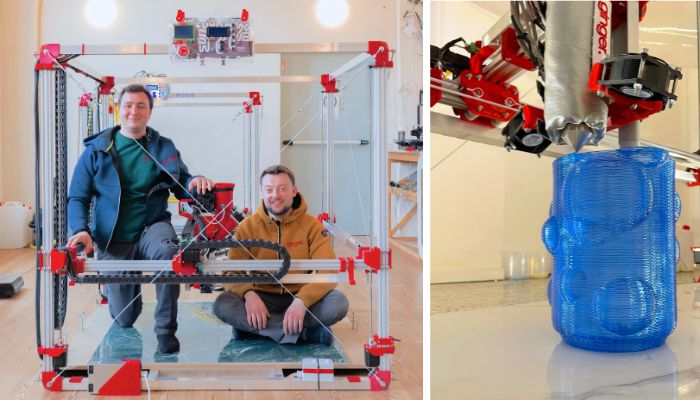
Umberto Bisotti and Davide Malnati with their solution, Ginger.one
3DN: How did Ginger Additive come about and what is its mission?
Ginger Additive is a Milan-based startup working on large-format pellet 3D printing. 3D printing is destined to be, in its countless variations, a sure option in the manufacturing world. However, pellet printing has, to date, still been lacking. Though it is a technology that is already well-developed, it is still searching for its place in different sectors. The machinery on the market as of now reflects this situation. So today Ginger’s mission is very simple: accessibility. We want to develop technology that can be used in everyday life and also open the doors of this world to SMEs and independent professionals.
More from the desk
Six other notes from the rest of the bench.
 NewsCeramic Additive Manufacturing, a Growing Niche MarketThe research firm IDTechEx has published a new report on the ceramic additive manufacturing market: it is expected to be worth $400 million by 2032, a seven-fold increase which is being driven by more and more players banking on this…
 News#TOP5 videos: 3D Printed Skaterbot and much more!We found the TOP 5 videos of the week about 3D printing and the way additive manufacturing is shaping and changing our society. 3D printed skaterbot, micro structures, biomedical implants, metallic dental parts and more! If you enjoy these, you can…
 NewsHow Can NFTs Be Used in 3D Printing?NFT, blockchain, Ethereum, Ether, cryptocurrency, eWallet, Metaverse…You’ve probably come across these terms often in recent months. After all, they can be found in numerous headlines and fuel the debate on whether digital asset trading is just another investment bubb
 ApplicationsBoeing to Use 3D Printing for Apache Helicopters3D printing is continuing to gain momentum in the U.S. defense industry! Boeing has announced plans to start testing the fully 3D-printed prototype of the main rotor system of their AH-64 Apache attack helicopter in April 2024. In addition, Boeing…
 MaterialsThe Common Kitchen Spice That Could Neutralize Light Scattering During Ceramic 3D PrintingYou might not be familiar with curcumin, but you certainly know turmeric: the vibrant spice native to Southeast Asia. Curcumin is the active chemical compound within turmeric responsible for giving it that iconic bright yellow hue. Extracted from the Curcuma…
 MaterialsCopper Laser Fusion: AFU Overcomes Density ChallengeAFU, a French company specializing in machining, has been investing in metal 3D printing since 2014 to expand its capabilities and produce more complex components. Now equipped with three machines, it has worked for two years on copper parametrics, and…