News
GE Uses Binder Jetting to Design the World’s Largest Offshore Wind Turbine
The American giant General Electric (GE) has announced the signing of a partnership with Fraunhofer IGCV and Voxeljet to develop a new 3D printer capable of designing the molds of certain key components of the Haliade-X offshore wind turbine. The…
- 3 min read
- News
- Six more stories
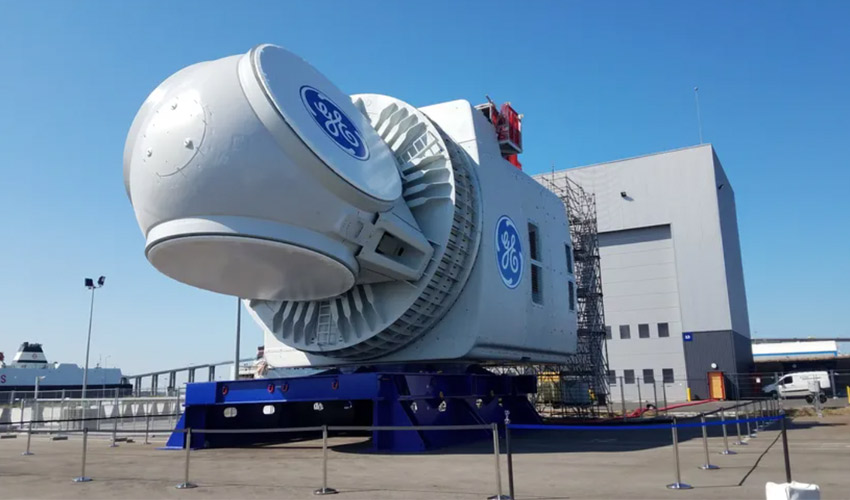
The American giant General Electric (GE) has announced the signing of a partnership with Fraunhofer IGCV and Voxeljet to develop a new 3D printer capable of designing the molds of certain key components of the Haliade-X offshore wind turbine. The particular wind turbine is notably for its impressive size – 260 meters (~853′) high, with three 107-meter (~351′) long blades, compared to the 381-meter (1250′) height of the Empire State Building or the Statue of Liberty which is 93 meters (~305′) tall. The project, which is scheduled to begin testing in early 2022, will use 3D printing of sand molds via the Binder Jetting process to cast the components of the wind turbine’s nacelle. This would reduce the development time for these molds from 10 weeks to just two.
The Haliade-X offshore wind turbine is designed to produce 310 MWh in a single day, which would produce enough energy for a city of 250,000 inhabitants in 24 hours! Built in three different cities, including Saint-Nazaire and Cherbourg, it would be the most powerful wind turbine on Earth to date. For us, it is particularly interesting because its production process involves the use of additive manufacturing and more specifically the binder jetting process.
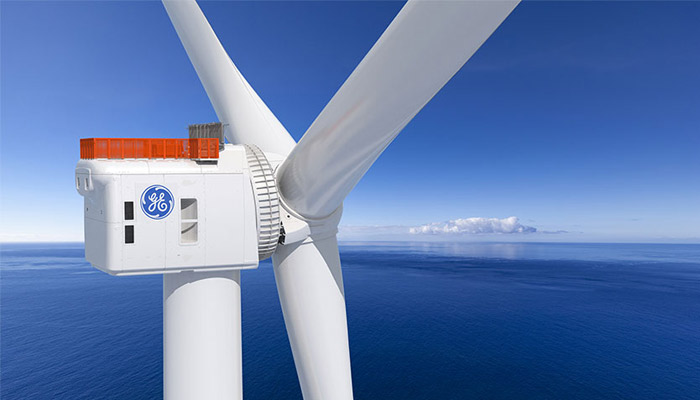
The wind turbine is equipped with 3 blades of 107 meters (photo credits: GE Renewable Energy)
The three partners are working on the development of a new machine called Advance Casting Cell (ACC). This would allow the production of sand molds in which certain key components of the wind turbine would be cast. Thanks to the powder bonding technology, the teams would be able to produce their molds in only two weeks, which is five times faster than with conventional processes. Juan Pablo Cilia, GE Renewable Energy senior additive design engineer, explained, “The 3D printed molds will bring many benefits including improved casting quality through improved surface finish, part accuracy and consistency.Furthermore, sand binder jet moulds or additive moulds provide cost savings by reducing machining time and other material costs due to optimised design.”
More from the desk
Six other notes from the rest of the bench.
 NewsMIT launches ADAPT; A consortium dedicated to additive manufacturingThe American research institute MIT announced the creation of a consortium dedicated to additive manufacturing called ADAPT (for Additive and Digital Advanced Production Technologies). The goal of this business association is to identify visionary research, scalable education pla
 NewsFirst-Ever 3D Printed Starbucks to Open in TexasIt may not be as American as apple pie, but Starbucks has quickly become an emblem of American soft power and consumerism, similar to McDonald’s. And now, Starbucks has announced its first-ever 3D printed location. Opening on April 28th, it…
 NewsThe #3DStartup of 2018!Throughout 2018 we have had the pleasure of being introduced to 12 original 3D printing startups with whom we discussed products, services and innovations. We wanted to reward the most inventive one by organising a competition: we gave you the…
 NewsFormnext 2022: Moving Towards a More Consolidated Additive Manufacturing MarketThis is it, the long-awaited meeting place for additive manufacturing in Europe closed its doors last Friday evening. This new edition was full of successes, reaching new records and showing the return of the pre-COVID industry. This year, more than…
 Printers#3DStartup: Sprybuild and the Automation of Resin 3D PrintingBased in Israel, Sprybuild has set itself the goal of developing automated 3D printing solutions, offering greater flexibility for the user. With this in mind, it has designed a resin 3D printer with a conveyor belt. Instead of the traditional…
 ApplicationsDrexel Electric Racing Relies on SolidCAM to Create End-Use Parts for Race CarsTraining in additive manufacturing is essential in order to ensure that those working in a wide variety of fields are at the forefront of current technological advances. For this reason, many companies in the market have educational offerings for all…