News
The Complete Guide to Fused Deposition Modeling (FDM) in 3D Printing
FDM 3D printing, short for fused deposition modeling, is an additive manufacturing process that melts and extrudes thermoplastic filament layer by layer to build 3D objects. It is the most accessible and widely used 3D printing technology on the market…
- 3 min read
- News
- Six more stories
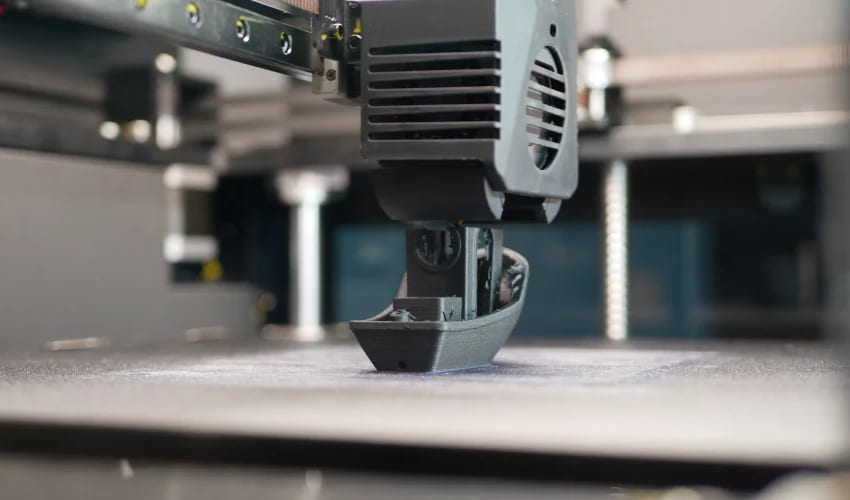
FDM 3D printing, short for fused deposition modeling, is an additive manufacturing process that melts and extrudes thermoplastic filament layer by layer to build 3D objects. It is the most accessible and widely used 3D printing technology on the market today. This accessibility is fueling massive economic growth: the FDM market is projected to skyrocket from $3.26B in 2026 to $8.37B by 2031, maintaining a robust 20.74% CAGR.
Scott Crump invented and patented FDM in 1989, launching it commercially in 1990 through his company, Stratasys. For years, strict trademark protections meant only Stratasys could legally use the “FDM” moniker. However, the landscape shifted in 2005 with the birth of the open-source RepRap movement. Led by Adrian Bowyer, the team introduced FFF (Fused Filament Fabrication) as a legally unconstrained alternative for the maker community. Ultimately, FDM and FFF describe the identical material extrusion technology, differing only in brand name, not mechanics.
How FDM 3D Printing Works
FDM printing is widely regarded as one of the most fundamental and accessible 3D printing technologies. Here’s the process breakdown:
More from the desk
Six other notes from the rest of the bench.
 ApplicationsSPARTA: The 3D-Printed Drone Designed by Soldiers for the BattlefieldDrones have become indispensable to modern warfare. From frontline reconnaissance to target acquisition, unmanned aerial systems are now as critical to ground operations as any weapon in a soldier’s arsenal. But fielding them fast enough to match the pace of…
 Guides#3DStartup: Pint Develops Advanced Metal Alloys for 3D PrintingAdvances in additive manufacturing technologies are enabling major companies in the industry to develop new and innovative solutions, not only in terms of machinery, but also with materials. In particular, metal 3D printing is gaining popularity in all kinds of…
 SoftwareSimplify3D, a Slicer for Professionals?Simplify3D is a slicer designed to help you import a model from online platforms, modify it to your liking, and send it to your 3D printer as G-code so that the object can be printed. Although some programs, such as…
 ApplicationsThe Growing Market of 3D Printed ImplantsResearch firm, Precedence Research, recently published a report on 3D printed medical implants. According to the report, 3D printed implants should generate more than 9 billion dollars in 2030 against 1.5 billion in 2020, an annual growth of 19%. Faced with increasingly complex&h
 PrintersWhat to Look For When Purchasing an Industrial 3D Printer?More and more companies are deciding to bet on additive manufacturing technologies, as it has been clear for some years now that it is the future of manufacturing. When we talk about 3D technologies, we are not only referring to…
 MaterialsUT Austin Unveils New 3D Printing Method for Advanced ElectronicsA research team led by The University of Texas at Austin has introduced a new 3D printing technique that could redefine how semiconductor components are designed and produced. The method, known as Holographic Metasurface Nano-Lithography (HMNL), offers a way to…