Applications
Furthering Bioprinting with Innovative New Printheads
When we talk about recent innovations in the medical sector, one subject that often comes up is bioprinting. Defined as the utilization of 3D printing techniques to combine cells, growth factors, and or biomaterials to make biomedical parts, the concept…
- 3 min read
- Applications
- Six more stories
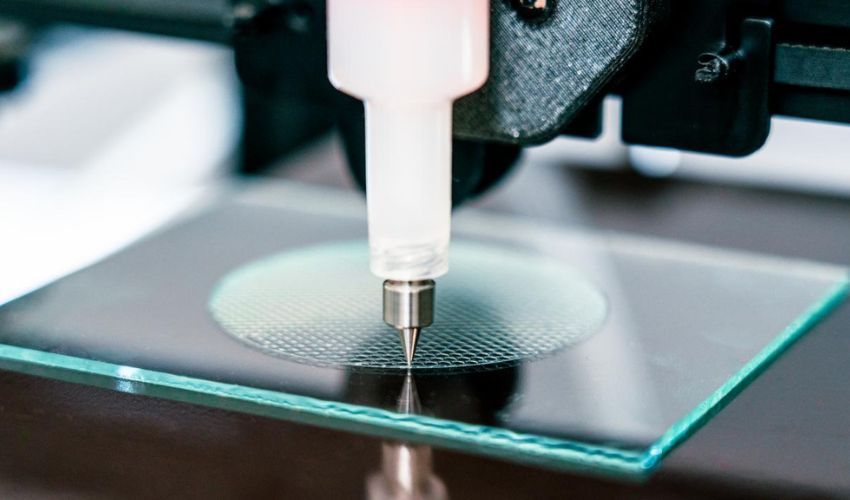
When we talk about recent innovations in the medical sector, one subject that often comes up is bioprinting. Defined as the utilization of 3D printing techniques to combine cells, growth factors, and or biomaterials to make biomedical parts, the concept is exciting for its vast possible applications. By turning to bioprinting, doctors could 3D print biocompatible organs, bones, or more, revolutionizing healthcare. However, because it is a developing field, it is still in need of new solutions to meet the special requirements of the market. Luckily one of the players on the market, ViscoTec Pumpen- und Dosiertechnik GmbH (ViscoTec), was able to turn to rapid product manufacturing GmbH (rpm), and by extension Carbon, for the creation of better printheads designed for bioprinting through the use of the Carbon Digital Light Synthesis™ (DLS™) process.
ViscoTec manufactures dosing solutions for progressive cavity technology. Their Puredyne printhead solution uses patented single-use cartridges, enabling precise dispensing for extrusion-based bioprinting. Ultimately, these printheads are expected to be used for a variety of applications including organ models, cancer research, tissue engineering, personalized medicine, scaffolds, drug development and testing, food, organs-on-a-chip and cosmetics, among others. They work by processing low to high viscosity liquids and pastes such as hydrogels and cell-laden material, conductive inks, ceramic pastes and more. However, due to the delicate nature of bioprinting, manufacturing the printhead proved difficult as it was almost impossible to do with traditional methods. Additive manufacturing provided the solution.
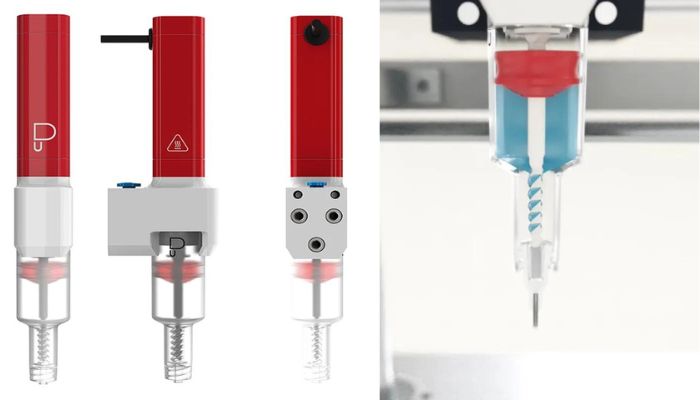
The Puredyne printhead incorporated milled materials (left) and complex internal channels (not displayed) that require high accuracy 3D printing (photo credits: Puredyne)
Turning to Additive Manufacturing for Better Bioprinting Printheads
When ViscoTec started designing the Puredyne printhead part, they knew they had a number of requirements. Namely, the part needed to be made out of a material that had been medically approved and was chemically resistant to detergents and disinfectants. Additionally, it needed to be made with a solution that provided high design freedom, tight tolerances, easy cleaning, and high surface quality. Additive manufacturing is a clear choice when it comes to high design freedom as well as cost-effective low production quantities, but for the perfect product they could not turn to just any technology.
More from the desk
Six other notes from the rest of the bench.
 NewsCould 3D Printed Foods Made With Alternative Protein Sources Like Insects Prevent Food Crises?Researchers from the Singapore University of Technology and Design (SUTD) recently introduced a more sustainable 3D food printing approach. By using alternative protein sources including algae, plants, and insects, and combining them with more common nutrient-rich foods such as v
 MaterialsRedwire Manufactures Ceramic Part in SpaceRedwire, the new leader in mission critical space solutions announced that its Ceramic Manufacturing Module (CMM) – initially developed by Made in Space – successfully manufactured a ceramic part in space. Its module is based on stereolithography (SLA) and uses pre-ceramic&hellip
 GuidesWhich 3D Printing Companies Have Raised the Most Money?The additive manufacturing sector has attracted many investors for a few years now, with several notable fundraisers sometimes followed by major acquisitions. Manufacturers, software publishers, startups, and other players around the world are taking advantage of the benefits of
  NewsGE Brings COBOD Concrete 3D Printing Technology to Climate SummitLast week, GE put COBOD ’s 3D concrete printing technology forward at the Climate Summit, hosted by President Biden. The event was attended by leaders of 16 different countries across the world, which together are responsible for 80% of global…
 ApplicationsU.S. Navy Partners With Hunt Valve for 3D Printed Submarine ComponentsThe United States military has begun to modernize its fleet across all branches with the adoption of 3D printing technology. In a major overhaul for the U.S. Navy, Hunt Valve, the Fairbanks Morse Defense subsidiary, has recently been awarded a…
 GuidesMONAD Studio: 3D Printing Musical InstrumentsWe were lucky enough to sit down with Monad Studio recently to discuss their recent developments. Monad Studio have created some of the most beautiful, 3D printed instruments we have ever seen. These include instruments used by Viktoria Modesta and more,…