Materials
Making Extremely Wear-Resistant Plastic Gears with 3D Printing
For centuries, gears have been used in a variety of everyday objects. However, they can be difficult to make. To ensure that as little friction loss as possible is generated during the transmission of power, special attention must be paid…
- 3 min read
- Materials
- Six more stories
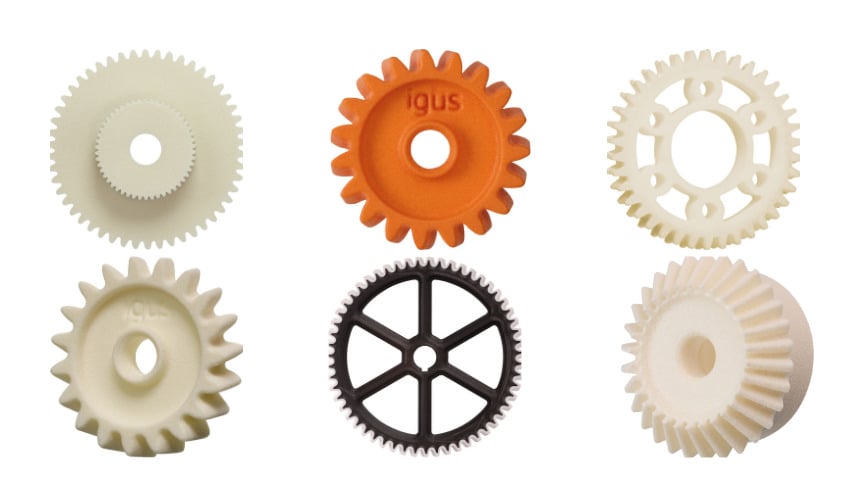
For centuries, gears have been used in a variety of everyday objects. However, they can be difficult to make. To ensure that as little friction loss as possible is generated during the transmission of power, special attention must be paid during their design. The material used for the gears is also a decisive factor in optimum power transmission. Traditional manufacturing methods leave only limited scope to truly optimize gears, as it is too costly to produce ones that have been customized. This is mainly due to the fact that several individual steps would have to be carried out and, if necessary, suitable tools would have to be created or purchased. One way around this is by using Selective laser sintering (SLS), which offers a possible solution in that through AM processes the gear can be manufactured in one piece and without additional tools. In combination with iglidur® high-performance polymers developed by igus, customized plastic gears can be created. These could be revolutionary for a variety of industries as they have increased service life and lower friction values. In addition to the long service life, the printed gears made from iglidur® have a particularly high efficiency, which is only minimally lower than that of lubricated metal gears. The plastic gears can be created on the igus website in the free CAD configurator and then ordered via the igus 3D printing service, starting at just one part.
3D-printed gears made from iglidur®
As already mentioned, customized plastic gears can be produced much more easily using SLS. In principle, any gear with a minimum wall thickness of 0.5 mm can be produced. The installation space of the SLS printer is the only limitation here. Regardless of this, design freedom can be used, for example, to achieve weight reduction. In contrast to mechanical production, there are also cost advantages that can be achieved through more efficient use of materials and shorter printing times. In addition, the design plays a much larger role in the extended service life of the product. Compared to mechanical production or injection molding, the geometries of the gear do not have to be simplified, but can be optimally adapted in the print model. Thus, a higher resistance and a lower shaft calculation can be achieved in the final product.
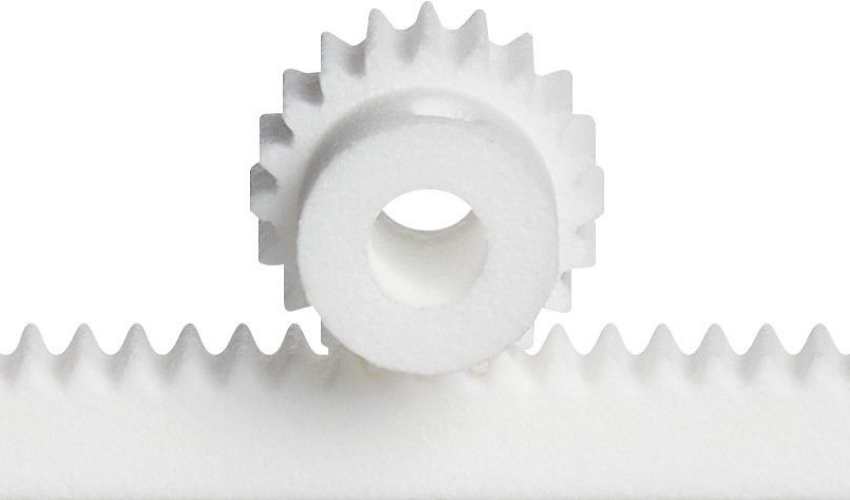
Any cog edge with a minimum wall thickness of 0.5 mm can be manufactured with SLS. (Picture credits: igus)
The material used represents another quality feature – especially because not all plastics are the same. igus was able to develop plastic plain bearings with the iglidur® materials, which have good friction values and low wear due to the tribological properties. For this reason, iglidur® is perfectly suited for moving applications, such as gear wheels. Nevertheless, some iglidur® materials are better suited for certain applications than others. For example, iglidur I3 is characterized by a higher strength and is therefore especially suitable for spur and bevel gears. iglidur I6 has an optimized gliding capability in comparison and is especially suitable for worm gears for this reason. However, if ESD properties are required, iglidur I8-ESD is suitable. However, since the service life is also always dependent on the application parameters, the free service life calculator on the igus website creates an overview of the expected service life of the plastic gears to be manufactured, taking into account the selected application parameters.
More from the desk
Six other notes from the rest of the bench.
 NewsJapanese online platform sells fully 3D printed jewelryBy now we already know that one of the biggest advantages of 3D printing is that it allows almost limitless freedom of design. And who is enjoying it the most if not fashion designers? Finally having an opportunity to create…
 PrintersInside BQ’s 3D Printing Factory: A Closer LookIf you have ever thought about a 3D printing factory and what the history of 3D printer manufacturing, this is the article for you. How long does it take to build a 3D printer? What process is necessary for the…
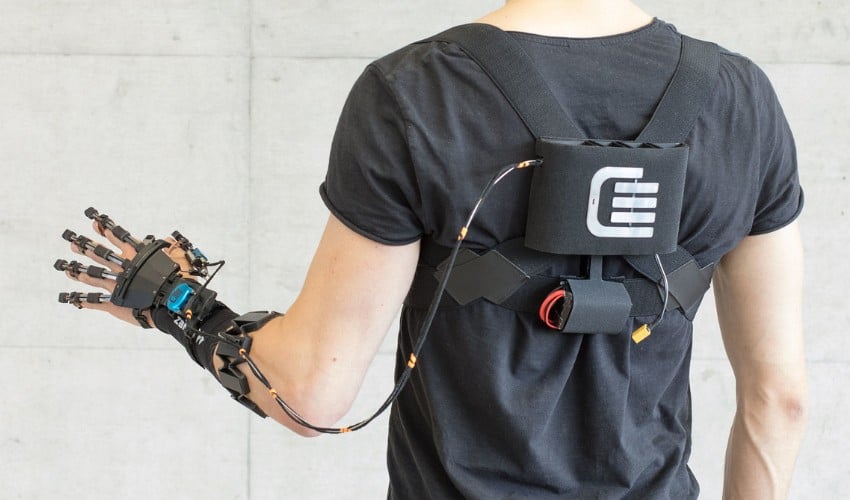 MaterialsExoskeletal Assisted Rehabilitation uses 3D PrintingAccording to the Centre for Disease Control and Prevention, almost 800,000 people suffer from a stroke each year in the US. During a stroke, blood supply to part of the brain is cut off. In 85% of cases, it is…
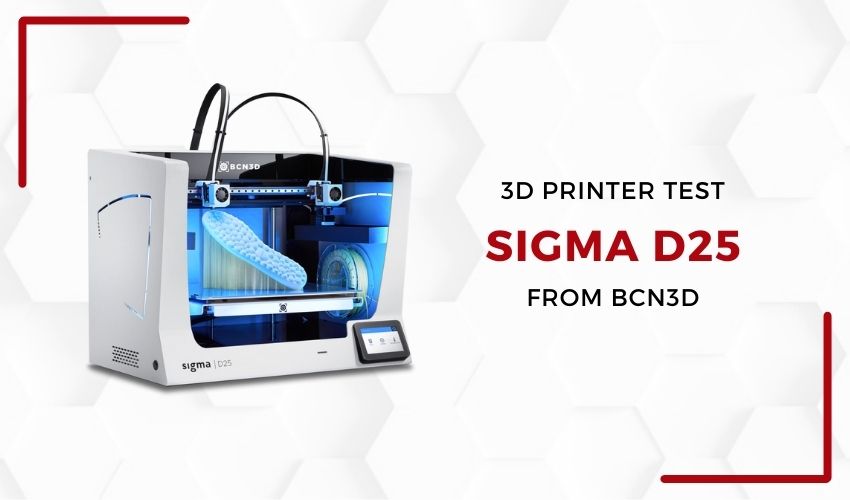 Printers3Dnatives Lab: Testing the Sigma D25 3D Printer from BCN3DFounded in 2012 by three students from the Polytechnic University of Catalonia (also known as BarcelonaTech), the manufacturer BCN3D has become one of the key players in the FDM 3D printing market over the years. Though initially focused on kit…
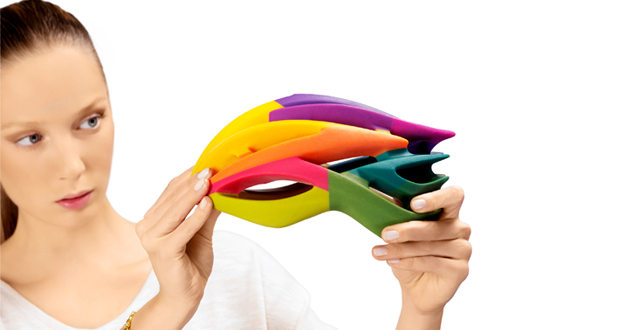 PrintersCurious about 3D printing in color? then let us explain!These are always questions that may arise as you begin taking an interest in 3D printing, and one of these areas where we see many questions asked is when it comes to 3D printing in color. Most people, when 3D…
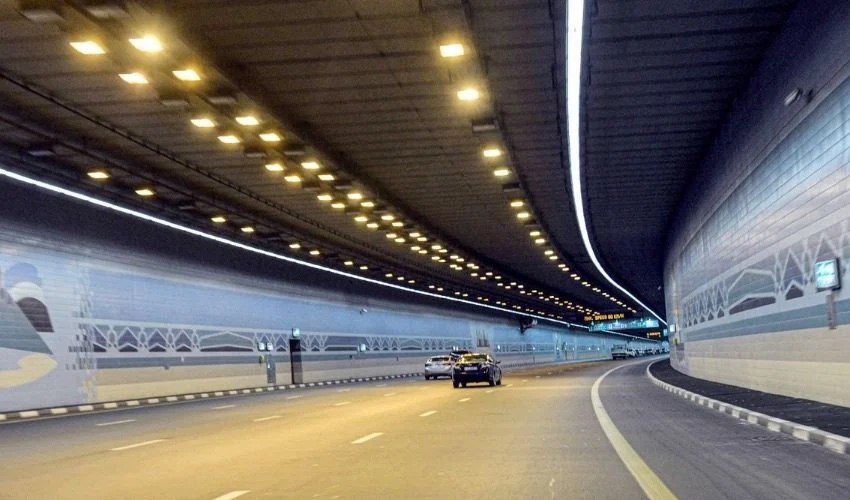 NewsDubai to Rely on 3D Printing for Road MaintenanceWhile additive manufacturing is being used by the rail industry to improve the condition of rails, it is still rare to see the technology employed for roads. But that could soon change. In the United Arab Emirates, in Dubai to…