News
ETH Zurich Develops Efficient 3D-Printed Ceramics for Solar Energy Production
Researchers from ETH Zurich’s Departments of Complex Materials and Renewable Energy Sources have succeeded in producing a solar reactor core from individually 3D-printed ceramics. Solar reactors are used to produce carbon-neutral liquid fuels such as solar kerosene for the
- 3 min read
- News
- Six more stories
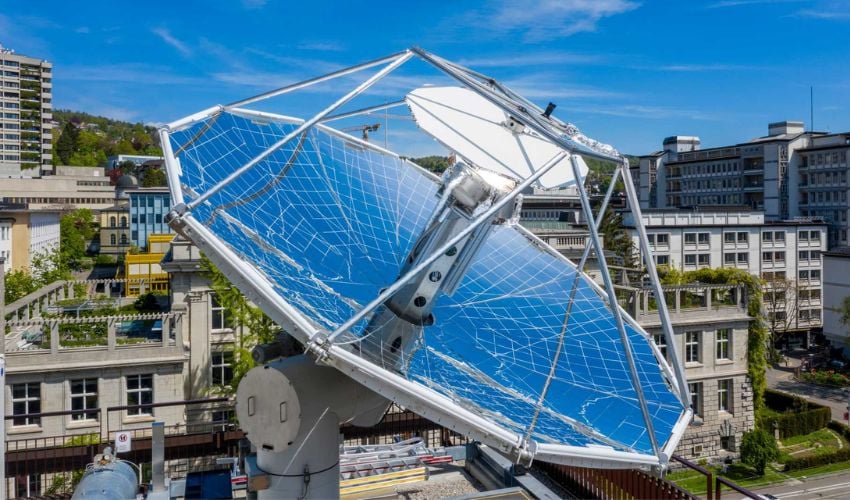
Researchers from ETH Zurich’s Departments of Complex Materials and Renewable Energy Sources have succeeded in producing a solar reactor core from individually 3D-printed ceramics. Solar reactors are used to produce carbon-neutral liquid fuels such as solar kerosene for the aerospace industry. The technology therefore holds a great deal of potential for lower-emission aviation that is made possible through the use of additive manufacturing. More environmentally friendly fuels of this kind can now be produced in greater quantities thanks to the increased efficiency of solar reactors. The project at ETH Zurich is being made possible with funding from the Swiss Federal Office of Energy.
In a nutshell, the solar reactor functions by first being illuminated by sunlight from a parabolic mirror. The new structure of the reactor includes a 3D-printed complex of hierarchically arranged ceramic structures. This opens up on the surface facing the sun and narrows further towards the rear of the reactor, trapping the heat. As the first successful tests at ETH Zurich showed, the entire structure is capable of reaching a reaction temperature of 1500°C due to concentrated solar radiation. In addition, the solar radiation is transported more efficiently into the interior of the reactor thanks to the 3D printed components. As a result, twice the amount of carbon-neutral solar fuel is produced with the same amount of solar radiation compared to previous isotropic structures. The ceramic structures themselves are printed through extrusion from a specially developed paste from the 3D printer. The extruded paste consists of a high amount of cerium oxide particles in order to obtain the most reactive material possible and thus maximize the efficiency of the solar reactor.
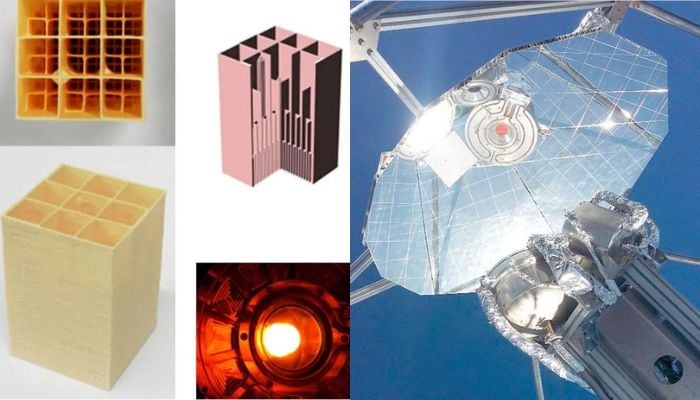
3D-printed ceramic structure (left) and solar reactor (right)
ETH Zurich has been researching solar fuels for over a decade and has previously demonstrated the process for their production on the university campus in 2019. The engineers at the Swiss university have also already developed a solar reactor in which the energy of concentrated solar radiation is used to produce synthesis gas (hydrogen and carbon monoxide) through a series of thermochemical cycles to split water and CO2. This in turn is used for the production of liquid solar fuels such as solar kerosene as aircraft fuel. These fuels are CO2-neutral, as only as much carbon is released during their combustion as was previously extracted from the air for the production of the synthesis gas. The structures previously used in the reactor had an isotropic porosity. The sun’s rays hitting the reactor were attenuated on their way into the reactor due to the surface properties. This meant that the optimum internal temperature could not be reached in the reactor, which limited its performance and fuel production.
More from the desk
Six other notes from the rest of the bench.
 MaterialsRigid or Elastic? The Plastic Material that Changes Properties Thanks to 3D PrintingIn recent years, many university research projects have been developing multifunctional materials through additive manufacturing. In the medical field, for example, it is important to create fabrics capable of regenerating organs or bone structures and design advanced biomedical
  News#3DExpress: What’s Next For Nexa3D, Nano Dimension & Velo3D?As the year winds down, the 3D printing world shows no signs of slowing. In this final edition of #3DExpress for the year, we bring you five headlines that captured our attention. The updates are a mixed bag—some promising, others…
 NewsThe Cabin of Curiosities – 3D Printed Hub !The American company Emerging Objects has recently revealed a 3D printed cabin, The Cabin of Curiosities, which is a building project that is a little out of the ordinary, with an exterior that looks more like a garden. At a time when…
 ApplicationsLightForce Orthodontics 3D prints customisable ceramic bracesThe dental sector has kept reinventing itself since the introduction of 3D printing technologies! And one company that caught our eye is LightForce Orthodontics. Based in Boston, it provides a digital platform to orthodontists to fully personalise 3D printed dental…
 News3D Printed Revival of PUMA Mostro Sneaker Shown at New York Fashion WeekTime and again, we have seen manufacturers design and develop 3D printed shoes. Now, famed shoe designer Puma has also jumped on the additive manufacturing bandwagon. At New York Fashion Week, the company presented a 3D-printed version of its Mostro…
 MaterialsThe First 3D-Printed School Has Opened its Doors in MalawiClass is in session at the world’s first 3D-printed school. Located in Malawi, the school was built by 14Trees, a joint venture between Holcim and the UK’s CDC Group, using a BOD2 printer from Danish 3D construction robot printer company…