Materials
Engineers Have Developed an Ultra-Fast Opaque Resin 3D Printing Process
At EPFL in Switzerland, engineers from the Laboratory of Applied Photonic Devices (LAPD) have developed a resin 3D printer capable of designing objects in a few seconds. Based on a volumetric printing technology, it can produce parts with an opaque…
- 3 min read
- Materials
- Six more stories
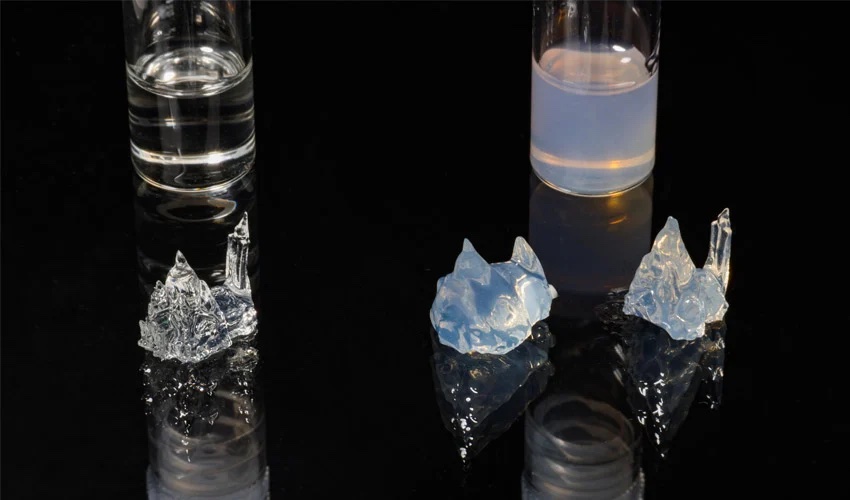
At EPFL in Switzerland, engineers from the Laboratory of Applied Photonic Devices (LAPD) have developed a resin 3D printer capable of designing objects in a few seconds. Based on a volumetric printing technology, it can produce parts with an opaque resin, which until now was not possible with this type of method.
Innovations centering on resin processes are numerous and already 5 years ago, this team of engineers had developed a technology to considerably accelerate the printing process. Normally, it can take several hours to obtain a final part and many manufacturers are looking to optimize the speed of their machines. In this case, the engineers are relying on a volumetric method to do so. Christophe Moser, professor at EPFL, explained how it works: “We pour the resin into a container and spin it. Then we shine light on the container at different angles, causing the resin to solidify wherever the accumulated energy in the resin exceeds a given level. It’s a very precise method and can produce objects at the same resolution as existing 3D-printing techniques.”
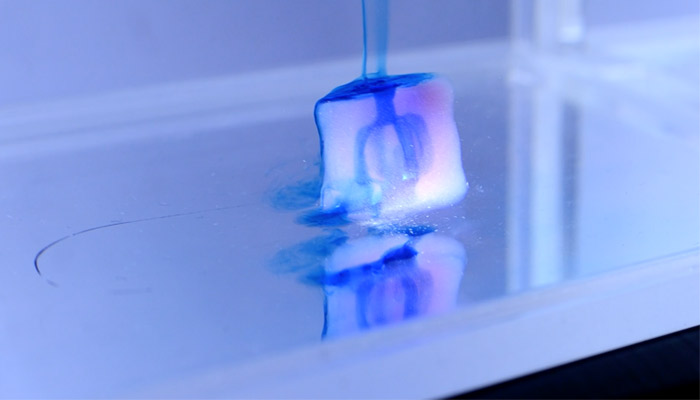
Photo Credits: EPFL
In addition to obtaining a part with a good resolution, the process is considerably faster. In fact, the engineers tested their method and successfully printed a tiny Yoda in only 20 seconds. But what is particularly interesting is the material used: an opaque resin. The use of such a resin in a volumetric process poses a major challenge. Light does not propagate smoothly, which reduces the amount of energy needed to solidify the liquid resin. As a result, the resolution drops, which makes volumetric printing less attractive to many users. Engineers therefore sought a solution to circumvent this challenge and ensure that the light could pass through the resin in a straight line.
More from the desk
Six other notes from the rest of the bench.
 NewsTop 5 Videos: Using 3D scanners to restore Michigan Central StationThis week we found the top 5 videos about 3D printing and the way additive manufacturing is changing production. The technology has infiltrated many sectors, from medical to automotive – check our selection of the week to keep up with the innovations! If you enjoy these, you&hell
 MaterialsCan You Use Eggshells as a 3D Printing Material?We are always discovering new and interesting 3D printing materials. Just recently, we told you about how researchers are using bacteria to essentially grow strong and porous 3D printed composite materials. And today we have yet another one: eggshells! This…
 PrintersHow Does 3D Scanning Improve Carrot Harvesting in France?Agri Techni Concept is a French company that specializes in the manufacturing of agricultural and forestry machines. Based in Sore, a part of the Landes region, it develops solutions that adapt to the harvesting of carrots and potatoes. For several…
 MaterialsCeramic 3D Printing: A Revolution within Additive Manufacturing?The origin of the use of ceramics goes back to ancient Greece, initially created for the creation of pots or plates for food, and based on clay cooked at temperatures of up to 500ºC. Later, around the 19th century, the…
 ApplicationsZENOS, the open-source 3D printed arm prosthesis for cyclistsIndustrial designer Chan Lee, based in New York, has developed ‘ZENOS’, the 3D printed arm prosthesis for mountain bike riding and cycling. The project was developed for amputees who require a prosthesis for sports activities such as mountain biking and…
 ApplicationsKnee replacement with additive manufacturing and artificial intelligenceThe Italian medical implant manufacturer, REJOINT, announced it is using GE Additive’s Electron Beam Melting (EBM) technology to additively manufacture knee implants. The medical company aims to offer a customized medical solution to patients. Both additive manufacturing and arti