News
Improving the performance of next-generation energy applications with metal 3D printing
Metal additive manufacturing is increasingly being used to develop the next-generation of turbomachinery. Turbomachinery describes machines that transfer energy between a rotor and a fluid, including both turbines and compressors. To produce innovative designs in this field, with
- 3 min read
- News
- Six more stories
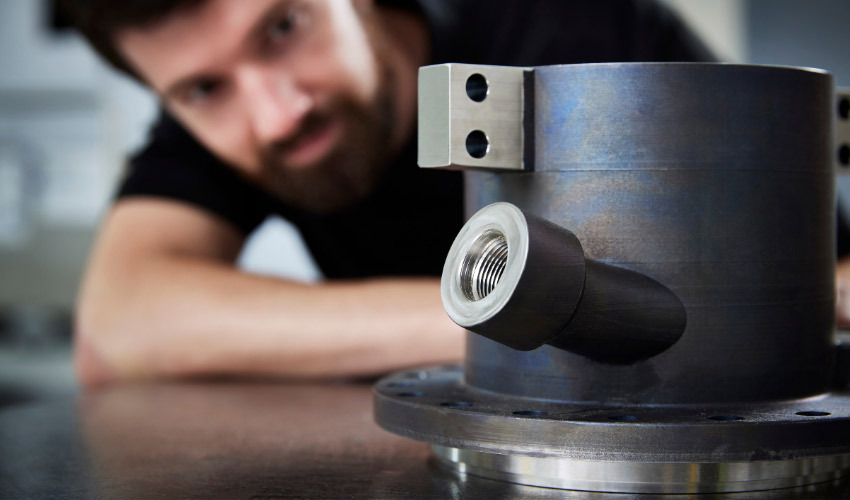
Metal additive manufacturing is increasingly being used to develop the next-generation of turbomachinery. Turbomachinery describes machines that transfer energy between a rotor and a fluid, including both turbines and compressors. To produce innovative designs in this field, without having to contend with long, expensive development cycles, companies are investing in new technologies. As such, Mohawk Innovative Technology recently integrated VELO3D’s metal technology in its compressor design for a Concentrated Solar Power (CSP) project sponsored by the U.S. Department of Energy (DOE). Fabricating the compressor via traditional manufacturing methods, such as casting and mold-making, would have taken some 20 weeks and cost more than $90,000. Instead, Mohawk achieved a part, from start to finish, in shorter lead times, and that cost 2.5X less.
In 1994, co-founders Jim Walton and Dr. Hooshang Heshmat merged their aerospace and metallurgical expertise to form Mohawk Innovative Technology, Inc. The company develops oil-free bearing technology incorporated into sophisticated components for energy, power, defence, aerospace and other industries. Following some successful projects, such as the development of a cast-metal centrifugal compressor for a hydrogen transport system, they qualified for a new DOE-sponsored project.
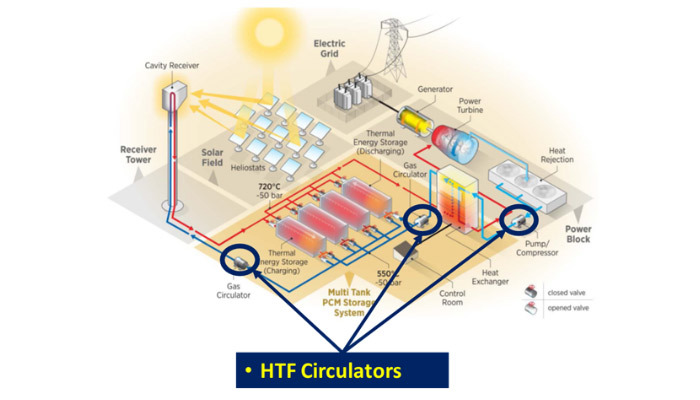
Diagram of a Concentrated Solar Power (CSP) system, with Heat Transfer Circulators (HTF) that would include compressor housings similar to the one designed by Mohawk Innovative Technology for the U.S. Department of Energy Office of Energy Efficiency and Renewable Energy (EERE) under the Solar Energy Technology Office (SETO) Award Number DE‐EE0008374 | Image credit: DOE
In this project, Mohawk Innovative Technology was asked to design Heat Transfer Circulators for a Concentrated Solar Power (CSP) system that would be competitive with conventional power generation. CSP systems use mirrors to reflect and concentrate sunlight onto a receiver, where the light is collected and converted into thermal energy used to produce electricity. In this case, the thermal energy was in the form of supercritical CO2 (s-CO2), which is the fluid state of CO2 (when CO2 is held at or above its critical temperature and pressure). Under extremely high pressures, s-CO2 has the density of liquid but the viscosity of gas. This makes it an ideal conduit for heat and energy, delivering far more power than steam. It is also capable of being compressed through heat exchangers and channeled to tanks to be stored for peak-hour power needs. Therefore, Mohawk began designing a compressor housing, specifically geared to s-CO2. Moreover, its oil-free bearing technology was a perfect fit given that oil is reactive with s-CO2 and causes corrosion.
More from the desk
Six other notes from the rest of the bench.
 Applications3D Printed Freedom Payload Drives New Era of Space-Based Data StorageThe ever-growing demand for data storage compels innovation, forcing us to look beyond Earth’s atmosphere for solutions. In a recent partnership, Lonestar Data Holdings Inc. and the renowned Danish architectural firm Bjarke Ingels Group (also known as BIG) have introduced&h
 GuidesJay Dinsmore Debunks Common Misconceptions in Additive ManufacturingPart of the reason additive manufacturing (AM) has been able to grow so steadily and become ever stronger since its origins in the 80s is because of the people involved. This is especially the case when it comes to organizations…
 NewsWhat Were the Post-Processing Trends in 2022?Every year post-processing solution manufacturer PostProcess Technologies unveils a study on the post-processing market including trends, challenges and opportunities for users. In this 4th edition for 2022, the results are constant from previous years: post-processing remains a
  Guides#TALK3D: Meet Bradley Rothenberg, the CEO of nTopologynTopology is an engineering software that specializes in developing the next generation of engineering design tools for additive manufacturing. It helps engineers iterate in real time and design new solutions that were previously infeasible. In layman’s terms, the tool incr
 NewsLines Manufacturing Is Combining Large Format and High Speed in Its Industrial 3D PrinterFounded in 2019, French start-up Lines Manufacturing intends to make its mark on the large-format additive manufacturing market with its Lines SONIC solution. The special feature of this FGF machine is the printing speed it can achieve, even on large…
 News3D printed prosthetics to help in a crisisAs the Number of Refugees fleeing Syria is still going up and has grown from 60.000 to 272.000 civilians over only days, the need for efficient and affordable tools are in high demand now more than ever. 3D printing keeps…