Applications
With the E-2 Liquid Rocket Engine, Metal Additive Manufacturing Is Improving Critical Rocket Engine Performance
There is no doubt that satellites play a critical role in our lives. They not only provide information about Earth’s clouds, oceans, land and air (thus allowing scientists to predict weather and climate), but they are also critical for daily…
- 3 min read
- Applications
- Six more stories
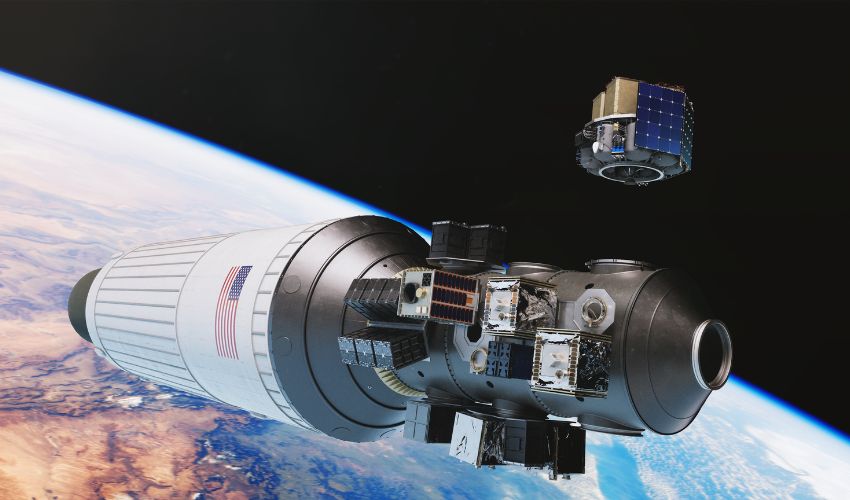
There is no doubt that satellites play a critical role in our lives. They not only provide information about Earth’s clouds, oceans, land and air (thus allowing scientists to predict weather and climate), but they are also critical for daily communications and more. But did you know that satellites have been shrinking? Today, satellites are cheaper to produce because they are lighter than previous versions resulting in lower launch costs. As a result, companies are also moving to create smaller, lower-cost rockets to support them. One of the most notable on the market is Launcher.
Californian start-up Launcher was founded in 2017 to address increasing launch demand, which is outpacing supply in the satellite launch market (expected to grow from $8B to $38B in 2030). The company combines liquid propulsion technology and metal 3D printing to create efficient rockets and transfer vehicles to deliver small satellites to orbit. Notably, they have conceived the low-cost Launcher Engine-2 (E2) rocket engine which has been optimized for mass production. It is aimed to be the highest performance liquid rocket engine of its class and is destined to be the central thrust component for Launcher’s Light rocket. And to realize this innovative design, Launcher turned to Stratasys Direct Manufacturing and Velo3D’s metal AM technology.
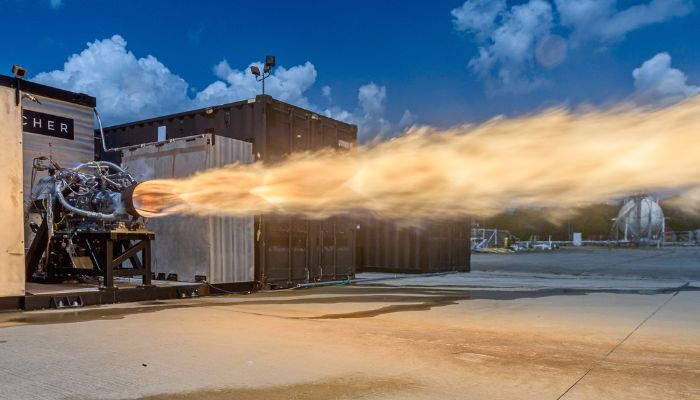
Testing the engine (photo credits: Launcher/John Kraus Photography)
A Closer Look at the E-2 Liquid Rocket Engine
As mentioned, the Launcher E-2 liquid rocket engine has been designed to be part of Launcher’s high-performance rockets. The 22,000 lbf (pound-force) engine, propelled by LOX (liquid oxygen)/RP-1 (kerosene), is considered to be the world’s highest performing engine for small launches. 3D printed with a copper alloy, it has a 98% Combustion Efficiency and a performance of 365s Isp. Furthermore, thanks to its high balance, the LOX pump’s impeller can spin at 30,000 rpms in cryogenic conditions all while transporting liquid oxygen.
More from the desk
Six other notes from the rest of the bench.
 SoftwareSmartBuild Brings Stereolithography to an Industrial ScaleWhile stereolithography is a well-established additive manufacturing technology used by many, it comes with its share of challenges, particularly when it comes to scaling up. Manufacturers are often forced to make a difficult trade-off between speed and quality, while also&hellip
 NewsWEBINAR: “Progress & Current Challenges in Online Process Control for L-PBF”Process control in Laser Powder bed Fusion (L-PBF) is often referred to as the holy grail for for industrial metal 3D printing. Though only offered by certain companies and machines, process control significantly reduces errors in printing which in turn…
 NewsCan 3D Printing Correct Color Blindness?3D printing could now treat color blindness according to a study conducted by Abu Dhabi’s Khalifa University of Science and Technology (UK). Otherwise known as color vision deficiency, this condition is an inherited eye disorder in which one or more…
 PrintersTop Examples of 3D Printed ProsthesesWhen it comes to industries adopting 3D printing, one of the earliest and most fervent supporters of the technologies is of course the medical sector. Indeed, AM is becoming a crucial tool in healthcare thanks to a variety of factors.…
 NewsTop 5 Videos of the Week: 3D printing at the Met Gala…This week we found the top 5 videos about 3D printing and the way additive manufacturing is shaping our society. The technology has infiltrated fashion, as seen by the 3D printed dresses at the Met Gala, not only this, it…
 NewsADDITIV digital World is starting tomorrow, are you ready to take part?Every year, key events in the sector are at the centre stage of big developments and advancements in additive manufacturing. Active players and users of 3D printing technologies come together to discover the latest solutions from manufacturers, experience first-hand the…