News
Discovery, the 3D printed carbon fiber satellite
Mini-Cubes is a young American company that designs very small satellites: called PocketQubes, they measure only 5 cm and remain more accessible than traditional satellites. The reason we are telling you about it today is because the company has started…
- 3 min read
- News
- Six more stories
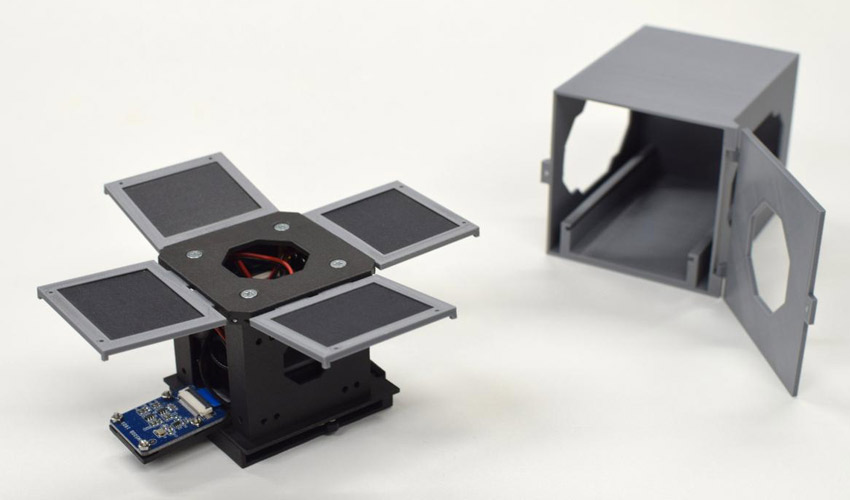
Mini-Cubes is a young American company that designs very small satellites: called PocketQubes, they measure only 5 cm and remain more accessible than traditional satellites. The reason we are telling you about it today is because the company has started using additive manufacturing to develop the satellites called Discovery: 3D printed on an SLS machine, they are made of carbon fiber, which ensures high rigidity and remarkable lightness at the same time. According to Mini-Cubes, this is the first time such a material has been used to 3D print satellites capable of going into space.
For its production purposes Mini-Cubes has opted for 3D printing with composites. The CEO of the company, Joe Latrell, explains: “For me, space is the next big frontier. Instead of seeing it as an impossible challenge, I see it as the source of saving the Earth.” The purpose of the Discovery satellite would be to monitor natural resources on the Earth’s surface.
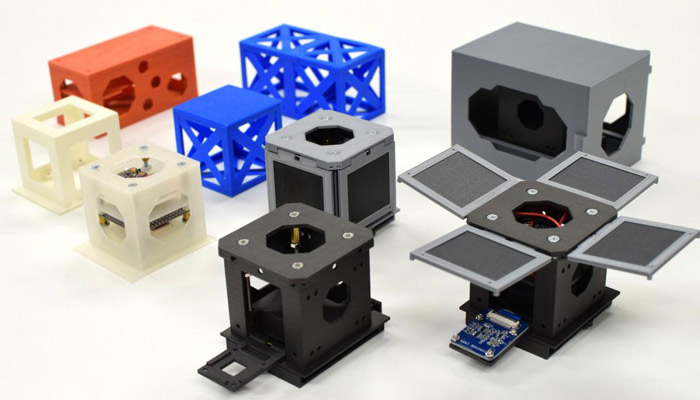
PocketQubes are very small satellites. (Image credits: Mini-Cubes)
The manufacturing process of Discovery
Therefore, the team at Mini-Cubes wanted to integrate a camera into the satellite in order to enable the surveillance of our planet’s natural resources. It proved to be a relatively complex operation considering the size of the device: the company wanted to create a satellite with an internal volume of only 50 x 50 x 50 mm. So they turned to additive manufacturing, which makes it possible to develop more complex shapes at a lower cost. To 3D print parts of good quality they sought help from CRP USA, a 3D printing service provider. Then, they had to choose the right material that would answer all the requirements needed for space launch. Lightness is an essential point in order to reduce the associated costs as much as possible, but resistance must not be sacrificed. After numerous tests, the two partners opted for Windform XT 2.0, a carbon fibre reinforced polymer.
More from the desk
Six other notes from the rest of the bench.
 NewsHow well do YOU know 3D Printing? Take Our Quiz:Do you fancy yourself as a bit of a 3D printing genius? Test yourself in our 3D printing quiz! [os-widget path=”/3dnatives/are-you-a-3d-printing-expert”] Have an opinion? Let us know in a comment below or on our Facebook and Twitter pages! Sign up for our free weekly
  GuidesDiveDesign on Their Development of 3D Prostheses to Improve Animals’ LivesMajor advances in 3D technology have made it possible to use 3D printing to help animals, specifically to improve their quality of life. Many of them are rescued, but their poor conditions do not allow them to be independent. That…
 ApplicationsRubble to Rockets: Utilizing Scrap Metal and Machine Learning for On-Demand 3D PrintingLast week, we explored how the Defense Advanced Research Projects Agency (DARPA) is pushing the boundaries of additive manufacturing, and the momentum is not slowing down. On June 4th, the Worcester Polytechnic Institute (WPI) announced a $6.3 million grant from…
 PrintersYoav Zeif Talks About the Current State of the AM Market, U.S. Tariffs and the Launch of Stratasys’ Neo®800+ 3D PrinterWhat does 2025 hold for the world of additive manufacturing? Amid geopolitical challenges, technological evolutions and new market balances, the 3D printing industry is gearing up for what is likely to be a critical year. To analyze emerging trends and…
 GuidesHow Is 3D Printing Used in the Tourism Industry?Additive manufacturing, with its sustainability benefits and capacity for customization, has found its place in the travel industry. The use of 3D printing has expanded beyond just consumer goods, with aircraft parts being additively manufactured to improve sustainability and red
 GuidesThe 3D Printing Books to Read This YearWorld Book Day is celebrated annually on April 23rd (except in the UK and Ireland where a similar event is observed in March). And as it is coming up fast, so we thought there was no better occasion to present…