News
Lilach Porges Combines Roller Coasters, 3D Printing and Female Empowerment in Her Fashion Collection
The fashion industry is considered one of the biggest environmental polluters, putting it at the center of the sustainability debate. While large fashion companies are changing course in some of their production methods, suppliers of cheap fashion are striving to…
- 3 min read
- News
- Six more stories
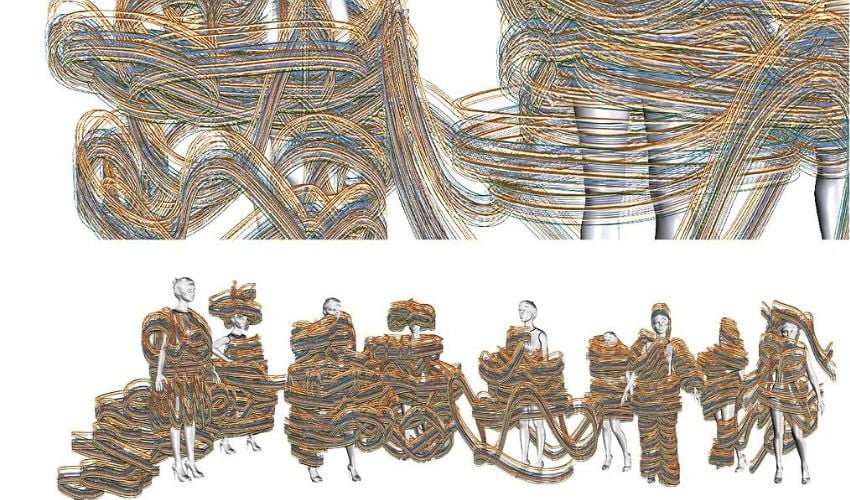
The fashion industry is considered one of the biggest environmental polluters, putting it at the center of the sustainability debate. While large fashion companies are changing course in some of their production methods, suppliers of cheap fashion are striving to do the same. Although environmentally conscious consumers are now frequently turning to second-hand clothing and having a positive impact on the supply-demand system, the aim is to make production itself “greener”.
Forward-thinking companies are pioneering resource-conserving manufacturing methods and eco-friendly materials. Balena, for instance, champions compostable materials for textile production, strengthening this trend. Additionally, designers like Lilach Porges from Israel are actively striving to infuse sustainability into their professional realms. Porges recently unveiled her first ready-to-wear collection, dubbed the Roller Coaster collection, under her label PROCODE_DRESS. The garments were crafted using robot-controlled 3D printing techniques while utilizing sustainable printing materials.
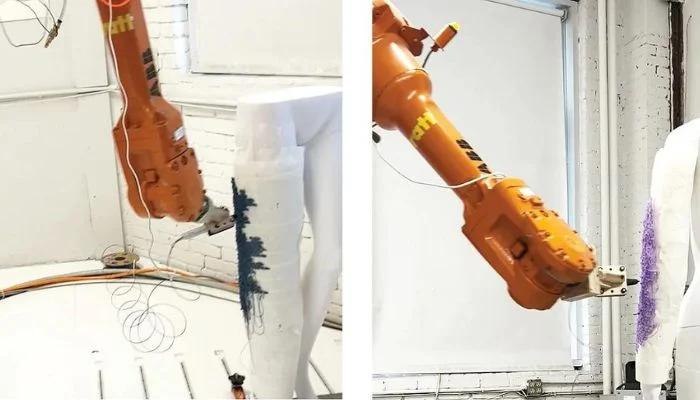
Printing in process on the garments
Porges developed a unique 3D printing process exclusively for the Roller Coaster collection, employing robotic arms to execute various tasks. These versatile arms not only create intricate patterns but also handle fabric sewing, efficiently producing clothing directly from 3D printed textile materials, resulting in the ready-to-wear attire. The robot’s movements are coded and coordinated using mathematical patterns. In contrast to conventional 3D printers, robotic arms offer an advantage in that large areas can also be printed with no volume limitations. In addition, the robotic arm can move flexibly depending on the code programming and can also print on curved verticals.
More from the desk
Six other notes from the rest of the bench.
 ApplicationsX-Plorer: The 3D Printed Jet Engine Made of 965 partsDeveloped by a group of engineering students named JetX, this functional 3D printed jet engine is one of the finalists of the Student Grant 3D Hubs competition. The competition is held to discover who can make the best project displaying…
 NewsTop 5 Videos: Optimizing your 3D printing designThis week we found the top 5 videos about 3D printing and the way additive manufacturing is changing production. The technology has infiltrated many sectors, from medical to automotive – check our selection of the week to keep up with the innovations! If you enjoy these, you&hell
 NewsTest Form ENRegister and win a Bambu Lab PS1 3D Printer! * Required Email * First Name * Last Name * Company * Country * 3D Printing IndustryAerospaceAutomotive and transportArchitecture / ConstructionDesignConsumer GoodsEducationElectronicManufacturingMakers / FabLabMedicalOil and GasOther
  GuidesLino3D on Democratizing Additive Manufacturing Through EducationAs additive manufacturing grows and becomes more widespread, acquiring the right skills and knowledge is becoming paramount. Indeed, the use of 3D technologies implies certain rules; it is not simply a matter of pushing the button on the 3D printer…
 NewsExOne’s New Metal Adoption and Application Center in Europe Provides One-Stop Shop for All Binder Jetting NeedsExOne, an industrial leader in binder jetting systems with a portfolio of both metal and sand 3D printers, has expanded its application and adoption center (EAC) in Europe. Now the 2,070-square-meter center will offer direct metal binder jet 3D printing…
 NewsAdvances in additive manufacturing in 2018Have you kept updated with additive manufacturing in 2018? Have you not followed the 3D printing news in recent months and you want an update? Find the highlights in our recap events, new products, strategic announcements and innovative applications that have…