News
CONTEXT reveals its predictions for polymer and metal 3D printer trends
CONTEXT, the London-based research firm revealed that we could expect good growth in shipments of both metal and polymer industrial and design 3D printers in 2019. The company defined industrial as 3D printers over $100K and design between $20K and…
- 3 min read
- News
- Six more stories
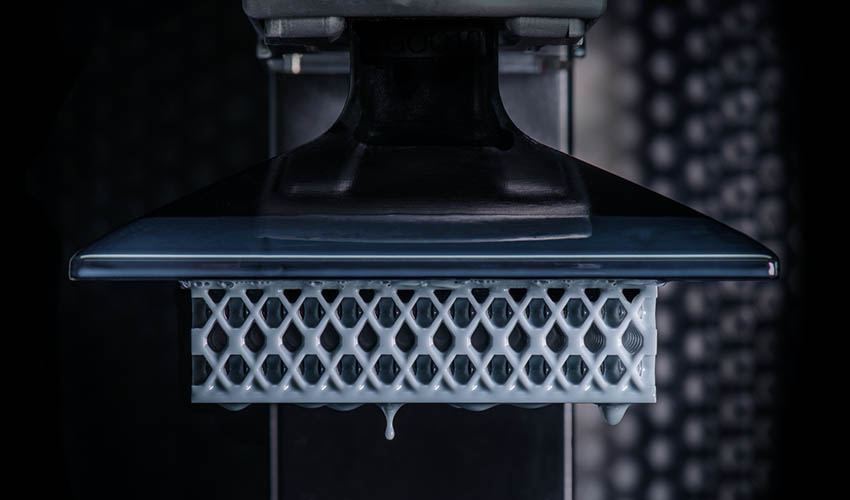
CONTEXT, the London-based research firm revealed that we could expect good growth in shipments of both metal and polymer industrial and design 3D printers in 2019. The company defined industrial as 3D printers over $100K and design between $20K and $100K. In fact, the cheapest class of 3D printers (under $2.5K) had already suffered in 2018 according to their report and this trend should continue. On the other hand, the industrial category, which accounts for 70% of the global revenues of printer hardware, experienced a year-on-year growth rate of 18%.
Growth in 2018 can therefore be boiled down to the increases in shipments of both metal 3D printers – up 26% year-on-year – and industrial and design class polymer 3D printers such as Carbon’s, HP’s and 3D Systems’. As for the professional segment, defined in the report as 3D printers between $2.5K and $20K, also saw good growth in 2018.
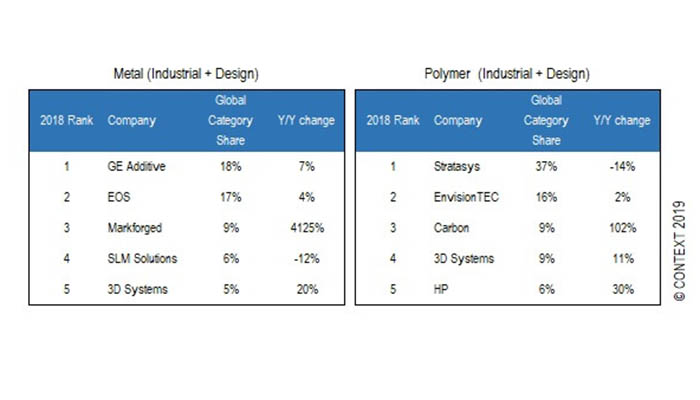
Top 5 industrial & design 3D printer vendor shipment share by machines shipped in 2018 | Credits: CONTEXT
In terms of innovations, the market saw the emergence of lower-priced multi-step metal printers, from Markforged and Desktop Metal for example. Chris Connery, VP of Global Research at CONTEXT comments, “New, lower priced metal 3D printers are targeted not just for factory use but also for office use and do not necessarily compete head-to-head with the more traditional robust metal 3D printers which use lasers to fuse powder in a single-step such as those from GE Additive, EOS, SLM Solutions, 3D Systems and others. Powder bed laser-based 3D printers are currently used for everything from jet engine parts to orthopaedic implants. New lower-priced metal printers look to augment this usage to now allow for more economical ways to create metal prototypes for these parts as well as allow for cheaper low-volume production of metal parts.”
More from the desk
Six other notes from the rest of the bench.
 NewsTop 5 videos: 3D printing metal parts for the automotive industry, and moreThis week we found the top 5 videos about 3D printing and the way additive manufacturing is changing production. The technology has infiltrated many sectors, from medical to automotive – check our selection of the week to keep up with the innovations! If you enjoy these, you&hell
 PrintersBigRep’s latest funding round has reached “Double Digit” millionsThe German start-up, BigRep, which specializes in large-format 3D printers, has announced that their latest funding round has reached the “Double digit” millions. Helping to reach the double digit amount is the family owned company, Koehler, the venture capital company…
 NewsASTM International launches personnel certificate program in AMASTM International is an international standards organization that develops and voluntarily publishes consensus technical standards for a wide range of materials, products, systems, and services. The organization’s technical committees have been writing standards related to addit
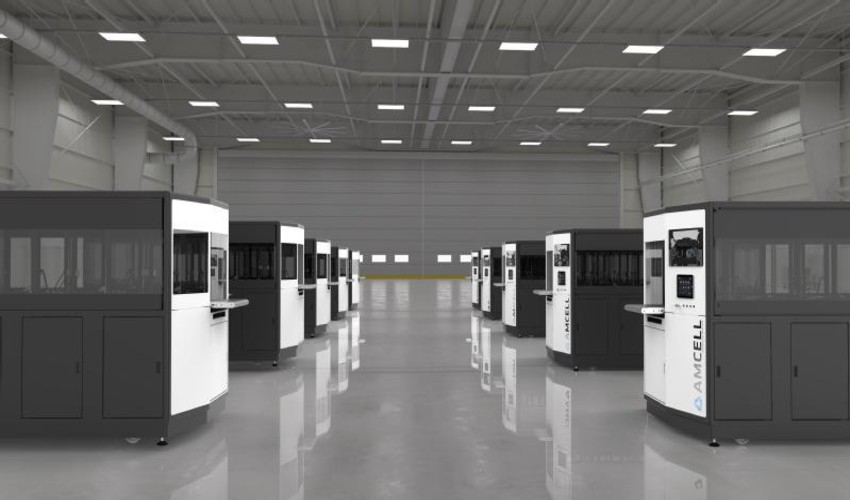 NewsTriditive Raises $1.8 Million in Seed FundingTriditive, a Spanish startup created in 2013 and that is also based in Hartford, CT in the US, has completed a $1.8 seed funding round. This company was able to complete this incredible fundraising thanks to the arrival of new…
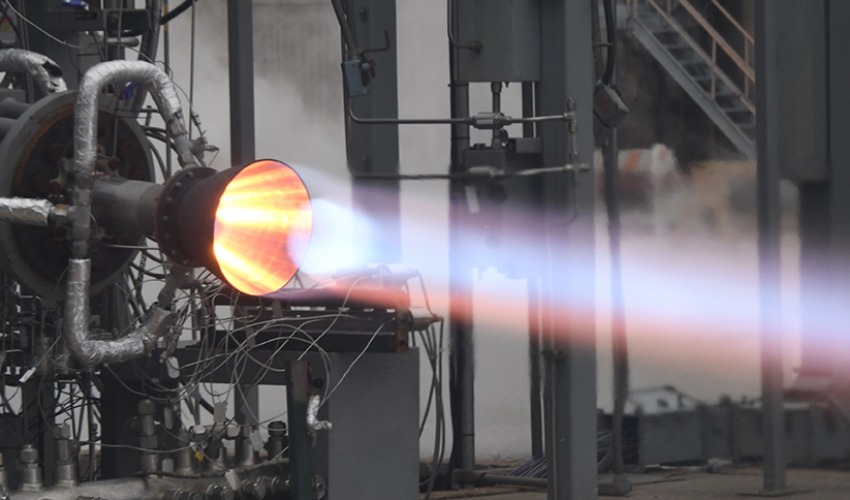 ApplicationsNASA and Aerojet Rocketdyne Partner to Test AM HardwareNASA has announced that its Robotic Deposition Technology (RDT) team is partnering with Aerojet Rocketdyne, an American rocket and missile propulsion manufacturer headquartered in Sacramento, to advance its 3D printing, and more specifically metal additive manufacturing, technolo
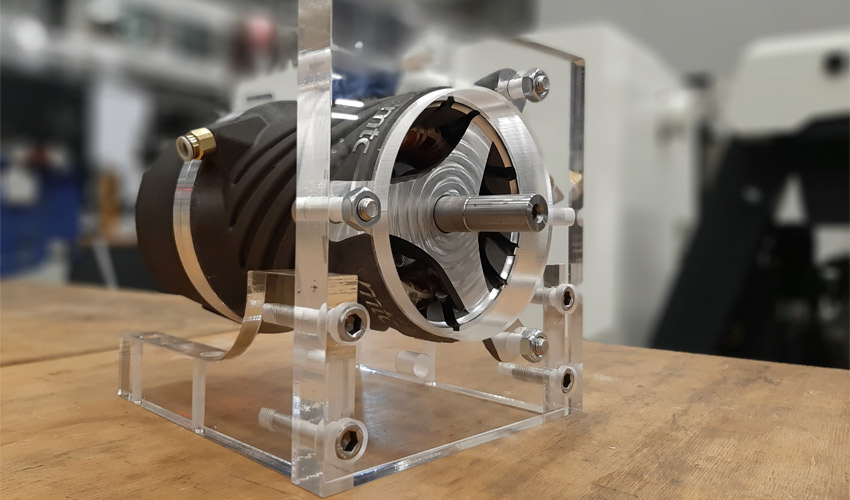 ApplicationsHas An English Research Center Found a Way to Commercialize a 3D-Printed Electric Motor?In England, the National Center for Additive Manufacturing (NCAM) has designed a 3D-printed electric motor, which they proclaim is the first of its kind. The motor consists of multiple 3D-printed parts. Furthermore, the motor has comparably more power, requires less…