Applications
NASA and Aerojet Rocketdyne Partner to Test AM Hardware
NASA has announced that its Robotic Deposition Technology (RDT) team is partnering with Aerojet Rocketdyne, an American rocket and missile propulsion manufacturer headquartered in Sacramento, to advance its 3D printing, and more specifically metal additive manufacturing, technolo
- 3 min read
- Applications
- Six more stories
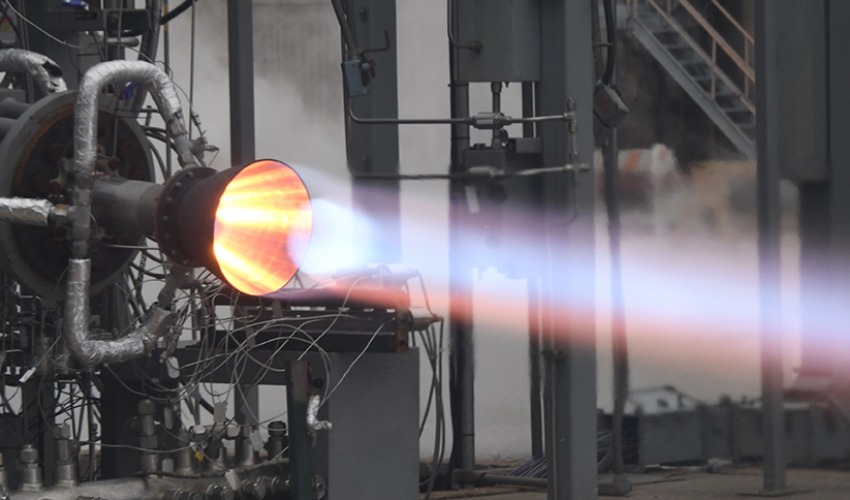
NASA has announced that its Robotic Deposition Technology (RDT) team is partnering with Aerojet Rocketdyne, an American rocket and missile propulsion manufacturer headquartered in Sacramento, to advance its 3D printing, and more specifically metal additive manufacturing, technologies. NASA also hopes that this partnership will aid in the advancement of its capabilities for liquid rocket engines in landers and on-orbit stages/spacecraft. With Aerojet Rocketdyne, NASA’s RDT team has manufactured rocket engine hardware which has successfully passed both cold spray and hot fire tests.
Led out of NASA’s Marshall Space Flight Center in Huntsville, Alabama, the team has been designing and manufacturing innovative and lightweight combustion chambers, nozzles, and injectors that will incorporate automated robotic deposition 3D printing technologies. These include cold spray deposition, laser wire direct closeout, laser powder bed fusion, and laser powder directed energy deposition. With this work NASA intends to evolve these processes using weight-optimized materials to validate operability, performance, and reusability through hot fire testing.
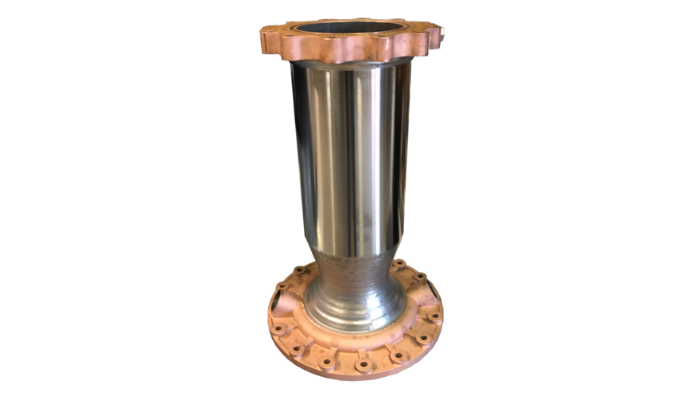
3D-printed bimetallic lightweight thrust chamber assembly before hot fire testing at NASA’s Marshall Space Flight Center in Huntsville, Alabama. (Photo Credits: NASA)
Last year, the RDT team tested hardware such as injectors and carbon composite nozzles and hot fire testing its 3D printed lightweight combustion chamber and nozzle under the Long Life Additive Manufacturing Assembly, or LLAMA, project. Together with Aerojet Rocketdyne, NASA has now finished testing hardware under a second lamoid-named project – the Advanced Lander Propulsion Additive Cold-spray Assembly, or ALPACA, project. According to Thomas W. Teasley, an engineer at the Marshall Space Flight Center “Testing of the RDT Advanced Lander Propulsion Additive Cold-spray Assembly (ALPACA) chamber went very well and demonstrated a new technology capability for NASA and industry partners”.
More from the desk
Six other notes from the rest of the bench.
 Guides#3DStartup: Lensy Medical Creates Personalized Contact Lenses With 3D Printing3D printing continues to transform the medical sector, and its influence now extends to the ophthalmology sector, particularly in the manufacturing of lenses. This is the case of startup Lensy Medical, which manufactures contact lenses using 3D technologies. Its approach…
 Applications3D Printing is Helping Doctors to Treat LupusOnce again, doctors are turning to 3D printing to solve unique issues in the field of medicine. In this case, engineers and doctors at the University of Minnesota Twin Cities used the technology to develop a unique light-sensing medical device…
 NewsTOP 5 videos of the week: vaccines, prosthetics, beer and more!A new selection of the best 3D printing videos of the week, just for you! Find our TOP 5 videos of the week below and tell us what your favorite video is in a comment below or on our Facebook and…
 PrintersFrench Manufacturer Namma Expands Its Range of Hybrid Solutions to Meet Industrial RequirementsIn 2021, Bordeaux-based start-up Namma presented EVA, an industrial multiprocess machine that combines three processes to produce metal, polymer and composite parts. Three years later, it has strengthened its offering with two additional models, positioning itself in both hybrid
  ApplicationsNew FDA-Approved Oral Stent From Kallisio Could Change the Way We Treat CancerIncreasing research has been done in recent years on the ways that 3D printing can be used in the battle against cancer. Though much of this has understandably focused on things like bioprinting, including for the creation of prostheses and…
 NewsAre 3D Printer Shipments Back to Pre-COVID Levels?When the pandemic shut down the world last year, a number of industries were severely impacted. However, 3D printing proved to be more robust than many others. That being said, a few studies have shown that though it did not…