Materials
Chopped or Continuous Fibers: Which Reinforcement to Choose for Composite 3D Printed Parts?
When specific or superior properties are needed in 3D printed parts, composite 3D printing is often used. The resulting parts are stronger than certain metals and offer high performance. Composites are defined as two materials that are combined to achieve…
- 3 min read
- Materials
- Six more stories
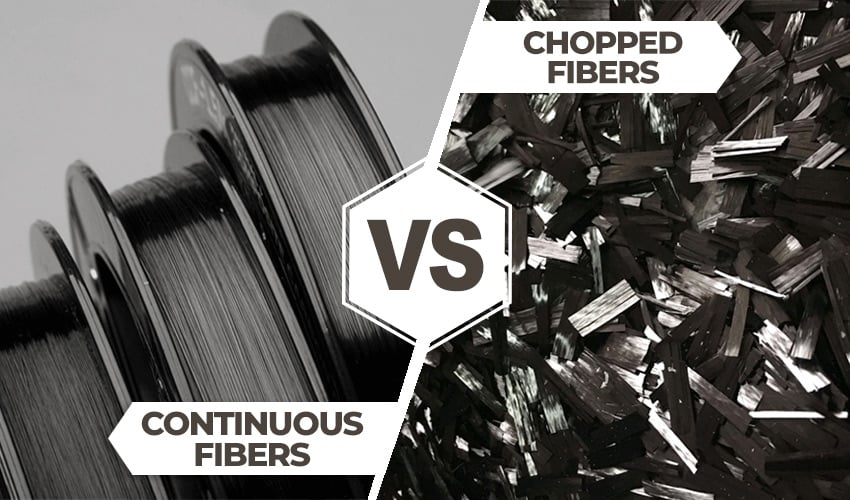
When specific or superior properties are needed in 3D printed parts, composite 3D printing is often used. The resulting parts are stronger than certain metals and offer high performance. Composites are defined as two materials that are combined to achieve new or improved properties as compared to those of the starting materials. As such, there are numerous composite materials, although in this case, the focus will be on composite materials that are formed by a polymer matrix and fiber reinforcement. In the 3D printing industry, carbon fiber, glass fiber and Kevlar are three of the most common fiber materials used for composites.
In this article we will look at 3D printing of chopped and continuous fiber reinforced composites.These two techniques give different results and are done with different technologies. Although, for both, the most popular material extrusion and therefore is the technology that will be most emphasized.But what, then, are the similarities and differences between these two techniques and how to choose the most suitable type of reinforcement for a specific application? Let’s take a closer look.
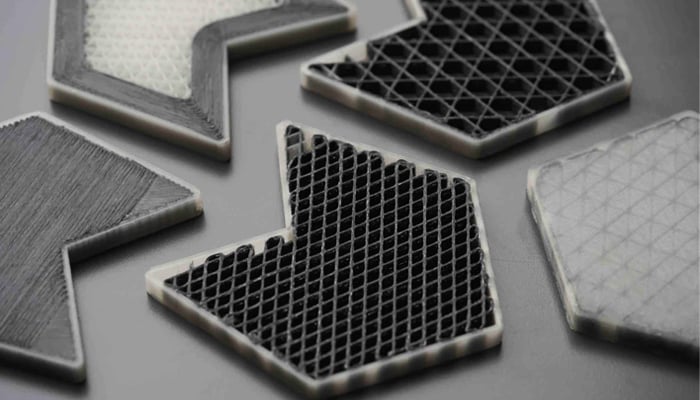
Photo Credits: Anisoprint
Characteristics of Chopped and Continuous Fiber Composite Materials
By chopped, or short, fibers we mean smaller pieces of fibrous material, the length of which can vary from centimeters to millimeters or even less. This is a process similar to that used to reinforce concrete with pieces of reinforcement. The fibers are dispersed in the plastic matrix and act as reinforcement throughout the material.
More from the desk
Six other notes from the rest of the bench.
 News3D printed corals could help energy production and coral conservation3D printing technologies can be used to create complex and intricate structures by enabling a new level of design freedom. This is one of the main benefits of additive manufacturing, and one of the aspects many scientists around the world…
 GuidesExclusive interview with aRks 3D, the creators of the 3D printed bikinisA few weeks ago, we presented you with the first collection of 3D printed bikinis by the Italian design studio aRks 3D. The swimsuit is fully customized, perfectly adapted to your body and is environmentally friendly with a recyclable printed…
 NewsBarilla Has Introduced Spaghetto 3D, a New 3D Printed SpaghettiFor Italians at home and abroad, no pasta is more iconic than spaghetti. Even in the United States, spaghetti is a staple in homes across the country with the long form of the noodles an endless source of inspiration for…
 NewsGanit Goldstein on her vision of 3D printing for fashionGanit Goldstein is a 3D designer working on how to merge additive manufacturing technologies with fashion to bring new possibilities to the industry. Her aim is to work with new technologies to provide custom-made items that fit the wearer perfectly.…
 ApplicationsAM Helped General Motors Avoid Supply Chain Problems With the Chevrolet Tahoe 2022These days, many industries are being affected by supply chain problems. One sector that is particularly troubled by this is the automotive industry. All over the world, delays of important parts lasting weeks are definitely making the life of car…
 NewsIKEA customizes gaming chairs using 3D printingSwedish furniture giant IKEA has announced a partnership with UNYQ, a specialist in 3D printing who manufactures medical prostheses. Together, they want to create more ergonomic, personalized and interactive video game equipment, a goal that could be achieved by using…