Materials
How Cement 3D Printing Can Contribute to Decarbonization
For the past decades, the global population has been steadily increasing, which means that these people have to be accommodated somewhere. Consequently, with this increasing number, the amount of accommodation must also increase. Essential for its construction are cementitious pr
- 3 min read
- Materials
- Six more stories
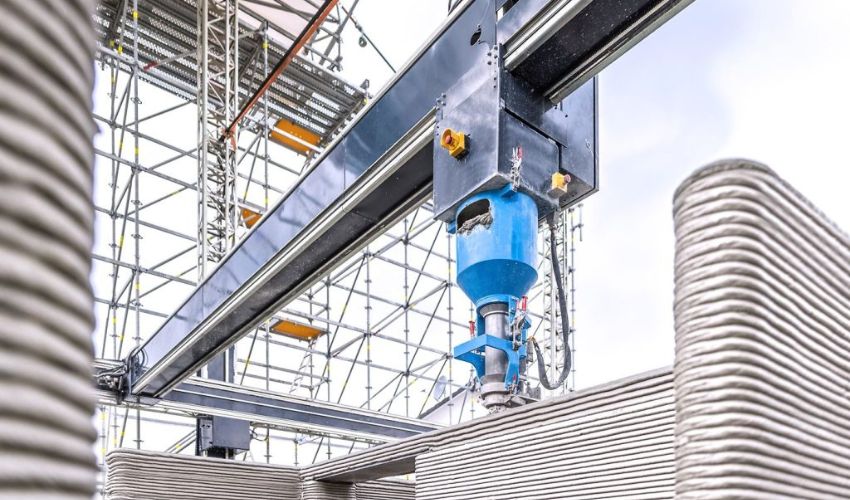
For the past decades, the global population has been steadily increasing, which means that these people have to be accommodated somewhere. Consequently, with this increasing number, the amount of accommodation must also increase. Essential for its construction are cementitious products (including cement and concrete), which are among the most widely used resources nowadays. If we take a look at the study carried out by the UN DESA (Population Division) to forecast the world’s population in the coming years, this could mean that by 2060 there will already be more than ten billion people living on this planet. Considering the production of cement, which currently accounts for around 8% of total CO2 emissions, this is likely to increase even further for the construction industry. As a result, a team of researchers consisting of Ankita Gangotra, Emanuela Del Gado and Joanna I. Lewis, all of whom work at Georgetown University in the United States of America, have been looking into the possibilities of 3D printing with cement and the associated climate protection.
The threat to our planet from CO2 is a serious growing issue, and since the production and use of cement plays a major role in this, it will take 3D printing to achieve carbon neutrality in terms of the cement and concrete supply chain by the middle of this century. The goal the researchers have been addressing in the course of their work is dedicated to decarbonization in the cement sector. This means a change in the way the economy is run, which should lead to less carbon being emitted.
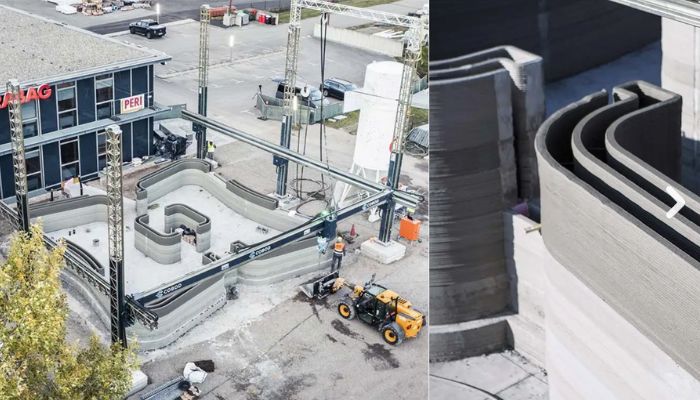
An example of cement 3D printing can be seen in the construction of the first 3D-printed building in Austria (Image: PERI 3D Construction GmbH)
Is Climate Protection Possible Through 3D Printing With Cement?
We know that additive manufacturing in the construction sector provides us with savings in materials, time and costs, and also minimizes the human workload, but when considering the possibilities in terms of climate protection, the researchers state that 3D printing still has a lot of potential. With reference to the cement supply chain, greenhouse gas emissions can be sustainably reduced using 3D printing. Starting with the production of the 3D printable mixtures and ending with the final end use and thus the construction of buildings. In the first step of this supply chain, the researchers state that this could involve the production of novel low-carbon 3D printable cement mixes that have been reinforced with other cementitious materials. For example, this could include industrial waste such as fly ash or slag, but could also include naturally formed materials such as clay. The research paper goes on to say that alternative binders such as geopolymers and recycled materials from conventional concrete can also be used for this purpose. All these factors to renew the cement mixture for subsequent 3D printing can lead to the reduction of emissions.
More from the desk
Six other notes from the rest of the bench.
 NewsFormnext Start-Up Challenge 2023: What Do This Year’s Winners Expect From the Event?The most anticipated event of the year in the Additive Manufacturing industry, Formnext 2023 is just around the corner. Held in Frankfurt, Germany, from November 7 to 10, companies and professionals from all over the world have already secured their…
 News#TOP5 videos: Bird was saved by 3D printing and much more!We found the TOP 5 videos of the week related to 3D printing and collected the additive manufacturing here. Share your videos and comment on the article below or on the 3Dnatives’ Facebook or Twitter account. Hope you’ll enjoy and…
 ApplicationsGerman Aviation Club Restores Historic Beechcraft D18SThe Beechcraft 18, also known as the “Beech 18,” is an American twin-engine aircraft from the 1930s. It is small, fast, rugged, and versatile. These qualities quickly made it appealing to the military, and during World War II, it was…
 NewsThe best 2019 videos about 3D printing!2019 has been a year full of exciting developments for the additive manufacturing industry across all sectors. New machines have been introduced to the market, many applications have broken records, better performing materials have been developed, etc. Fortunately, most of&hellip
 ApplicationsHarvard Researchers Develop Microbial Ink to 3D Print Living MaterialsWhat if you were told that 3D printing is getting closer and closer to revolutionizing science? A team of researchers at Harvard University and Brigham and Women’s Hospital is rising to the challenge. Recently, they developed a microbial ink or…
 NewsWohlers Report 2022: Strong Growth in the Additive Manufacturing IndustryFor the 27th consecutive year, Wohlers Associates has published its annual report on the additive manufacturing industry. Wohlers Report 2022 marks the first report that has been published by Wohlers Associates since its acquisition by ASTM International late last year.…