News
Carbon and Kú Cycle Are Working Together to Improve the Performance of Triathletes
In sports like triathlon, what matters most is being the fastest. And though of course the athlete is largely responsible for the speed, high performance equipment is also paramount to going as fast as possible. Due to this, companies are…
- 3 min read
- News
- Six more stories
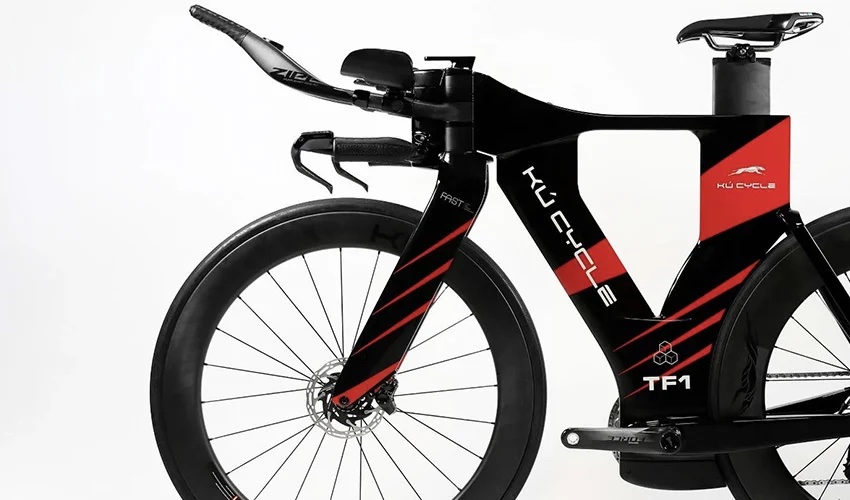
In sports like triathlon, what matters most is being the fastest. And though of course the athlete is largely responsible for the speed, high performance equipment is also paramount to going as fast as possible. Due to this, companies are constantly looking for new innovations to improve the features of their bikes, and 3D printing seems to be becoming an increasingly popular technology. One example is with Pinarello, which made the BOLIDE F HR 3D, the world’s fastest bike that incorporates 3D printed parts. Mythos and IXO have also collaborated to produce a new stem using metal additive manufacturing.
It is now Kú Cycle’s turn to benefit from 3D printing to manufacture its new product. The Netherlands-based company aims to design a high-performance bicycle that is perfectly suited to cyclists. It is collaborating with QDP, a company that designs plastic solutions for many applications. With the help of Carbon, Kú Cycle has now introduced the Kú TF1, a custom-made triathlon bike.

The armrests, grips and shifter incorporate 3D printed parts (photo credits: Carbon)
The Kú TF1 Is a Customized Bike for Cyclists
You have almost certainly already heard of Carbon. In the world of sports, the 3D printer manufacturer has already contributed to the creation of numerous sports equipment. Indeed, it has already 3D printed a baseball glove, the FutureCraft 4D in collaboration with adidas, and the world’s first field hockey helmet liner, among other projects. For these reasons, QDP contacted the company to manufacture the Kú TF1. As it was looking for a way to build faster while lowering manufacturing costs, Carbon’s 3D printing solution seemed to be the right choice. Moreover, QDP was able to create durable lattice structures by using the Carbon Design Engine software.
More from the desk
Six other notes from the rest of the bench.
 Printers3D Print ceramic pieces on your SLA 3D printerSix years ago, the American manufacturer Formlabs unveiled their first stereolithography 3D printer that was made to be accessible to as many people as possible, with a relatively low marketing price. Since then, the company has grown quickly, evolving their…
 News#TOP5 videos: 3D printing trends of 2019 and much more!We found the TOP 5 videos of the week related to 3D printing and collected the additive manufacturing here. You can enjoy even more 3D printing videos on the our youtube channel, as well as share your videos and comment on…
 News3D printing in footwear: disrupting the shoe industry?3D printing is being incorporated into more and more industries, and fashion is no exception to this. The technology is opening up for new, creative possibilities and solutions. Something we’ve seen being utilised in a variety of ways from jewellery to costume…
 ApplicationsUS Troops 3D Print Drone Parts While Flying in Black HawkThe Indiana Army National Guard has achieved a technological first by successfully demonstrating 3D printing aboard a UH-60 Black Hawk helicopter. This marks a considerable milestone in military innovation, showcasing the shift towards additive manufacturing within the defense se
 ApplicationsAdvancing Additive Manufacturing in Aerospace and Defense: Industry Leaders Convene for Panel DiscussionIf you’re looking for game-changing Additive Manufacturing (AM) materials for Aerospace and Defense (AeroDef) applications or need to upgrade to AM materials that offer high performance, connectivity, and cybersecurity, SPE’s online Between the Layers: Panel Discussion – Ad
 ApplicationsBlood vessels 3D printed with sugarAt Rice University, in order to print complex 3D shapes, researchers use not polymers or metals but sugar! An ingredient that could have a particular impact on the medical sector and the understanding of our cells: indeed, with powdered sugar,…