Applications
Blueflite Has Developed a 3D-Printed Hydrogen Storage System for UAVs
In the years to come, drones could play a decisive role in many areas, ensuring the rapid and safe transport of goods. Isolated rural areas in particular stand to benefit, as drones can quickly supply them with medicines or emergency…
- 3 min read
- Applications
- Six more stories
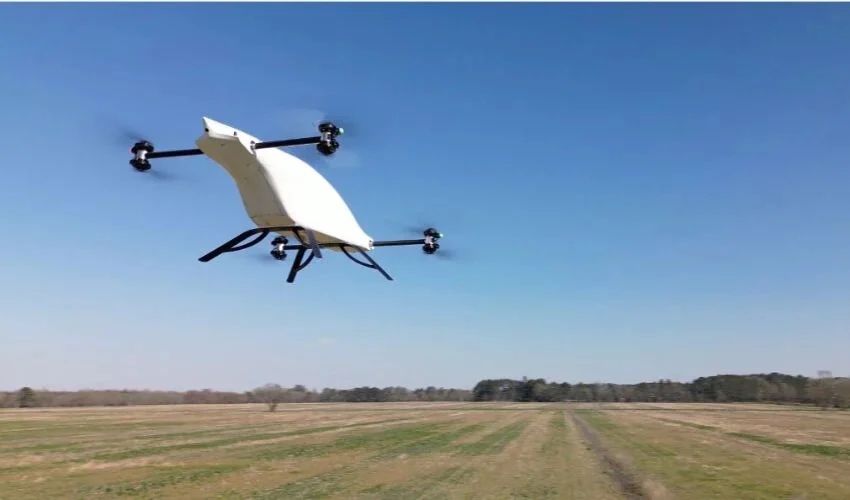
In the years to come, drones could play a decisive role in many areas, ensuring the rapid and safe transport of goods. Isolated rural areas in particular stand to benefit, as drones can quickly supply them with medicines or emergency foodstuffs. In addition to their use for humanitarian purposes, drones also offer advantages for agriculture and mining. Many companies are therefore working to make unmanned aerial vehicles (UAVs) even more reliable, faster and more efficient.
Demand is growing, especially for long-distance flights, hence the increasing interest in fuels such as hydrogen to power UAVs. For this reason, Australian UAV logistics platform Blueflite has teamed up with the Australian Northern Territory Government and Charles Darwin University (CDU) to develop a hydrogen-based fuel storage technology for UAVs in a joint project. This project was also made possible by the use of additive manufacturing.
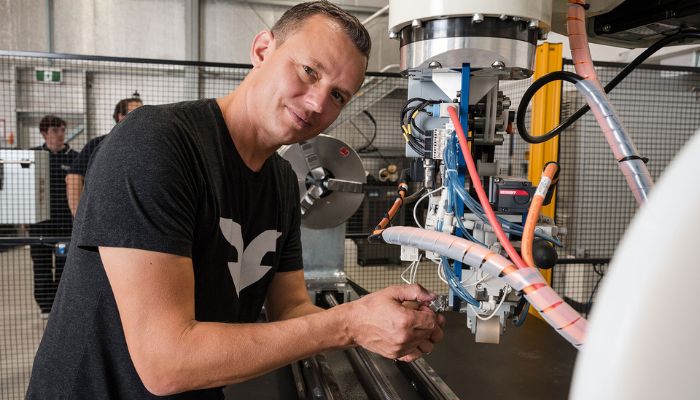
Making the part
The Position of Blueflite on the UAV Market
Already today, long-range drones account for almost a quarter of the global drone market, which is expected to reach $3 billion by 2033. According to Airservices Australia, the number of drone flights in 2024 has so far been 1.5 million (individual take-offs and landings), but flights are expected to reach around 60.4 million by 2043. These figures illustrate the need to develop high-performance UAVs and scalable solutions. By integrating hydrogen fuel cells, for example, it is possible to optimize their efficiency and increase their range by up to 700% compared with conventional lithium-ion batteries.
More from the desk
Six other notes from the rest of the bench.
 ApplicationsUS Navy Opens Additive Manufacturing Center of ExcellenceThe US Navy has opened its Additive Manufacturing Center of Excellence in a formal ceremony featuring the Virginia Governor and the Office of the Secretary of Defense, as well as Navy officials and industry partners. The Center will be based…
 PrintersThe Best DIY 3D Printer KitsMost 3D printers today are sold as ‘plug-and-play’ systems—either fully assembled or semi-assembled and ready to print out of the box. However, this wasn’t always the standard. The industry’s roots can be traced back to the RepRap project, launched by&hell
 Printers#3DStartup: Apis Cor, Creators of the 3D Printed HouseIf you’ve been on the internet in the last year, you may have seen the viral clip of a 3D printed house built in just 24 hours. Apis Cor are a Russian company who built a whole, functional house in…
 NewsTop 5 Videos: Aerosint’s New And Innovative Powder RecoaterAnother Sunday means another Top 5 list of videos straight from the world of 3D printing! We start off this week’s top 5 with a video about Aerosint, a Belgian AM company that has developed a new 3D printing solution…
 Guides#3DStartup: Xolo and Volumetric 3D PrintingLast December, we presented xube, a compact 3D printer capable of printing parts in just a few seconds thanks to a volumetric printing process. Behind this innovation, is the young company Xolo. Based in Germany, it intends to change the…
 NewsPorsche and Puma Unveil New 3D Printed Sneakers, 3D MTRXPuma and Porsche Design, a brand dedicated to sportswear and accessories from the famous car brand, have partnered to design the 3D MTRX sneaker, whose midsole was 3D printed. The midsole has a lattice structure, but is inspired by the…