Applications
Bioprinted artificial tissue to heal bone and cartilage injuries
A team of scientists from Rice University and the University of Maryland in the US are developing 3D printed artificial tissues to help bone and cartilage that has been damaged. This could help injuries, typically induced by sports, including knee,…
- 3 min read
- Applications
- Six more stories
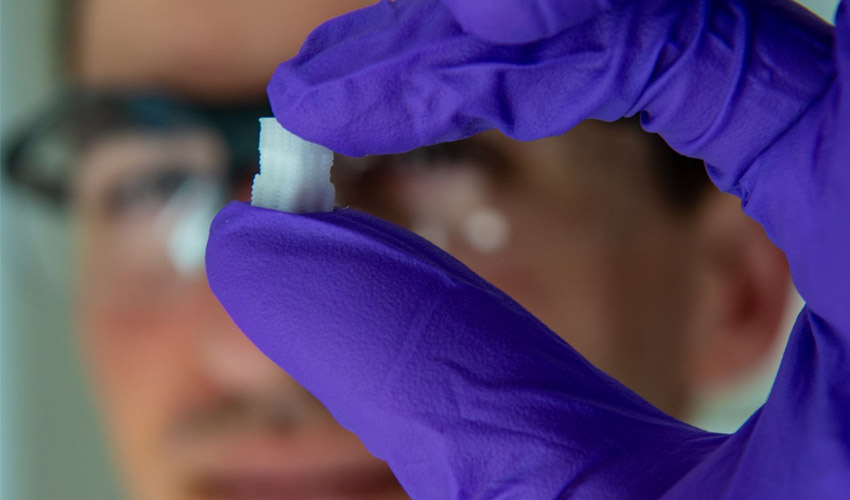
A team of scientists from Rice University and the University of Maryland in the US are developing 3D printed artificial tissues to help bone and cartilage that has been damaged. This could help injuries, typically induced by sports, including knee, ankle and elbow injuries. The bioscientists designed scaffolding that reproduces the physical characteristics of an oesteochondral lesion (a type of crevice that appears at the surface of cartilage, usually found in the talus or tibia bone). Using the 3D printed uniform and gradient scaffold for bone and osteochondral tissue, the team hopes to offer treatment for this sort of injury.
The recent developments in bioprinting make it possible to understand certain diseases or injuries better. Also, bioprinting allows to find solutions adapted to each patient and their needs. The method involves depositing bio-ink layer by layer. The bio-ink is typically loaded with cells. The procedure can be used to create artificial tissues, organs or cartilage. We are still at the beginning of the technology but the results are promising. There was already the successful bioprinting of a kidney – able to work for 40 days.
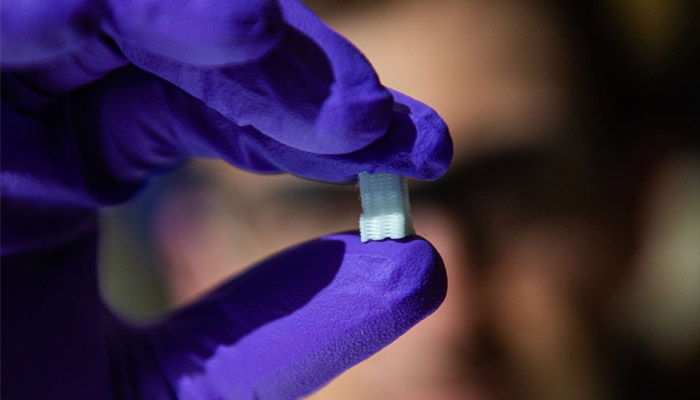
Credits: Jeff Fitlow/Rice University
This particular project, led by bioengineer Antonios Mikos, aimed to imitate a tissue that gradually turns from cartilage (chondral tissue) at the surface to bone (osteo). In order to do this, the team of researchers bioprinted a scaffold with custom mixtures of a polymer for the cartilage part and ceramic for the bone part (with imbedded pores to allow the patient’s own cells and blood vessels to infiltrate the implant). Eventually, the scaffold should become part of the natural bone and cartilage, enabling osteochondral lesions to heal.
More from the desk
Six other notes from the rest of the bench.
 ApplicationsA 3D printed pulley can improve the performance of cyclistsThe Danish company CeramicSpeed and the Danish Institute of Technology (DTI) have worked together to produce a 3D printed titanium pulley for professional cyclists. The pulley is placed on the external gears of the gear shift and therefore subject to…
 ApplicationsZebro Robots to Use 3D Printing to Help Colonize MarsWhat may still sound like science fiction to some is actually becoming more and more likely in reality: the colonization of another planet. Various projects are actively working on the implementation of ideas that are supposed to bring about the…
 ApplicationsLamborghini Sian Roadster features 3D printed partsOne of the sectors that benefit the most from 3D printing technologies is the automotive industry. Additive manufacturing is often associated with affordability and speed, so many car manufacturers use this technology to produce car parts cheaper and faster. Meanwhile,…
 NewsMagnetic field impacts the fiber alignment of a 3D printed partResearchers from the Institute for High Performance Materials at Florida State University and the FAMU-FSU College of Engineering recently conducted a study that shows that using magnetic fields in the vicinity of a 3D printer can change the alignment of…
 NewsZap&Buj, making fashion through additive manufacturingThe development and manufacture of fashion through additive manufacturing is not new in the technology sector. Many firms have already benefited from 3D printing for fashion design and production. Innovation and originality in the creation of unique products opens up…
 NewsPost-processing trends report reveals current methods and challengesPostProcess Technologies has just released its annual report on post-processing trends in additive manufacturing. This second edition highlights the main methods available in the industry, and the challenges AM users face regardless of the additive manufacturing technology they u