Materials
Bioink Manufacturers: What’s on the Market?
Bioprinting, which involves 3D printing living tissue models, holds incredible promise for medicine and biology. The technology helps researchers develop personalized medicine, engineer tissues and test drugs and cosmetics. Another application, while far-off, would be 3D printing
- 3 min read
- Materials
- Six more stories
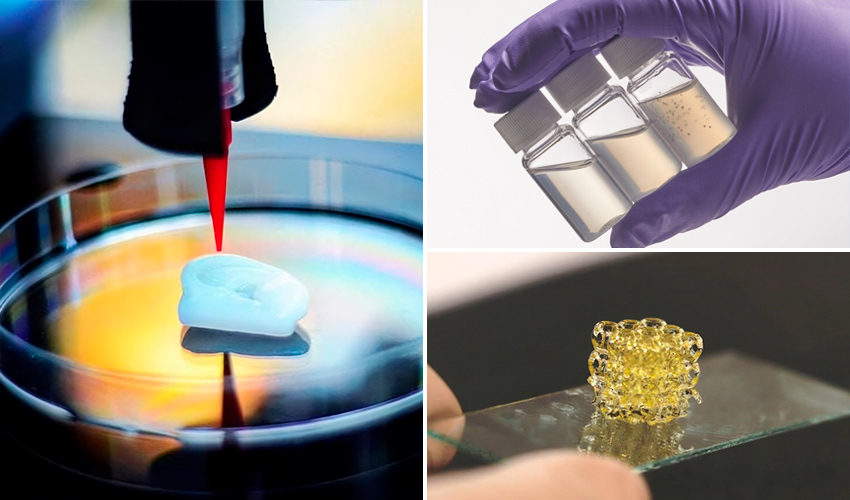
Bioprinting, which involves 3D printing living tissue models, holds incredible promise for medicine and biology. The technology helps researchers develop personalized medicine, engineer tissues and test drugs and cosmetics. Another application, while far-off, would be 3D printing functional human organs—a feat that could change the fate of thousands in need of transplants. Bioprinting can be achieved with various technologies and materials, and one of the most common is bioinks. These printable materials can incorporate live cells and bioactive molecules. While bioinks are made of diverse materials, they will typically help with cell adhesion, cell proliferation and cell differentiation during maturation. For an overview of bioinks on the market, we have made a list of companies that produce them, specifying the types of inks they make.
Advanced BioMatrix
San Diego-based Advanced BioMatrix specializes in 3D applications involving tissue culture, cell assay, bioprinting and cell proliferation. In addition to producing bioinks, Advanced BioMatrix has expertise in production, isolation, purification, cell culture, protein testing and other 3D matrix products, rendering the company an all-inclusive solution for bioprinting needs. It sells two different DLP printers, a Two-Photon Polymerization (2PP) printer and an extrusion bioprinter, along with over two dozen bioinks tailored to each technology. The lineup includes bioinks with collagen, hyaluronic acid, gelatin and to name a few. Furthermore, Advanced BioMatrix offers base inks for crafting custom bioinks specific to users’ needs.
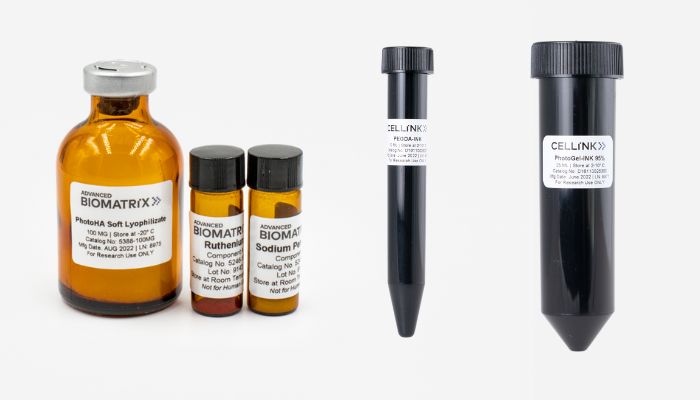
A few of Advanced BioMatrix’s bioinks, including PhotoHA®-Soft (left), PEGDA-INK (center) and PhotoGel®-INK (right). (Image credit: Advanced BioMatrix)
Allevi
Allevi, a part of 3D Systems since 2021, is working to make it easy to design and engineer 3D tissues. To accomplish this, the manufacturer creates both bioprinters and bioinks that are used by researchers worldwide. Currently, they offer a wide range of bioinks, bioink additives, cells, reagents and consumables including for the liver, heart, bone, cartilage, kidney, nervous system, skin, vascularization, lung and brain. Allevi also asserts that all its bioinks have been thoroughly tested by academia and the tissue engineering industry for the best biological results. Common materials incorporated include collagen and hyaluronic acid.
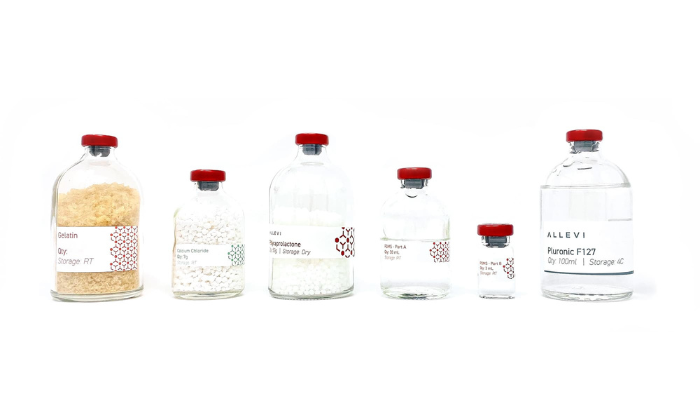
Some of the materials available from Allevi (Photo credits: Allevi)
BIO INX
One of our most innovative 3D startups in 2023, BIO INX is a spin-off of Ghent University and Vrije Universiteit Brussel which focuses on the commercialization of materials and bioinks for 3D bioprinting. The company offers a number of ready-to-use bioinks including offerings for deposition-based 3D printing, multiphoton lithography, digital light processing/stereolithography and volumetric printing. You can even choose a bioink based on application, whether bone, cardiac, cartilage, ocular or organ-on-chip and biological function including no cell interactivity, cell encapsulation and cell seeding.
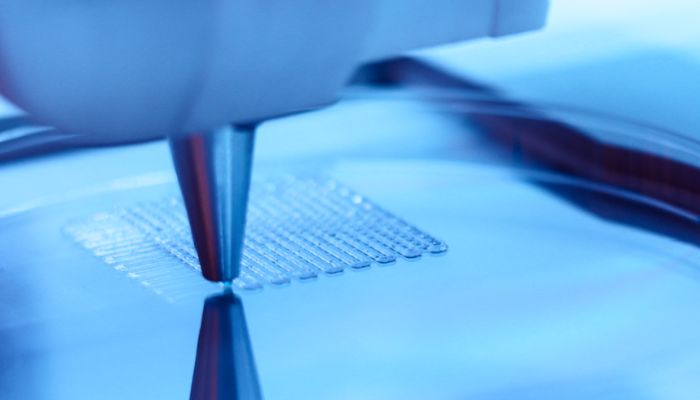
Photo credit: BIO INX
Cellbricks Therapeutics: Innovation with Implantable Tissue Therapies
Cellbricks Therapeutics develops implantable tissue therapies to improve the length and quality of patients’ lives. Drawing on its exclusive biomanufacturing platform and 10 years of expertise in tissue engineering, the company creates solutions that are biologically functional, immunocompatible and suitable for surgical implantation. These therapies represent a breakthrough in regenerative medicine by making cellular treatments implantable, guaranteeing stable grafts and effective treatment. Cellbricks combines therapeutic cells and customized biomaterials through light-based bioprinting to design these solutions.
More from the desk
Six other notes from the rest of the bench.
 Guides#3DStartup: Spectroplast and Silicone 3D PrintingSpectroplast provides a SLA silicone additive manufacturing service in order to produce functional parts for mass markets. The startup spun out of ETH Zurich after a few years of research and development in silicone resins. The company was created by…
 News3D Printed Microrobots that Swim and Move like Living OrganismsA robot that behaves like a living being but has no sensors. That moves without software. That makes decisions without a “brain.” This is the latest breakthrough by Professor Daniela Kraft at Leiden University (Netherlands). Recently published under the title…
 PrintersDisco Ultimate; the new generation of 3D printers from DagomaFrench manufacturer Dagoma revealed its new generation of FDM 3D printers, the Disco Ultimate. 4 years after the creation of the Discovery200 which later evolved into DiscoEasy200, the company presents a new kit that should attract the attention of more than one. The…
 SoftwareFree3D, a Platform for Free 3D FilesThe 3D printing process begins with STL files. As such, this is where users must initially focus their attention. Currently, these present a few limitations that prevent designers from transferring their ideas to the digital realm. Many people choose to…
 NewsTop 5 Videos: Stratasys Moves to More Mindful ManufacturingOnce again, we want to share with you the top 5 3D printing videos of the week. First up, Stratasys talks about the need to transition to more “Mindful Manufacturing,” especially the role of 3D printing in making supply chains…
 NewsAMBOTS is our 3D startup of 2019!The first few days of the year are an opportunity for us to look back on the highlights of the past year, including major innovations in the additive manufacturing sector, driven by international startups. We launched a competition to reward…