Guides
Akira Science on 3D Printing Biomaterials for Tissue Regeneration
As 3D printing continues to revolutionize the healthcare field, more and more companies are exploring its applications in the development of innovative medical solutions. This technology, which excels in customization and precision, is transforming the way devices and materials a
- 3 min read
- Guides
- Six more stories
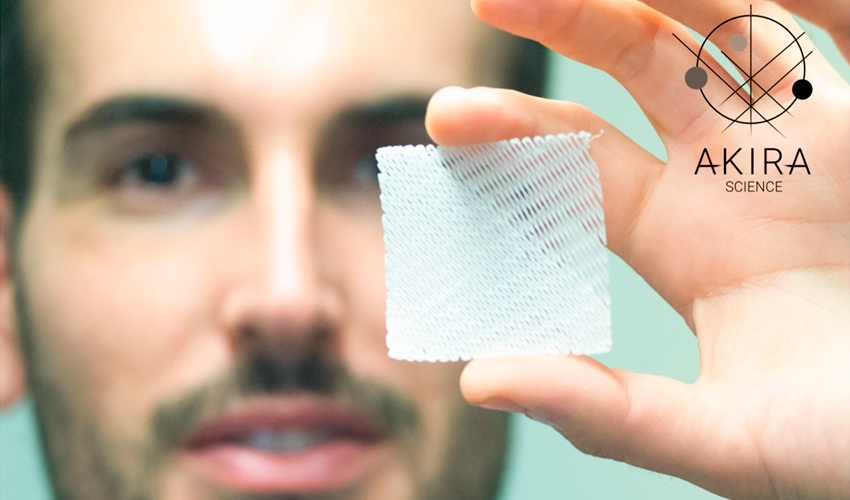
As 3D printing continues to revolutionize the healthcare field, more and more companies are exploring its applications in the development of innovative medical solutions. This technology, which excels in customization and precision, is transforming the way devices and materials are designed and produced for the healthcare sector. In the case of tissue engineering and regenerative medicine, 3D printing also offers enormous potential. This is the case of Akira Science, a Swedish company that is already taking advantage of this technology in its activity. Specifically, they have developed 3D printed bioabsorbable polymeric structures to facilitate tissue regeneration in various medical applications. We spoke with the Akira Science team to learn more about this solution and their use of additive manufacturing in medicine.
3DN: Could you introduce yourself and your connection with 3D printing?
My name is Álvaro Morales and I am the CEO of Akira Sciences. My fascination for 3D printing started in 2016, during the Materials Science module during my Chemical Engineering degree, taught by Professor Guillermo Vilariño at UPV. Professor Vilariño’s passion and inspiring methodology in tissue engineering ignited my interest in this technology, which led me to focus my career towards 3D printing and the development of advanced polymeric materials for biomedical applications.
That motivation later led me to pursue my master’s degree at the KTH Royal Institute of Technology in Sweden, I delved into the use of biodegradable polymers through the PrintKnit project, focused on the creation of 3D scaffolds for soft tissue regeneration. This experience not only solidified my vision on the integration of 3D printing into real clinical solutions, but also marked the birth of Akira Science.
More from the desk
Six other notes from the rest of the bench.
 ApplicationsSee-Shell: 3D printed transparent skull to ‘see’ how the brain worksAt the University of Minnesota, researchers have developed a unique 3D printed transparent skull implant for mice. The skull named the See-Shell can be used to view real-time activity on the brain surface and could provide new insights for human…
 NewsWEBINAR: How to Optimize your Designs for SLS 3D printingThough there are a number of materials that can be used for 3D printing, it is undeniable that the most popular materials are polymers. Plastics, especially high-performance thermoplastics, are used in a variety of industries for functions as wide-ranging as…
 Printers3DGence Premieres Series of Metal FFF 3D PrintersDespite the continued dominance of polymers in additive manufacturing, metal 3D printing has also increased significantly in recent years with a faster growth rate than many other AM product segments. This is especially the case when it comes to desktop…
 ApplicationsAM Helped General Motors Avoid Supply Chain Problems With the Chevrolet Tahoe 2022These days, many industries are being affected by supply chain problems. One sector that is particularly troubled by this is the automotive industry. All over the world, delays of important parts lasting weeks are definitely making the life of car…
 ApplicationsCould 3D Printing Be Used to Treat Brain Aneurysms?When it comes to medical issues, very little can be as scary as those affecting the brain. This is especially the case for brain aneurysms. Defined by the Mayo Clinic as a bulge or ballooning in a blood vessel in…
 GuidesRecozy on Designing 3D Printed Objects for Interior DesignAdditive manufacturing is becoming more and more prevalent in many different sectors, whether in aerospace, medicine or the food industry. This is mainly due to the benefits it offers in all of them. What makes it special is, above all,…