Materials
AI Is Optimizing LPBF for Titanium Alloys
Manufacturing parts using titanium alloys is complex and expensive, requires a lot of patience and users make only slow progress. Even modern technologies such as metal 3D printing can only help to a limited extent. Currently, trial and error is…
- 3 min read
- Materials
- Six more stories

Manufacturing parts using titanium alloys is complex and expensive, requires a lot of patience and users make only slow progress. Even modern technologies such as metal 3D printing can only help to a limited extent. Currently, trial and error is the main approach utilized in order to gradually identify the optimum manufacturing conditions. However, titanium parts are of great value in the aerospace, defense and maritime sectors. It is therefore important to speed up the production of these parts in order to meet demand more quickly and reduce costs. That is why researchers at the Johns Hopkins Applied Physics Laboratory (APL) and the Whiting School of Engineering have been searching for a solution. As such, they have developed a new technology that enables fast, stable and precise processing of titanium parts for additive manufacturing using AI.
In recent APL research, AI has been used in many different ways in various fields and examined for its potential, but also to a certain extent for its risks and side effects. The study “Machine learning enabled discovery of new L-PBF processing domains for Ti-6Al-4V,” which was published in Additive Manufacturing in December 2024, covers the opportunities for AI in process control and optimization. As the title of the study suggests, the research team focused on the titanium alloy Ti-6AI-4V, which is valued in numerous industries for its high strength and low weight. The aim of the research was to create optimal conditions for faster processing of the alloy and thus obtain precise, strong end parts.
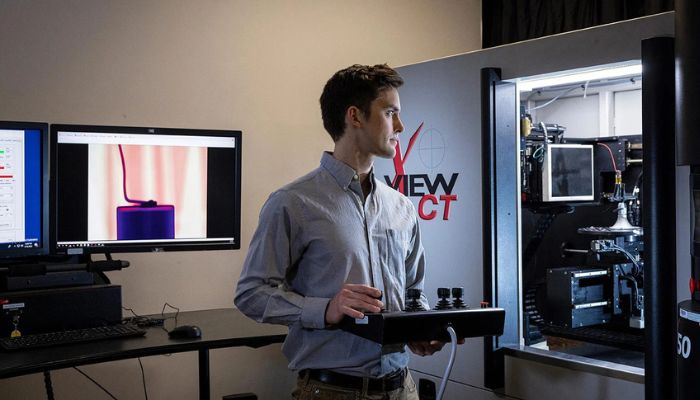
Brendan Croom, a senior materials scientist at Johns Hopkins APL, in the lab (photo credits: Johns Hopkins APL/Ed Whitman)
AI Goes Beyond the Processing Limits of Titanium Alloys
As with all materials, processing conditions have an influence on the material properties. Laser power, scanning speed, etc. can determine how the material hardens and whether it is ultimately solid, flexible or brittle. The correct configuration of the process parameters is therefore largely responsible for the quality of the end parts. This is only possible as well through constant trial and error and adjustment.
More from the desk
Six other notes from the rest of the bench.
 News3D Printing Could Help Fight Coastal ErosionCoastal erosion is defined as the loss or displacement of land along the coastline. The main causes of this natural phenomenon are the depletion of soil organic matter (sand, rock) as well as the degradation of soil structure or problems…
 MaterialsFormlabs Announces Color Printing for their SLA 3D Printers3D printer manufacturer Formlabs will launch a new range of resins for their SLA machines including color. The Color Kit is available for their Form 2 3D printer, and will print color parts. This is important as it eliminates the…
 SoftwareOctoPrint, the application to control your 3D printerOctoPrint is a controller application for 3D printers: open-source and free, it allows you to manage all your prints remotely and to control your machines with peace of mind. It works directly on your web interface, you just need to…
 ApplicationsWhich Automotive Manufacturers Are Using 3D Printing in the United States?3D printing has become an increasingly essential technology in the automotive industry, transforming how vehicles are designed, prototyped, and even produced. From lightweight components to complex, custom geometries, additive manufacturing enables carmakers to innovate faster an
 NewsSolidworks World 2018 Recap: Industrial RenaissanceHaving spent 4 days in Los Angeles, Solidworks World 2018 ended on Wednesday. The event brought many users of Dassault Systèmes’ software, Solidworks, together. These range from companies in the virtual reality, CAD, augmented reality and 3D printing industries, eager&helli
 NewsTop 5 Videos: World Music Day editionThis week we found the top 5 videos about 3D printing and the way additive manufacturing is shaping our society. The technology has infiltrated many sectors, from medical to automotive; but since today is World Music Day, we decided to select videos that are related…