Materials
Advanced b-FDM Breakthrough Enhances Material Blending in 3D Printing
Fused Deposition Modeling (FDM) offers many advantages, particularly its accessibility and office-friendliness, making the technology appealing. However, the extrusion nozzle can only print and process one type of filament at a time, limiting precise, spatial control of material
- 3 min read
- Materials
- Six more stories
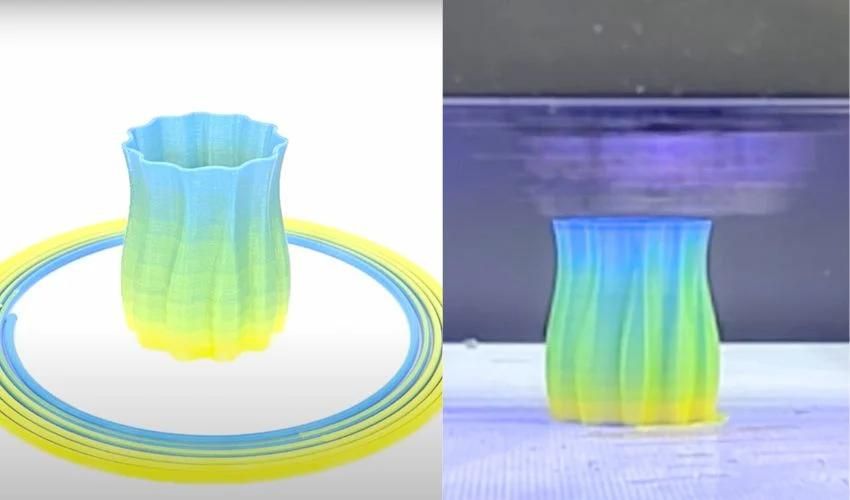
Fused Deposition Modeling (FDM) offers many advantages, particularly its accessibility and office-friendliness, making the technology appealing. However, the extrusion nozzle can only print and process one type of filament at a time, limiting precise, spatial control of material blending. To address this limitation, researchers Sang-Joon Ahn, Howon Lee, and Kyu-Jin Cho from Seoul National University have developed a unique two-step process for FDM 3D printing, allowing different properties to be combined in a single base material. Using this Blended-FDM (b-FDM) method, they successfully printed a single FDM filament with 36 different colors by utilizing four primary color filaments.
The b-FDM process consists of two steps. First, the team printed digital material (DM) by layering different base materials and manually switching between them. The resulting filament is then used as the base material for the final object in the second step. As the filament is extruded through the nozzle, the materials are mixed, creating the desired properties in the final product. This technology enables the printing of diverse material properties by combining several base materials into a single DM filament, ensuring precise control over the material composition.
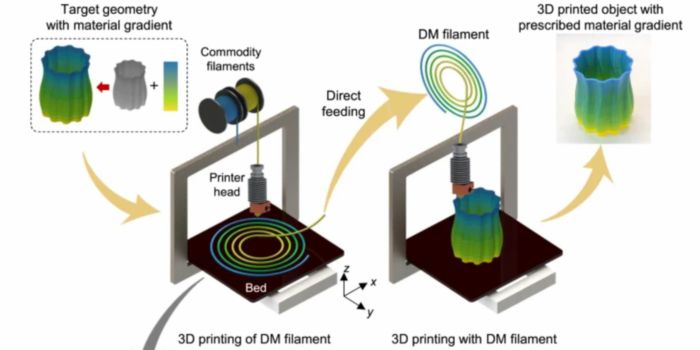
The b-FDM printing process.
The filament was printed with a layer thickness of 125 μm and consists of 14 layers of extruded material. Each layer includes two to four 3D printing lines, each 440 μm wide. During the printing process, the raw material was changed manually, allowing different properties such as color, strength, conductivity, and stretchability to be combined. The filaments were printed into several test parts using the original Prusa i3 MK3S from Prusa Research, with good adhesion achieved by heating the 3D printing bed to 70°C. The researchers combined conductive, brittle PLA (CPLA) with soft, flexible polyurethane (TPU), resulting in conductive parts with potential applications in wearable electronics and sensors. The filament is also designed to have a standard diameter of 1.75 mm, making it compatible with any FDM printer.
More from the desk
Six other notes from the rest of the bench.
 NewsWEBINAR: Metal Additive Manufacturing for Research: Exploring ValCUN’s Molten Metal Deposition TechnologyMetal additive manufacturing is advancing fast, but for researchers, the most important questions are still open. How do printing parameters influence microstructure and final mechanical performance? What does process control actually look like in a metal extrusion system? And ho
 NewsSteakholder Foods Expands Menu With 3D Printed ShrimpSince we learned about the ability to buy 3D printed bacon in supermarkets last year, it has been clear that food 3D printing is ready to soar. What was once deemed unreliable for consumer applications has now become possible on…
 Applications#3DExpress: The First Metal 3D Printer Is Going to Outer SpaceOnce again, it is time to take a look back at some of the news that has marked the additive manufacturing sector this week. And we’re starting with a piece of news that truly does show that not even the…
 NewsCan bio-printing tumour cells, become a treatment against cancer?A student from the University of Waikato in New Zealand, Shalini Guleria, is now seeking to identify the best treatment for all breast cancer patients. She turned to bio-printing to 3D print tumour cells. It would be possible to collect cells in a…
 MaterialsScientists manage to 3D print transparent glass for the first timeResearchers at the Lawrence Livermore National Laboratory have successfully 3D-printed transparent glass. What’s more, this test was successfully conducted at room temperature. Reports from the test claim glass structures with composition gradients can also be produced with
 NewsSmart Design & Gantri Join Forces to 3D-Print Lighting Designed for the Home OfficeSince the start of the pandemic, the daily life of the majority of professionals has been turned upside down. Many people now work from home to avoid contracting or transmitting viral illnesses. With so many people across the globe being…