News
Steakholder Foods Expands Menu With 3D Printed Shrimp
Since we learned about the ability to buy 3D printed bacon in supermarkets last year, it has been clear that food 3D printing is ready to soar. What was once deemed unreliable for consumer applications has now become possible on…
- 3 min read
- News
- Six more stories

Since we learned about the ability to buy 3D printed bacon in supermarkets last year, it has been clear that food 3D printing is ready to soar. What was once deemed unreliable for consumer applications has now become possible on an industrial scale. Driven by an escalating desire for plant-based alternatives to traditional meat or fish, propelled by health, ethical, and environmental considerations, 3D printing is increasingly standing out as an optimal solution to meet growing demand in a thriving market.
This has been shown most recently with Steakholder Foods, renowned for its proficiency in cultured meat and 3D printing technology. The company has recently extended its expertise, successfully developing the world’s very first plant-based 3D printed shrimp. Just days after achieving eel reproduction, the company has successfully tackled the task of replicating the distinctive flavor and texture of shrimp, a favorite food for many different cultures.
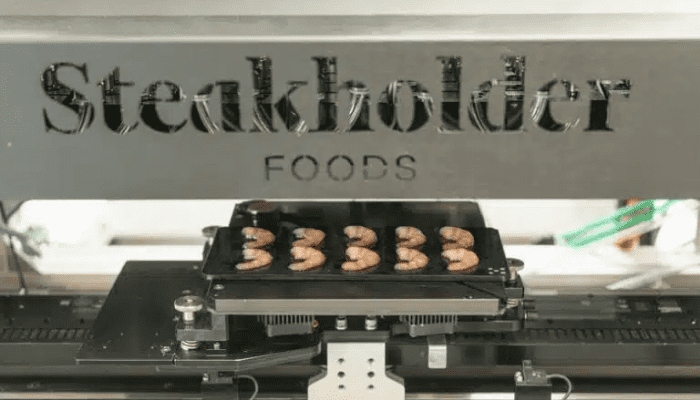
Steakholder Foods’ presents its plant-based, 3D-printed shrimps
The company strategically ventured into this sector due to its high profitability – an estimated market value of $60 billion. With a demand of approximately 7.6 million tons of shrimp harvested annually, the sector demonstrates consistently high demand. Given the premium pricing of shrimps, which typically ranges from $20 to $40 per kilo, Steakeholder Foods perceives this as a lucrative opportunity to introduce a more cost-effective and competitive alternative to the market.
More from the desk
Six other notes from the rest of the bench.
 NewsStratasys Pushes into ‘Additive Manufacturing 2.0 Era’ with Launch of Machines For Every Market NeedStratasys, one of the largest and most-established 3D printing companies in the world and a leader in polymer 3D printing solutions announced today the launch of three new 3D printers that together will address a large portion of the multibillion-dollar…
 ApplicationsŠkoda Publishes 3D Files to Personalize Your CarIf you drive a Škoda, you’re in luck! The Czech automotive manuufacturer recently shared a collection of 3D files for personalizing its vehicle interiors. The models include things like a USB cable holder and a coin organizer, and are designed…
 ApplicationsWith the RDRE, NASA Has Demonstrated That Engines Made With AM Are Suitable for Deep Space MissionsWe are still barely into 2023, but already the year has shown to be a promising one for additive manufacturing in space. Earlier this week we told you about the ESA which has included 3D printed parts on a rover touching…
 NewsTop 5 Videos: 3D Printed Fashion Designs & More!This week’s Top 5 Videos include videos ranging from 3D printed fashion designs to 3D printing in education, and more. This shows how versatile 3D printing is and how many industries it can benefit. Remember, a new Top 5 Videos…
 NewsAurora Labs uses its Rapid Manufacturing Technology to print metal 55 times fasterThe Australian metal 3D printer manufacturer Aurora Labs has recently revealed successful test results of its metal additive manufacturing process Rapid Manufacturing Technology (RMT). This came after the company closed a $5 million round of investment (before costs) from institu
 NewsGE Additive Education Program open to primary and secondary schools to inspire & educate students about 3D printingGE Additive, one of the primary business divisions of the American multinational company General Electric (GE), announced it has opened its GE Additive Education Program for the 2019/2020 year cycle. The program will be open for entries from primary and…