News
What Can We Expect From the Additive Manufacturing Market Over the Next 5 Years?
Research and Markets began 2023 with the release of a study on the global additive manufacturing market. The firm estimates the industry will be worth $44.03 billion by 2027, up from $16.83 billion this year, representing an annual growth rate…
- 3 min read
- News
- Six more stories
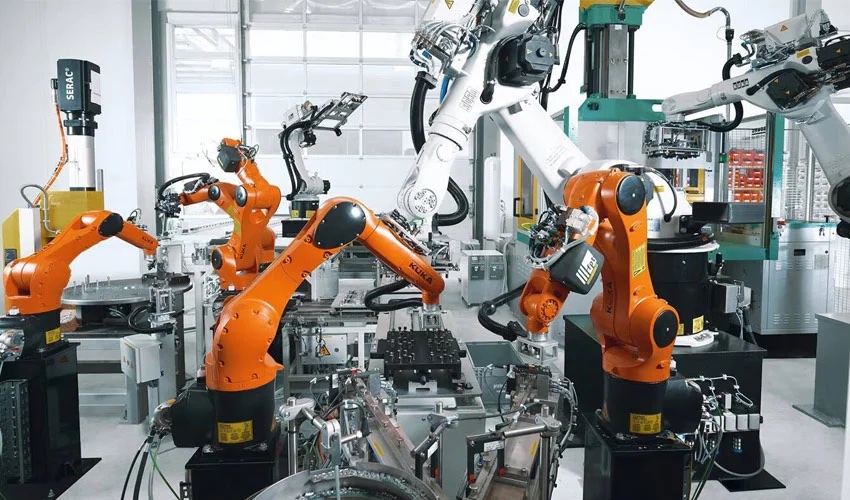
Research and Markets began 2023 with the release of a study on the global additive manufacturing market. The firm estimates the industry will be worth $44.03 billion by 2027, up from $16.83 billion this year, representing an annual growth rate of 21% between 2021 and 2027. There’s no denying that the industry is growing and can achieve even higher results, especially if you look at the general manufacturing market as such – 3D printing really has a role to play. The report focuses on the drivers of growth, highlighting the increasingly important role of governments and public authorities. Notably looking at how they can drive technology adoption through dedicated subsidies and actions. It also highlights the trend towards miniaturization, discussing micro-printing.
The growth of the additive manufacturing market has been evident for some time, and we are convinced that the coming years will bring many surprises. However, it is not always clear what is driving the industry: machines, materials, applications, software? Which vertical is the most promising? The Research and Markets report gives some clues, analyzing the most sought-after type of 3D printers, the most popular materials, the applications, the components and finally the regions. In Europe, for example, Italy is expected to be the main growth driver over the next five years.
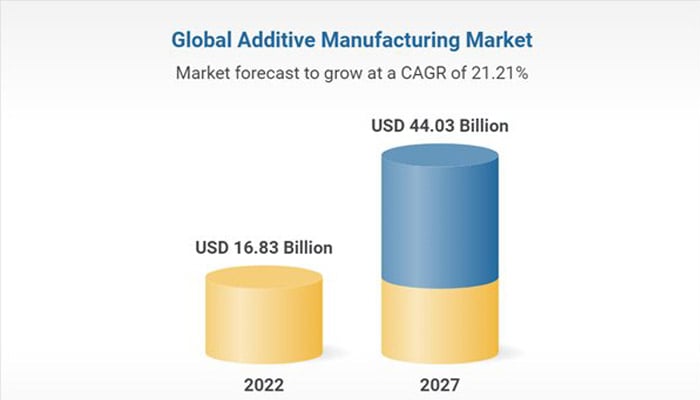
The growth of the additive manufacturing market (photo credits: Research and Markets)
Growth Drivers of the Additive Manufacturing Market
According to the Research and Markets study, the additive manufacturing market can be expected to reach more than $44 billion by 2027. This growth could be driven by an increase in the need for personalized medicine, where 3D technologies can be used to design custom tools and devices for patients; a strong resurgence of activity in the aerospace industry, compared to the disruptions caused by COVID-19; and last but not least, a strong (and increasing!) demand for lighter parts from the automotive sector. Here, the use of composite 3D printing could be particularly interesting. These three verticals are certainly not the only ones generating revenue for the market, but they remain the most important ones-to watch closely, consumer goods and electronics.
More from the desk
Six other notes from the rest of the bench.
 Materials3D Systems Plans to Develop Corrosion-Resistant Alloys for Shipbuilding and Maritime Applications3D Systems, in collaboration with Huntington Ingalls Industries’ Newport News Shipbuilding division, announced plans to develop Copper-Nickel (CuNi) and Nickel-Copper (NiCu) alloys for use in powder bed fusion additive manufacturing. Both CuNi and NiCu are corrosion-resistant, ma
 News3D printing and chocolates from Universal FavoriteThe Australian agency Universal Favorite created colourful chocolates through 3D printed molds. As they experimented with interlocking shape designs they ended up on a clean cut version. These chocolates have the shape of a modular staircase and can easily fit…
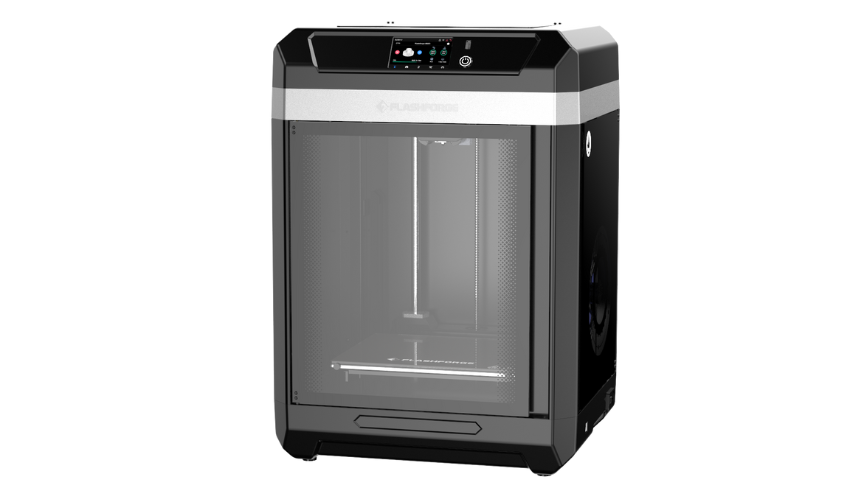 PrintersGuider 3, the New Professional 3D Printer from FlashforgeChinese manufacturer Flashforge has announced the launch of a new professional FDM 3D printer, the Guider 3. Designed for the production needs of small and medium-sized businesses, the machine is fast, with a compact and lightweight design to ensure flexible…
 NewsWEBINAR: Hybrid Manufacturing – Transforming the Future of Machine ShopsThe market for the various manufacturing methods is large and constantly changing. What is clear, however, is that additive manufacturing is becoming increasingly popular due to the numerous advantages it offers. The technology can also complement traditional manufacturing method
 ApplicationsAML3D ships 3D printed marine propellerThe Australian company, AML3D, has shipped a Stainless Steel grade 316L propeller to 3D Printing Corporation (3DPC), a Japanese based 3D printing consultancy firm. Compared to traditional manufacturing technologies, the promise of additive manufacturing is to deliver components a
 NewsWhat is Two-Photon Polymerization?Nano- and microscale 3D printing offers design freedom and efficiency, paving the way for numerous pioneering innovations, particularly in the fields of micro-optics and micromechanics. In turn, these achievements drive new developments, promoting technological progress. As a res