Applications
Adaptive 3D Printed Nitinol Antenna Opens Up Possibilities for Military and Space Research
Antennas are essential for wireless communications, navigation, radar, radio communication and science. Their main function is to receive or transmit electromagnetic waves. Until now, antennas were rigid and inflexible, something that is about to change thanks to a project by&hel
- 3 min read
- Applications
- Six more stories

Antennas are essential for wireless communications, navigation, radar, radio communication and science. Their main function is to receive or transmit electromagnetic waves. Until now, antennas were rigid and inflexible, something that is about to change thanks to a project by researchers at the Johns Hopkins Applied Physics Laboratory (APL) in Baltimore. The project began in 2019 and the goal was to develop 3D technologies and shape-memory alloys for antennas that can deform independently based on temperature. These 3D printed antennas could contribute to the future of military and space research.
The innovative 3D printed antenna is designed to dynamically adapt to a wider range of radio frequencies and replace traditional antennas thanks to its greater flexibility. The idea for the project came from Jennifer Hollenbeck, who was inspired by the science fiction series The Expanse. In this series, aliens use organic technology to change shape. She explains, “I have spent my career working with antennas and wrestling with the constraints imposed by their fixed shape. I knew APL had the expertise to create something different.”
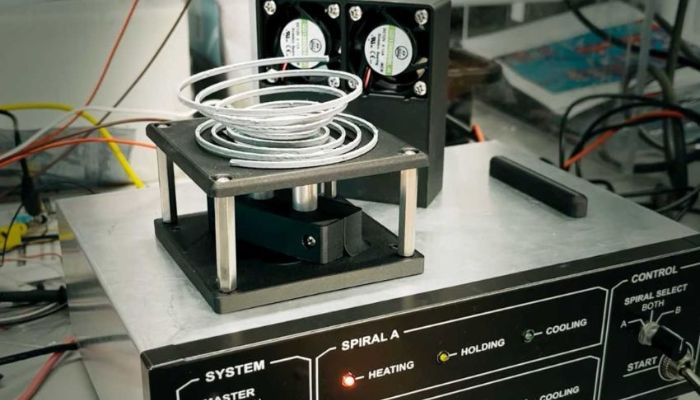
Photo Credits: Johns Hopkins Applied Physics Laboratory
The antenna was 3D printed from a nickel-titanium alloy, also known as Nitinol, one of the most popular shape memory alloys. This means that the alloy can recover its original shape after deformation when heated to a certain temperature, which is ideal for applications where materials must adapt to changing conditions. However, 3D printing posed some difficulties, such as printing the alloy in complex structures, as it deformed during fabrication and reacted to heat. Hollenbeck stressed, “It turned out to be a really complicated design, and it didn’t work as well as I would have liked.”
More from the desk
Six other notes from the rest of the bench.
 MaterialsZ-PEEK from Zortrax Confirmed Suitable for SpaceflightWhen it comes to exploring the unknown, what better than innovative, flexible technologies which can adapt to any need? For that reason, one of the largest adopters of additive manufacturing in the past few years have been organizations working on…
 NewsHive, a 3D Printed Clay WallAdditive manufacturing has made its debut in the construction industry a while ago. Today, it is possible to build all types of structures with the help of 3D printing technologies. Ever since then, it seems that one innovation follows the…
 News3D Printed Holiday Park to Be Built In AustraliaPlans are underway for the creation of a 3D printed holiday park in Dubbo, Australia. This will create a block of 3D-printed houses, public toilets, and a holiday camp featuring 50-100 cabins, using five large-scale printers. The holiday park will…
 PrintersGantri integrates its new 3D printer in its 3D printing factoryGreat design ideas are more than abundant, however most of the time cost is a huge barrier to creativity and manufacturing. The company Gantri has decided to offer an alternative solution to the current industrial manufacturing model, which they argue…
 GuidesBoston Micro Fabrication Talks Micro-Scale Printing Using StereolithographyAdditive manufacturing continues to evolve, though rather than getting bigger, this time it’s getting smaller, microscopic even. Boston Micro Fabrication (BMF), based as the name suggests in Massachusetts in the United States, is known for their high precision micro 3D&hell
 ApplicationsResearchers 3D Print Hydrogels to Protect Astronauts from RadiationSpace is an extreme environment where dangers abound, and radiation is one of them. During space missions, astronauts and their equipment are exposed to much higher radiation than on Earth. Without appropriate protection, the equipment could malfunction. As for astronauts,&hellip