Applications
4D Printing Replaces the Traditional Cast in Orthopedic Care
The Singaporean startup Castomize has developed a 4D-printed cast that addresses the drawbacks of conventional casts: itching, sweating, irritation, and the inability to get wet. Their solution leverages the properties of smart thermoplastics, allowing the cast to be molded preci
- 3 min read
- Applications
- Six more stories
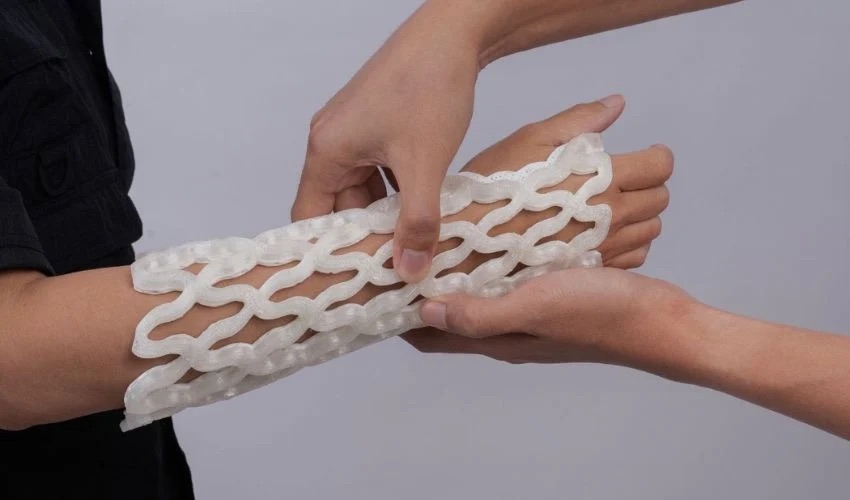
The Singaporean startup Castomize has developed a 4D-printed cast that addresses the drawbacks of conventional casts: itching, sweating, irritation, and the inability to get wet. Their solution leverages the properties of smart thermoplastics, allowing the cast to be molded precisely to each patient’s anatomy at the time of application, with no prior scanning required and no saw needed for removal.
The device originated from research at the Singapore University of Technology and Design and became a commercial product in 2022. It is aimed at clinics and healthcare professionals seeking a lighter, breathable, and waterproof alternative to fiberglass casts.
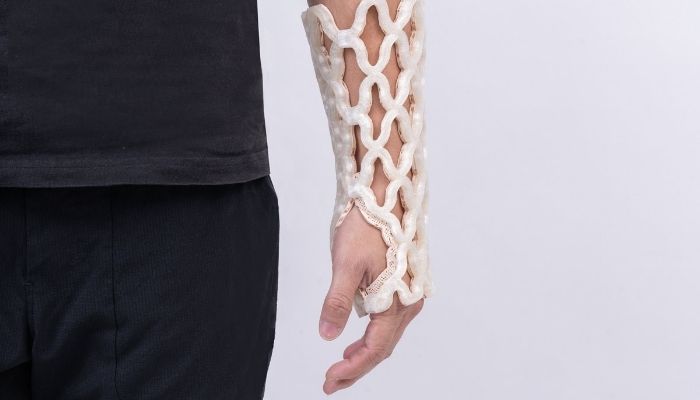
4D cast applied to the forearm. The open lattice structure allows for air circulation and makes the piece completely waterproof.
The concept of 4D printing is not new, but its translation into a viable commercial product remains rare. In short, it involves manufacturing structures that change when exposed to an external stimulus, in this case heat. The object is not customized during printing, but afterward: the cast comes out of the printer with a fixed geometry, softens when heated, and hardens when cooled. The clinician heats it, molds it over the patient’s wrist, forearm, or ankle, and waits for it to cool.
More from the desk
Six other notes from the rest of the bench.
 ApplicationsThe marketing of the first 3D printed eye has begunThe Severance Hospital belonging to the Yonsei University (YUHS), in South Korea, has announced that after more than three years of research they are preparing to market the first 3D printed eye, an eye prosthesis that will help hundreds and thousands…
 SoftwareSmartBuild Brings Stereolithography to an Industrial ScaleWhile stereolithography is a well-established additive manufacturing technology used by many, it comes with its share of challenges, particularly when it comes to scaling up. Manufacturers are often forced to make a difficult trade-off between speed and quality, while also&hellip
 ApplicationsThe Royal Dutch Navy Uses Nanoe’s 3D Printing SolutionsThere are already a number of examples where naval stations at sea have integrated additive manufacturing. The U.S. Navy, for example, is using 3D printing technology from manufacturer ICON in order to be able to react quickly in the event…
 NewsCECIMO study Shows Positive Results for the European Additive Manufacturing MarketCECIMO, the European Association of the Machine Tool Industries and related Manufacturing Technologies, has published the third edition of its European study dedicated to additive manufacturing. Conducted over a 6-month period, it focuses on four specific points to identify certa
 News3D Printing Accelerates Social Housing Construction in Ireland by 35%Some of construction 3D printing’s greatest benefits include that the technology can often build structures faster and cheaper than traditional building methods. That said, it is logical to adopt the technology for social housing. In Grange Close, Ireland, the company&helli
 NewsTOP 5 videos of the week: Easter Bunnies, Shape Changers and Sneakers!A new selection of the best 3D printing videos of the week, just for you! Find our TOP 5 videos of the week below and tell us what your favorite video is in a comment or on our Facebook and Twitter page.…