Guides
#3DStartup: Manufacturing Technology Project Turns Metal 3D Printing into a Predictive Process
Manufacturing Technology Project (MTP) is an American start-up dedicated to developing engineering tools. These tools combine artificial intelligence, multiphysics simulation, and digital twins to optimize manufacturing processes and predictive modeling, with the ultimate goal of
- 3 min read
- Guides
- Six more stories
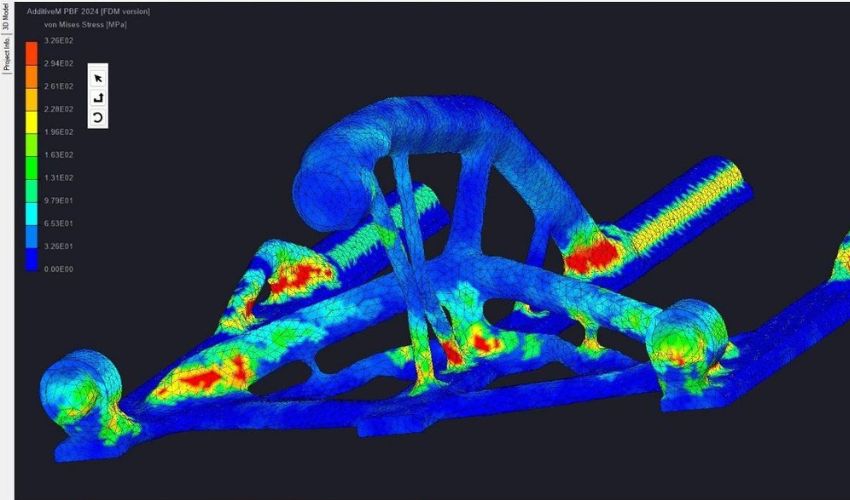
Manufacturing Technology Project (MTP) is an American start-up dedicated to developing engineering tools. These tools combine artificial intelligence, multiphysics simulation, and digital twins to optimize manufacturing processes and predictive modeling, with the ultimate goal of offering autonomous production control. Its first flagship product is called AdditiveM and, as its name suggests, is dedicated to metal additive manufacturing. One of the primary features of the simulation platform is that it improves the performance of 3D printing processes. We met with Hamed Hosseinzadeh, President & Tech Strategist, to learn more about the projects of this ambitious company!
3DN: Can you introduce yourself? How did you discover 3D printing?
I am a computational mechanical and materials engineer, and the President and Tech Strategist of Manufacturing Technology Project (MTP). My background is in physics-based modeling, multiphysics simulation, and AI-assisted engineering, with a strong focus on advanced manufacturing and materials processing.

Hamed Hosseinzadeh
I discovered metal additive manufacturing during my academic research while working on coupled thermal–mechanical–microstructural simulations. What immediately fascinated me was that additive manufacturing is not just a fabrication method, but a fully coupled physical system in which heat transfer, fluid flow, phase transformation, residual stress, microstructure evolution, and structural performance are all tightly interconnected. At the same time, I observed that much of the industry still relied heavily on trial-and-error and empirical tuning, which is costly, time-consuming, and risky for qualification-critical applications.
More from the desk
Six other notes from the rest of the bench.
 NewsAM Service Providers in the Spotlight at RAPID + TCT 2025What do you do if you want to enter into additive manufacturing without prior experience or an industrial 3D printer? Or experiment to see if 3D printing is the best fit for an application? Why, you go to an AM…
 NewsWhich Companies Manufacture Resin 3D Printers in the United States?Commercial resin 3D printing was born in the United States, with Chuck Hull’s 1984 patent of stereolithography laying the foundation for an industry that continues to grow today. Since then, American companies have played a central role in advancing resin…
 PrintersDynamical Tools to conquer the industrial additive manufacturing marketDynamical Tools is a company in Zaragoza that have grown well over recent years in the Spanish additive manufacturing market and continues to expand internationally. Since the presentation of its first 3D printer in 2016, the DT 600, the manufacturer has…
 ApplicationsAML3D Expands its Presence in 3D Printing in Aeronautics Through Boeing PartnershipAustralian metal 3D printing specialist AML3D has announced a renewed partnership with aircraft manufacturer Boeing. Earlier this year, Boeing commissioned AML3D to 3D print prototype aluminum aircraft parts. The parts must match AS9100D quality assurance requirements for “
 NewsDam Project in China to Be Worlds Largest Robotic 3D PrintChina is already widely known for its focus on innovation and new technologies. Recently, the East Asian country announced, that it will be relying on additive manufacturing in addition to artificial intelligence to build a dam on the Tibetan Plateau.…
 NewsFormnext 2019: 3DGence Presents the INDUSTRY F420At Formnext 2019, European 3D printer manufacturer 3DGence presented the 3DGence INDUSTRY F420. Even though the F421 is already on the market by now, the device still impresses with interesting features. Namely, the machine is compatible with a range of…