News
Project uses 3D printing to supersize and study pollen
In fields as far-ranging as medical and aerospace engineering, 3D printing has applications that can help students and professionals understand complicated concepts. For example, in the medical sector, exact anatomical models of patients’ organs are 3D printed to plan and&h
- 3 min read
- News
- Six more stories
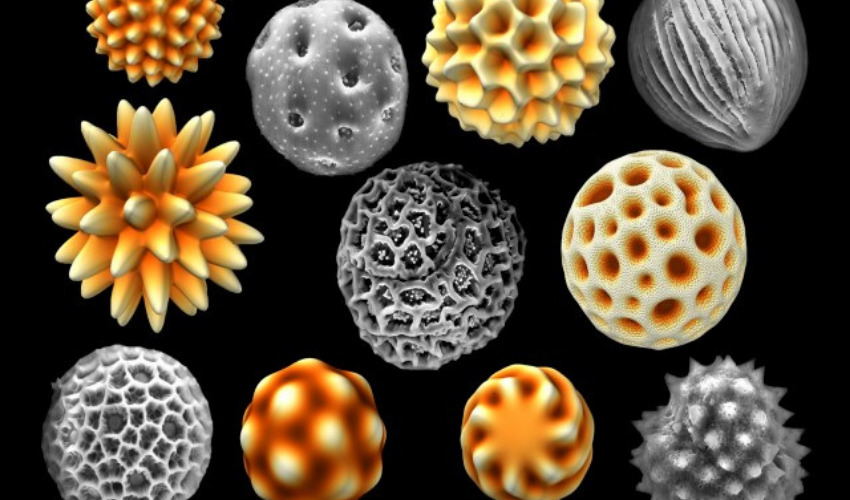
In fields as far-ranging as medical and aerospace engineering, 3D printing has applications that can help students and professionals understand complicated concepts. For example, in the medical sector, exact anatomical models of patients’ organs are 3D printed to plan and rehearse for surgery, providing better treatment pathways. It turns out, 3D printing can also help look at objects that might usually be too small for the naked eye and help researchers not only to present their designs but to also examine these microscopic objects. Such was the idea behind the 3D Pollen Project, which is using 3D printing to help students and researchers to better see pollen grains. Though many of us think of pollen as the invisible enemy, these microscopic grains could provide a holy grail of information for researchers and students alike.
The brainchild of Oliver Wilson, a PhD student at the University of Reading, the 3D Pollen Project was launched as a way to process and scan accurate, printable models of pollen grains to put in an online database. To accomplish this, Wilson’s team uses laser scanning confocal microscopy, a process which is used to obtain high resolution optical images and which is compatible with 3D printing. These scans are then put online, for free, thanks to funding from I’m A Scientist and the University of Reading. The aim is that “they will be of use and interest to scientists, communicators, teachers and the wider public, for outreach, education and research.” Additionally, though the team does not have the capabilities to print the pollen grains themselves, if provided with a sample of pollen, they can scan it and send them it directly to interested parties. As of now, 30 models of different pollen grains are already scanned and available online for download and Wilson plans to scan even more.

Different pollen grains in their microscopic form (photo credits: Dartmouth College Electron Microscope Facility)
According to the 3D Pollen website, the study of pollen has many different applications in a variety of scientific fields. Due to their durability and distinctive characteristics, they can be used to study effects of climate change, the quality of honey, forensic analysis and even medicine and vaccines. However, due to their size, pollen grains are not just difficult to study but also to showcase. The use of microscopes can be limiting due to the interpretation of the 3D pollen into a 2D image, not allowing for depth or a full view. With these downloadable scans, the pollen can be magnified when printed and then seen from all angles. 3D printing pollen grains will then allow for greater ease in teaching and presenting research.
More from the desk
Six other notes from the rest of the bench.
 NewsWohlers Report 2021: Weakened Growth for Additive ManufacturingAs is customary, Wohlers Associates has released its annual report on additive manufacturing trends, outlook and forecasts. The Wohlers Report 2021 this time highlights the impact of the health crisis on the 3D printing market: despite COVID-19, the industry grew…
 GuidesThe 10 Best STL Files of 2024Here’s the long-awaited moment: an article about the best STL files of 2024 that will make you look great at New Year’s Eve dinner. We have selected some of the most downloaded files in recent months, perfect for practical needs…
 NewsWhat to Expect at IMTS 2022This week, people from around the world are flocking to Chicago for the 33rd edition of the International Manufacturing Technology Show (IMTS), the largest and longest-running industry trade show in the Western Hemisphere. IMTS 2022 is already underway, taking place…
 NewsGrib3D, the Free 3D Modelling App based on Augmented Reality3D modelling is a key step in the manufacturing process of a product, especially when it comes to 3D printing. It involves specific knowledge and skills that are not always easily acquired. For this reason, several software companies have developed…
 NewsAconity3D presents its metal and modular 3D printersAconity3D is a machine manufacturer based in Aachen, the city is considered to be the birthplace of laser metal 3D printing. The company develops machines for series production that are distinguished by their modular design: they can be customized according…
 PrintersThe Top Crowdfunded 3D PrintersCrowdfunding platforms can be real gas pedals for many projects, and 3D printing is no exception. In fact, did you know that some of the most popular 3D printer brands were launched on Kickstarter? American manufacturer Formlabs, for example, launched…