Materials
3D Printing Glass at Room Temperature: Myth or Reality?
Glass is a material that we encounter every day, and it can be found in many forms. It also has interesting characteristics for numerous applications: transparency, chemical inertness, electrical insulation, heat resistance and recyclability. However, despite its advantages, it i
- 3 min read
- Materials
- Six more stories
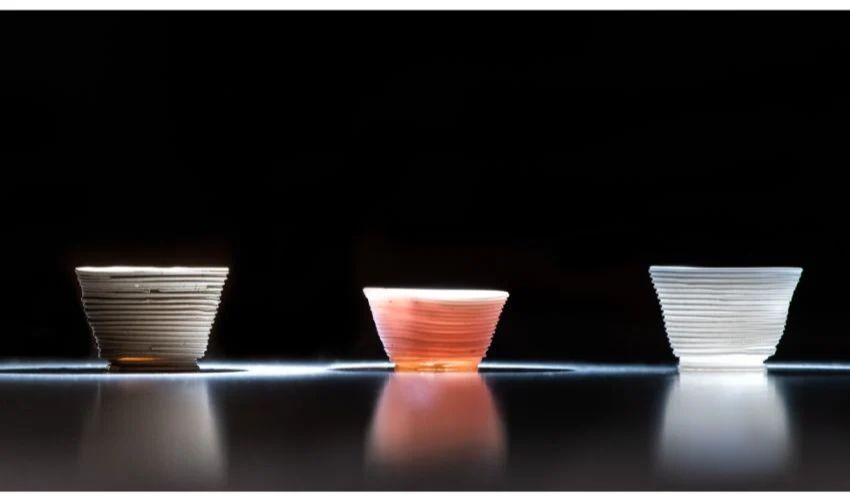
Glass is a material that we encounter every day, and it can be found in many forms. It also has interesting characteristics for numerous applications: transparency, chemical inertness, electrical insulation, heat resistance and recyclability. However, despite its advantages, it is still not often used for additive manufacturing, as it requires very high melting temperatures around 1,000°C, and a highly controlled thermal environment. Yet, a recent project at Lincoln Laboratory could change all that. A team has succeeded in 3D printing glass objects at low temperatures: their technique, direct ink printing, enables the process to be started at room temperature, followed by a heat treatment at just 250° C.
The direct ink printing technique uses a tailor-made ink composed of a silicate solution and nanoparticles of other inorganic substances. This is then extruded, layer by layer, through a 410-micron nozzle, ensuring very precise control of the printing process. The ink can be deposited on a plastic, metal, glass or silicone substrate, all at room temperature. The silicate particles react with each other and with the silica particles to form a three-dimensional part.
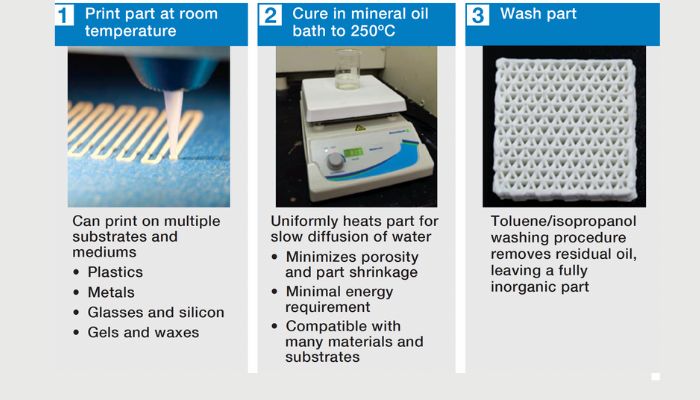
The 3D printing glass process in three steps
After this room-temperature printing stage, the team proceeds to a post-processing phase to guarantee the part’s structural stability. The part is placed in a mineral oil bath heated to 250°C. It is then completely hardened. Finally, it’s cleaned in an organic solvent (a mixture of toluene and isopropanol) to remove any residual mineral. According to the Lincoln Laboratory team, the tests carried out resulted in structures with very high resolution, less shrinkage and very good thermal stability.
More from the desk
Six other notes from the rest of the bench.
 NewsADDITIV Aerospace will Take Place Tomorrow!On March 18th at 8AM EDT (1PM CET), ADDITIV Aerospace will open its doors to Aerospace professionals to discuss the applications for additive manufacturing (AM) in the sector. This 100% virtual event will be an ideal opportunity to learn how…
 NewsWhat Is Laminated Object Manufacturing?There are a number of different technologies that can fit under the additive manufacturing umbrella. Though common ones like FDM and SLA are well-known in the industry, others may be more niche. Take for example, Laminated Object Manufacturing (LOM), a unique…
 NewsWhy The New York Embroidery Studio is Leveraging 3D PrintingA flash of sequins, elegant pleats, fastidious embroidery—this kind of detail, used deftly, will always make a difference in fashion. Why? Because thoughtful design should always elevate a piece. The New York Embroidery Studio (NYES) has been elevating clothing in…
 NewsInside RAPID + TCT 2026: Exhibitors You Can’t MissGood morning, Boston. RAPID + TCT 2026 officially opens its doors, bringing together key players across the additive manufacturing industry for one of the year’s most important events. Kicking off April 13 with its conference program, followed by the exhibition…
 SoftwareThe Best FDM Slicer Software For All Levels3D printing a part is a process involving several stages – modeling, file preparation, post-processing and so on. One of these is called slicing: it involves cutting your 3D model into a series of layers, and tells the 3D printer…
 Applications3DExpress: World’s First 3D Printed Femur Transplant for Child With Bone CancerThis week’s 3DExpress is full of exciting developments. First, we cover the world’s first femur transplant that succeeded with the help of a 3D printed femur. Then, we take a look at new collaborations: Women in 3D Printing is joining…