Applications
A 3D-Printed System Allows Genes Responsible for Cranial Malformations to be “Silenced”
What if cranial malformations could be treated without surgery, directly at their genetic source? An Italian research team has developed a promising therapeutic strategy to address craniosynostosis, a condition characterized by premature fusion of the skull sutures in infants. Th
- 3 min read
- Applications
- Six more stories
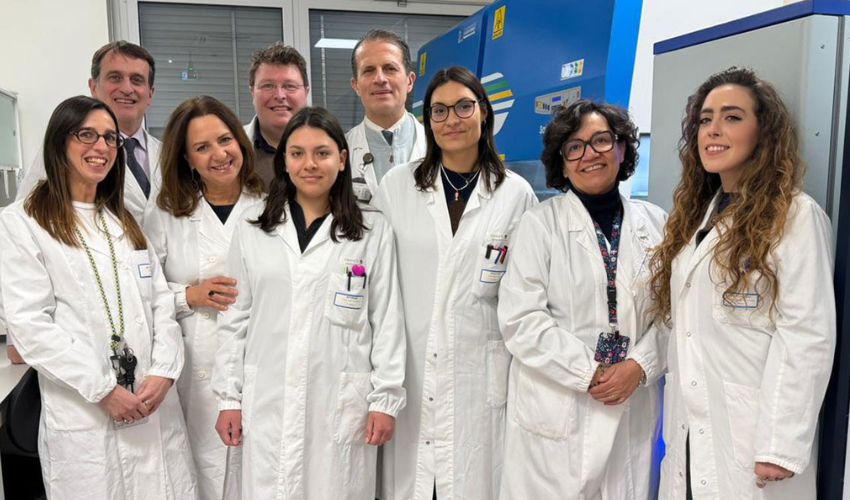
What if cranial malformations could be treated without surgery, directly at their genetic source? An Italian research team has developed a promising therapeutic strategy to address craniosynostosis, a condition characterized by premature fusion of the skull sutures in infants. The key lies in a “gene silencer” administered via nanoparticles and integrated into a 3D-printed hydrogel that acts locally and is minimally invasive.
In many cases, the most severe forms of craniosynostosis are caused by mutations in the FGFR2 gene, which is responsible for regulating bone growth. When this gene fails, the cranial sutures ossify too early, preventing normal brain development and causing severe deformities of the skull and face, as well as respiratory, auditory, and visual impairments. Currently, these conditions, such as Crouzon syndrome, can only be treated through invasive surgery performed within a few months of life and repeated throughout childhood. The new approach, still in the preclinical phase, aims for something different: correcting the problem at its molecular origin, without major surgical procedures.
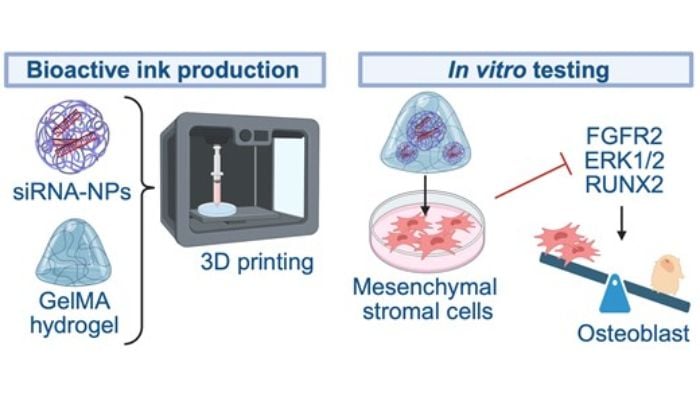
Graphic summary of the 3D system for treating cranial malformations (image credits: Lattanzi et al., 2025).
The team coordinated by Professor Wanda Lattanzi, from the Università Cattolica del Sacro Cuore and the Policlinico Gemelli campus in Rome, has been working for years to understand these cellular mechanisms. The most recent result is the development of small interfering molecules, called siRNA, capable of exclusively “silencing” the mutated version of the FGFR2 gene.
More from the desk
Six other notes from the rest of the bench.
 SoftwareMyMiniFactory, The Platform For Guaranteed Printable Free STL FilesWhether hobbyist or professional, anyone using a 3D printer is very likely to be using an STL file to print their project. An STL file, along with a 3D slicer, transmits data from a computer to 3D printer hardware. But…
 NewsMontana Has Given Regulatory Approval for Homes With 3D Printed Walls, the First State To Do SoBuilding code regulators from the Department of Labor & Industry recently confirmed that they have given broad regulatory approval for the use of 3D printing in construction, making Montana the first American state in history to recognize 3D printed walls…
 Applications3DPRINTUK 3D Prints Car Parts For Team Bath Racing3D printing is now indispensable to the automotive industry. Most major companies, such as Nissan and Audi, have already turned to the technology to streamline their production, thanks in part to the time savings and cost reductions that additive manufacturing…
 NewsORNL Has Released Free 3D Printing Datasets for Better AM Quality ControlThe Department of Energy’s Oak Ridge National Laboratory (ORNL) continues to show its dedication to advancing more industrialized additive manufacturing in the United States. And it’s not just 3D printed parts and materials coming out from the research institution. Ac
 NewsTop 5 Videos: What It Takes to 3D Print an Adaptive Bike SaddleIn this week’s Top 5, the focus seems to be on applications. First, we feature an in-depth video on an adaptive 3D printed bike saddle from Fizik, distributed by New Era Cycle. The video dives into every stage of production…
 NewsFormless Generative Design Heels from JapanThe Japanese design lab, Digital Artisan has partnered up with chemicals company, JSR Corporation and Castem, a manufacturer of precision casting parts to create the ‘Formless’ high heel shoe using the M2 3D printer from Carbon. Director of Digital Artisan,…