Applications
Researchers develop 3D printable material that mimics biological tissues
At the University of Colorado Denver, researchers have developed a method to create 3D printed liquid crystal elastomers with complex structures. The aim of this research is to build structures that match the physical properties of complex biological tissues, such…
- 3 min read
- Applications
- Six more stories
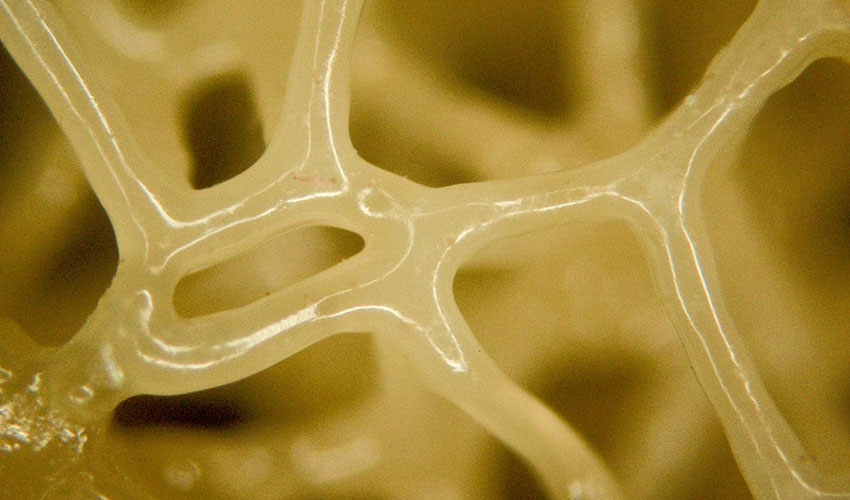
At the University of Colorado Denver, researchers have developed a method to create 3D printed liquid crystal elastomers with complex structures. The aim of this research is to build structures that match the physical properties of complex biological tissues, such as cartilage. Over the years, researchers around the world have been exploring the potential of 3D printing technologies for patient treatments and therapies. One of the main benefits of additive manufacturing is the level of complexity that can be achieved for a given structure. In this case, the researchers hope that the technique will help with creating patient-specific implants to replace tissues that have been lost because of injury or disease.
Given that tissues have unique properties, such as flexibility and strength, they are difficult to emulate when using synthetic substances. Tissues such as cartilage are extremely hard wearing, yet still soft and flexible enough to allow for movement and cushioning. For example, the spine’s components are strong and flexible enough to protect delicate neural tissue. Chris Yakacki, researcher involved in the study commented: “The spine is full of challenges and it’s a hard problem to solve. People have tried making synthetic spinal tissue discs and they haven’t done a good job of it.”
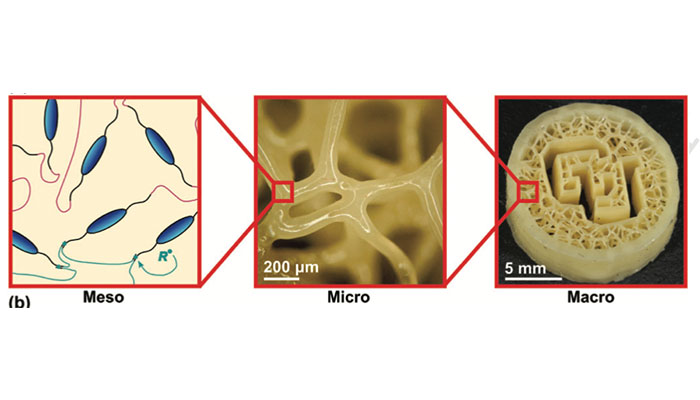
The structure at different scales | Image via CU Denver News
3D printed liquid crystal elastomers
In the study published in Advanced Materials, the team of researchers explain that they used liquid crystal elastomers to create complex structures that imitate biological tissue. More precisely, they used DLP 3D printing technology. DLP is similar to SLA in the sense that it also relies on photopolymerization to create an object layer by layer using ultraviolet light. The technology enables a high degree of precision, which is key for structures that will enter the body such as this one. During printing, the researchers used a photocurable (thus DLP printable) main-chain liquid crystal elastomer (LCE) resin. They explain that this resin showed “12 times greater rate-dependence and up to 27 times greater strain-energy dissipation compared to those printed from a commercially available photocurable elastomer resin,” after carrying out some mechanical tests.
More from the desk
Six other notes from the rest of the bench.
 NewsZap&Buj, making fashion through additive manufacturingThe development and manufacture of fashion through additive manufacturing is not new in the technology sector. Many firms have already benefited from 3D printing for fashion design and production. Innovation and originality in the creation of unique products opens up…
 NewsThe 3D Printing Construction Market is BoomingLast week, we wrote about how SmarTech Publishing’s report foreshadowed huge growth in the 3D printing dental market in the future. This week, we’re talking about how SmarTech also predict huge growths in the 3D printed construction industry. They expect…
 ApplicationsASTRO America to 3D Print Combat Vehicle Hull for U.S. ArmyOn Tuesday, the Applied Science & Technology Research Organization, also known as ASTRO America, announced that it had been chosen by the U.S. Army for the “Jointless Hull Project”. Contracted through LIFT, the Department of Defense supported manufacturing innovation institut
 NewsAsia’s Very First 3D Printed, Titanium Bike Frame Unveiled3D printing has transformed several industrial fields, introducing improvements in the design and manufacture of objects. The bicycle industry is no exception, also taking advantage of this technology to push back the frontiers of conventional manufacturing. TITAN SUPER BOND, whi
 NewsAdditive Manufacturing for Cheaper and Faster Particle Foam Tools and MoldsAlready, additive manufacturing is being used extensively in the production of equipment, tools molds and dies. This includes not only the production of prototypes but also the creation of strong, durable and customized end-use parts. One clear example of this…
 Software3D Builder, the Free 3D Modeling Software by Microsoft3D Builder is Microsoft’s 3D modeling software that allows you to easily design a 3D model, visualize it or make any modifications quickly. It is a free solution, installed by default on all computers with Windows 10 (though since later…