News
3D printed hair from MIT could have many innovative applications
The Media Lab at MIT is renowned for applying additive manufacturing to some of the most unusual and inspiring projects. In January, we reported on MIT researchers developing the G3DP2 system, capable of 3D printing glass. The Massachusetts Institute of…
- 3 min read
- News
- Six more stories
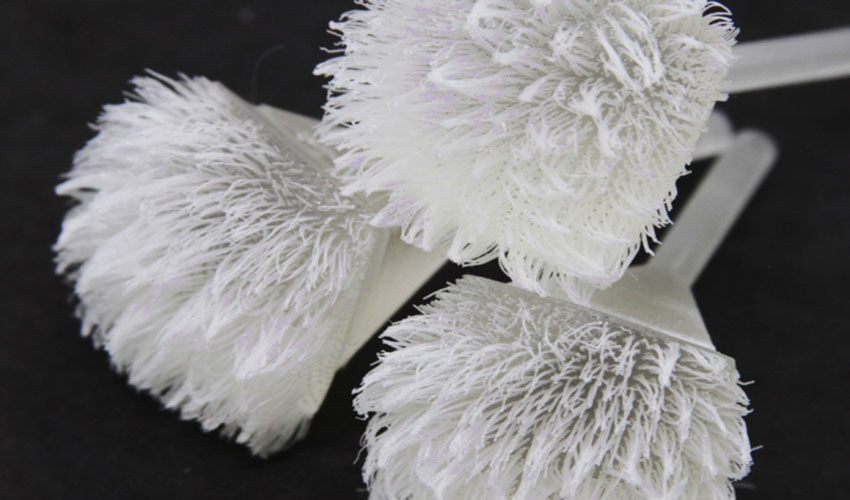
The Media Lab at MIT is renowned for applying additive manufacturing to some of the most unusual and inspiring projects. In January, we reported on MIT researchers developing the G3DP2 system, capable of 3D printing glass. The Massachusetts Institute of Technology invested in 2016 in a new project, Cilllia. The Tangible Media Group (part of MIT’s Media Lab) was behind this project, led by Professor Hiroshi Ishii. The group aims to “seamlessly couple the dual world of bits and atoms by giving dynamic physical form to digital information and computation”. Project Cilllia aspired to study the structure and purpose of hair. It is one of the applications of 3D printing not often talked about but could have many applications in the years to come.
Even though 3D printing has recently shown it can print pretty much anything, some things still defy the technology. This includes hair, fur, and other dense arrays of extremely fine features. These structures require a huge amount of computational time and power not only to design but also to print. The Tangible Media Group have found a solution to the design hurdles by using something different than the conventional CAD software used to create a 3D model. Instead of drawing thousands of individual hairs on a computer, the team built a new software platform called Cilllia.
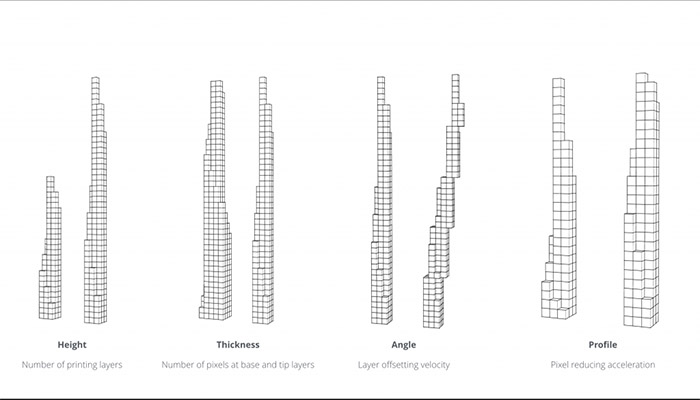
The software allows users to define the angle, thickness, density and height of thousands of hairs in just a few minutes. The designed arrays of hair-like structures have a resolution of 50 microns (width of a human hair). The team then experimented with different dimensions from coarse bristles to fine fur, onto flat and curved surfaces. They 3D printed these hairs using a conventional 3D printer.
More from the desk
Six other notes from the rest of the bench.
 PrintersWhich Are the New Machines Not to Miss at Formnext 2021?It’s been one day now since Formnext opened its doors and visitors can discover the 600 exhibitors from 35 different countries, spread over three halls. There is a lot of news and it is not always easy to find your…
 NewsThe Importance of 3D Printing in Industry 4.03D printing is one of the fundamental elements of Industry 4.0. But before considering the role of additive manufacturing, it is first necessary to understand what Industry 4.0 is. Industry 4.0, or the fourth industrial revolution, consists of the automation…
 ApplicationsFord Motor Company purchases new Production System P-1 from Desktop MetalAlready a leader in additive manufacturing in the automotive sector, Ford does not intend to stop here. The American firm has confirmed that it has already ordered the P-1, Desktop Metal‘s latest 3D printer, and will be one of the…
 ApplicationsItalian Volt have unveiled their 3D printed electric motorcycleItalian Volt is an Italian company that manufactures customizable electric motorcycles (such as the Lacama), by using 3D printing. Different styles, shapes and colors are offered thanks to 3D printing manufacturing, as it offers greater possibilities in terms of the personalizati
 MaterialsThe US Army invests up to $11 million in the development of new polymersThe US Army keeps exploring the wide range of possibilities provided by additive manufacturing technologies. Recently, the Army allocated $11 million in total for the research and development of new high-performance polymer materials. Who will be conducting the research? The&hell
 NewsTop 5 Videos: Michelin, MissouriThis week’s Top 5 Videos of the Week include videos ranging from metal 3D printing, 3D printing in construction, and 3D printing at university. Remember, another Top 5 Videos is published every Sunday, so make sure you don’t miss out…