News
3D Printed Beams Made From Recycled Plastic Replace Reinforced Concrete
A team from the Polytechnic University of Valencia (UPV) has developed an alternative to the reinforced concrete beams used in the construction sector. By using additive manufacturing, they have designed beams made of recycled plastic. The result is a drastic…
- 3 min read
- News
- Six more stories
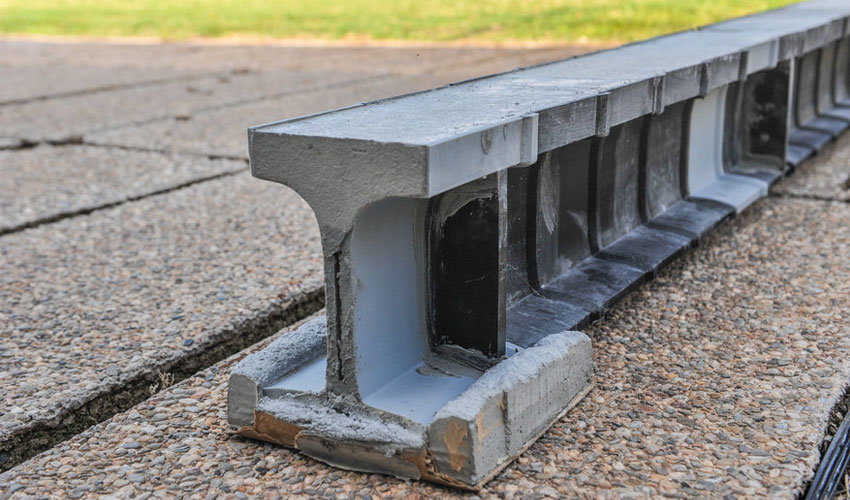
A team from the Polytechnic University of Valencia (UPV) has developed an alternative to the reinforced concrete beams used in the construction sector. By using additive manufacturing, they have designed beams made of recycled plastic. The result is a drastic reduction in weight, since they weigh 80% less than current solutions, making it considerably easier to transport them and reduce the energy required to assemble them. The various 3D printed components forming the beam can be assembled as easily as LEGO bricks.
Very popular in the construction sector, reinforced concrete is, as its name indicates, composed of concrete and metal, most often steel. It is therefore a composite material that can resist traction and compression and is capable of supporting significant loads. However, it is a material that remains heavy to transport as the presence of steel increases considerably the weight of the beam. Researchers have therefore tried to reduce this constraint as much as possible and have worked for 3 years on a 3D printing project. José Ramón Albiol, professor at the UPV’s Technical School of Building Engineering (ETSIE), adds: “Our goal was to propose an alternative to the current reinforced concrete beams. These are made using profiles built for the length of the piece, which requires expensive installation and are hard to transport.”
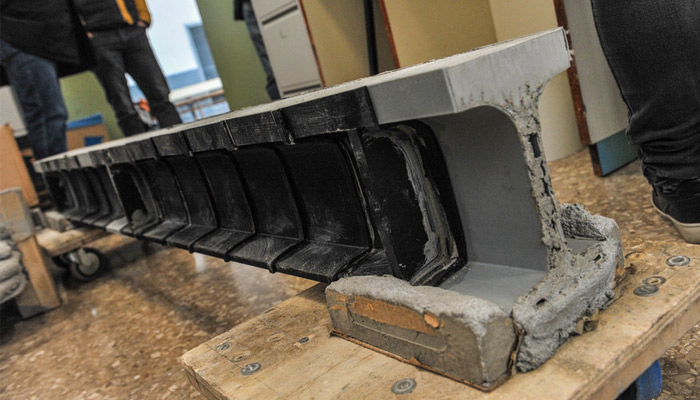
The different 3D printed blocks fit together like LEGO (photo credits: UPV)
3D printed beams inspired by human bone
The researchers remain rather discreet about the 3D printing process used; we only know that they preferred recycled plastic to reduce the ecological footprint, and that they were inspired by the shape of the bone to design their 3D models. The objective was to reproduce the structure of the epiphysis, the end part of the bones: it is made of several layers that give a significant rigidity while remaining quite light. Using additive manufacturing, the researchers were able to mimic this alveolar structure and putting material where it was needed.
More from the desk
Six other notes from the rest of the bench.
 NewsVolkswagen continues to produce 3D printed parts with HP Metal JetIn September 2018, the American manufacturer HP announced the arrival of its metal 3D printer, the HP Metal Jet. Among the first users of the technology is the car manufacturer Volkswagen. For the past year, the German company has been…
 News#TOP5 Videos: 3D printing for animation films, shoes and more!We found the Top 5 videos of the week about 3D printing and the way additive manufacturing is shaping and changing our society. This week we touch on 3D printing for animation films, shoes and much more! If you enjoy these, you…
 PrintersWhat Are the Current ELEGOO 3D Printers on the Market?As 3D printing gets more popular, so do cheaper desktop solutions which allow more and more access to the technology. One such company which has been gaining in popularity for its cheap but reliable printers is ELEGOO. Founded in 2015,…
 NewsADDITIV Aerospace will Take Place Tomorrow!On March 18th at 8AM EDT (1PM CET), ADDITIV Aerospace will open its doors to Aerospace professionals to discuss the applications for additive manufacturing (AM) in the sector. This 100% virtual event will be an ideal opportunity to learn how…
 NewsSandvik unveiled first-ever 3D printed diamond compositeAt RAPID + TCT last week, Sandvik unveiled the first ever 3D printed diamond composite. Recently, using SLA technology the company can say it has added 3D printed diamond material to their portfolio of materials. Quite recently the company was…
 NewsDutch city set to construct a 3D printed bridge for cyclistsEindhoven University of Technology in the Netherlands has begun construction on an 8-meter, 3D printed bridge for cyclists in the town of Gemert. The Royal BAM Group, a construction company who was established in 1869, will be carrying out this latest…