Applications
The Project to Manufacture 3D Printed Batteries Out of Lunar and Martian Regolith
It has been fifty years since the last crewed moon landing, but that does not mean that humanity’s desire to reach for the stars (or planetary bodies) has lessened. In fact, in recent years it seems that we have seen…
- 3 min read
- Applications
- Six more stories
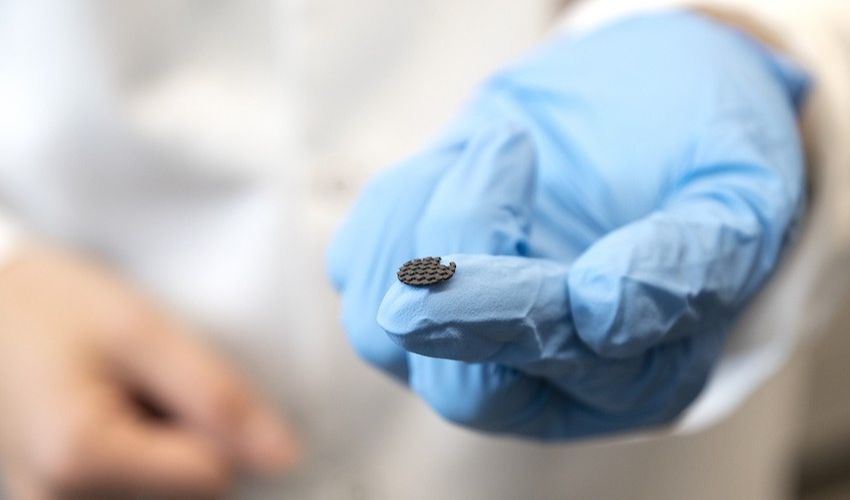
It has been fifty years since the last crewed moon landing, but that does not mean that humanity’s desire to reach for the stars (or planetary bodies) has lessened. In fact, in recent years it seems that we have seen an almost resurgence in efforts to not only reach other parts of our Solar System but to ultimately conquer it. And additive manufacturing has been at the forefront of those efforts. In fact, just last week, it was announced that the University of Texas at El Paso (UTEP) has become part of a project to maximize the sustainability of astronauts’ future lunar and Martian missions. It was awarded $615,000 to leverage 3D printing to learn how to manufacture rechargeable batteries out of lunar and Martian regolith.
As mentioned, this project is part of a larger one that aims to make it possible not only to go back to the moon and even Mars, but to possibly support human operations once we are there. The key to this is, of course, reducing payload weight and dead volume, something for which 3D printing is uniquely suited, in more ways than one. Notably, in this case, its ability to easily manufacture locally is actually the main benefit at play. Through 3D printing, it could be possible to develop infrastructure including habitation modules, power generation and energy storage facilities on the moon or Mars. This latest project focuses specifically on power generation, as the scientists are charged with creating the batteries needed to power small spacecraft, portable power devices, robots, and large-scale power systems on other planetary bodies.
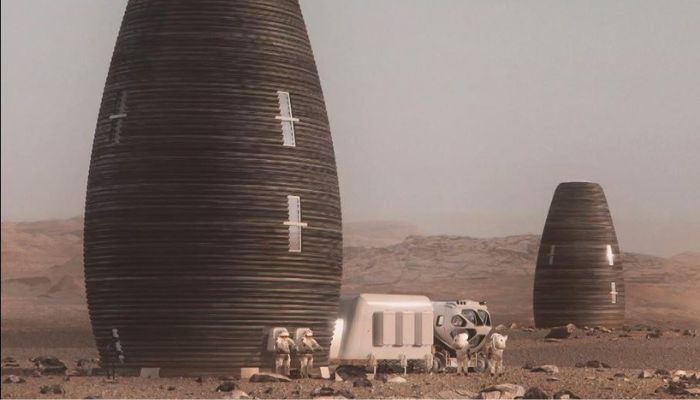
NASA is looking into how 3D printing could be used for various projects in space exploration, including these batteries but also 3D printed homes on the moon and Mars (photo credits: NASA)
3D Printing Batteries in Outer Space
UTEP’s work will be part of a larger $2.5 million project that includes Youngstown State University (YSU), 3D printer manufacturer Formlabs, as well as ICON. And already progress has been made by both UTEP and NASA researchers, as shown in a recently publishing article from the American Chemical Society, “What Would Battery Manufacturing on the Moons and Mars Look Like?” Specifically, it seems that two different 3D printing processes, material extrusion (ME) and vat photopolymerization (VPP), are being investigated to produce shape-conformable batteries, complex 3D battery designs that outperform existing commercial batteries, on these bodies.
More from the desk
Six other notes from the rest of the bench.
 NewsTop 5 videos of the week: 3D-printed spines, candy, & more!Our top 5 videos of the week showcase the week’s most interesting videos in relation to 3D-printing. We endeavour to find the most exciting, ambitious, or interesting updates, to summarise for you every week. So enjoy our list for this…
 PrintersLab 3Dnatives: Creality CR-10 3D Printer TestAs desktop 3D printers become more and more common, companies are trying to make cheaper and cheaper models. These cheap 3D printers claim to retain a high-quality print whilst cutting price. One of these companies is Creality, the Chinese manufacturer…
 NewsOWA Speaker: The 3D Printed Speaker based on a Circular EconomyOWA 3D have just launched their Kickstarter campaign for their DOT project which they also presented at CES 2018 in Las Vegas. This collaboration between 5 French companies led to the creation of the first customisable Bluetooth 3D printed speaker,…
 Printers3Dnatives Lab: Testing the Einstar 3D Scanner From SHINING 3DFounded in 2004, SHINING 3D is a Chinese manufacturer of both 3D printers and 3D scanners. With a particular focus on the medical and dental sectors, the brand has grown internationally in recent years and now has offices in China,…
 ApplicationsRolls-Royce is accelerating the integration of 3D printing into its production processSince the start of the year, the British manufacturer Rolls-Royce, a subsidiary of the BMW Group, has been 3D printing plastic and metal parts for its Rolls-Royce Ghost model. The parts are manufactured along the production line at various locations…
 NewsUWE Bristol Researchers Grow Rubies and Sapphires Inside 3D Printed PlatinumA team at the Centre for Print Research (CFPR) at the University of the West of England (UWE Bristol) has developed a method for placing a seed crystal inside a platinum structure during manufacture. The gemstone can then grow directly…