
Pioneering Metal 3D Printing in Orbit: A New Era for Manufacturing on the ISS
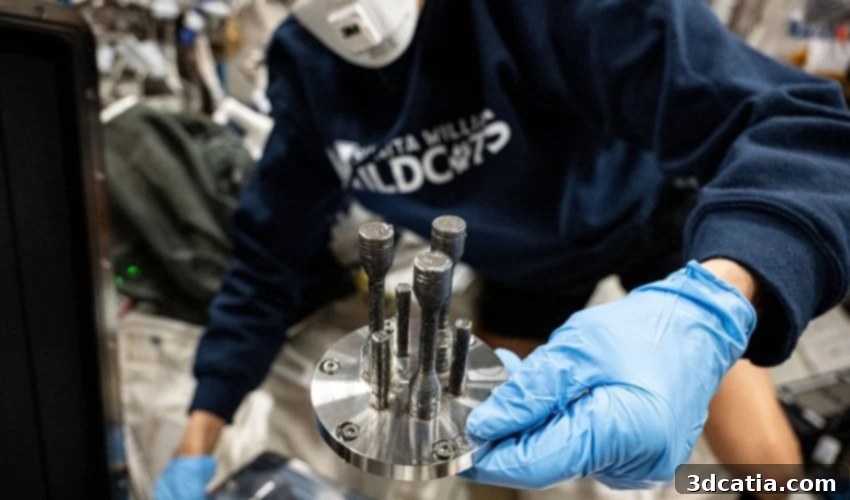
The landscape of space exploration and in-orbit capabilities has officially been reshaped with a monumental achievement: a metal part has been successfully 3D printed for the very first time in orbit. This groundbreaking feat took place aboard the International Space Station (ISS), a testament to the collaborative efforts of the European Space Agency (ESA), Airbus, and their esteemed partners. While the concept of microgravity 3D printing might sound familiar, given their prior success last June in designing a 3D-printed shape under similar conditions, this latest accomplishment pushes the boundaries significantly further. This time, it wasn’t just a design; it was a tangible, functional metal component, meticulously retrieved from the printing machine by astronauts Jeannette Epps and Sunita Williams. This landmark event serves as compelling evidence that additive manufacturing is not only viable but indispensable for future space endeavors, promising to facilitate on-demand production and enhance the self-sufficiency crucial for extended missions.
While the idea of 3D printing on the ISS is not entirely novel – polymer-based technologies have already proven their efficacy in space – the successful implementation of a metal-based process marks a critical turning point. The transition from polymers to metals introduces a unique set of complexities and challenges, particularly concerning safety and operational predictability. Terrestrial metal 3D printing already demands stringent safety protocols, but these are amplified exponentially in the confined, zero-gravity environment of the ISS. The temperatures required to melt metals can reach upwards of 1,200°C, posing significant thermal management and fire hazard risks. Furthermore, the absence of gravity makes the precise deposition of molten metal highly unpredictable. Unlike polymer extrusion, where material flow is more manageable, controlling a molten metal pool in microgravity requires exceptional engineering precision. These inherent difficulties invariably extended the project timeline; the specialized metal 3D printer, a marvel of engineering designed for orbital operation, arrived at the ISS in January 2024 but only became fully operational in May, following extensive setup and testing protocols.
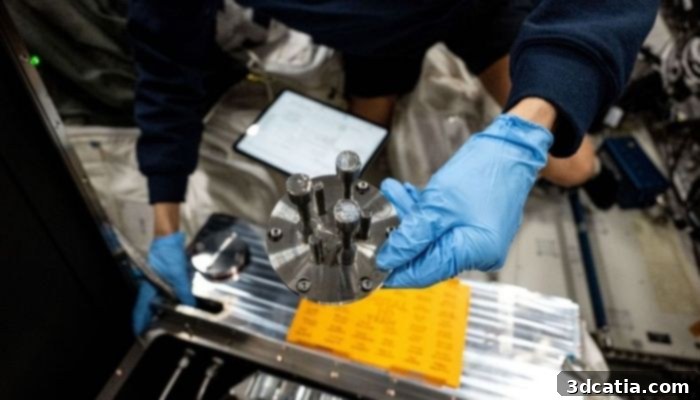
The part in question, successfully 3D printed in microgravity.
Executing metal deposition in zero-gravity demanded an extraordinary level of monitoring, control, and meticulous calibration. The process of accurately depositing successive layers of metal in an environment where gravity does not assist in material placement or melt pool stability is an engineering marvel. Achieving precise alignment and layer adhesion in microgravity is fundamentally different from terrestrial conditions, where gravity helps settle molten material and consolidate layers. The astronauts on board, acting as pioneering engineers, had to proceed through a painstaking, step-by-step process to achieve the perfect calibration of the printer. This involved countless adjustments, tests, and data analyses to ensure that each molten metal bead was accurately placed and fused, forming a structurally sound object. By this past summer, their diligent efforts paid off as they successfully printed 55 layers, incrementally extending the daily printing time from a cautious 3.5 hours to a more efficient 4.5 hours. This gradual increase in operational time highlights the careful, iterative approach required to validate and optimize the process in such a challenging environment.
The culmination of these efforts arrived last weekend, as the astronauts, with a profound sense of accomplishment, unveiled the very first metal part successfully fabricated in orbit. This was not a single, monolithic object, but rather several distinct components expertly printed onto a circular support structure. Each piece, measuring approximately 9 x 5 cm, was crafted from durable stainless steel, a material chosen for its strength and suitability for various space applications. The sophisticated machine responsible for this feat employs Directed Energy Deposition (DED) technology. This advanced additive manufacturing method works by melting metal wire feedstock with a powerful laser, capable of generating temperatures up to an astonishing 1,200°C. DED is particularly well-suited for in-space manufacturing due to its ability to work with wire or powder feedstock, its capability for repair of existing components, and its comparatively robust nature. This technology is instrumental in overcoming some of the unique challenges posed by microgravity, ensuring precise material deposition and control even in the absence of gravitational forces.
The implications of this successful demonstration extend far beyond the mere act of printing a metal part. This capability represents a paradigm shift for future space missions, promising a dramatic reduction in logistical dependencies on Earth. Imagine a scenario where astronauts on a distant Mars mission or a lunar outpost can simply fabricate a critical spare part or a specialized tool on demand, rather than waiting months or even years for resupply. This concept of “on-demand manufacturing” fundamentally alters mission planning, significantly lowering launch mass requirements by eliminating the need to pre-stock every conceivable tool or component. Furthermore, it opens up avenues for rapid repairs and modifications, enhancing mission resilience and crew safety. The ability to create complex metal structures in space also paves the way for “additive construction,” enabling the fabrication of larger structures like antenna components, habitat modules, or even entire spacecraft sections, layer by layer, directly in orbit or on celestial bodies. This self-sufficiency is paramount for long-duration human missions and the establishment of permanent off-world settlements, transforming the vision of interstellar travel and extraterrestrial habitation into a tangible reality.
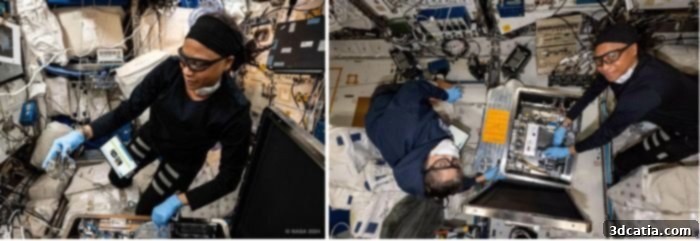
Astronauts retrieve the first-ever metal 3D-printed part from the ISS, marking a historic moment.
Anthony Lecossais, the esteemed Metal 3D Lead Engineer at Airbus Defence and Space, eloquently underscored the profound significance of this accomplishment. He explained, “One of the major objectives of this technology demonstrator is to gather as much data as possible of the effects of microgravity on the printing performance. We are very pleased to have achieved a successful print, right first time! It will help to advance technologies for in-space manufacturing needs, from tooling and repairs needs to additive construction, opening up new possibilities for future space exploration missions.” His statement highlights the dual triumph: not only the successful physical print but also the invaluable data collected. This data, encompassing thermal profiles, material behavior, and structural integrity in microgravity, will be crucial for refining future designs and processes. It will accelerate the development of more advanced in-space manufacturing systems, expanding their capabilities to produce a wider array of tools, more complex spare parts for critical systems, and even large-scale structures through additive construction techniques. The implications are profound, promising enhanced autonomy for astronauts, significantly reduced resupply costs, and enabling missions of unprecedented duration and scope, ultimately unlocking new frontiers for human exploration beyond Earth. The collaborative spirit between ESA, Airbus, and their partners demonstrates the synergy required to tackle such complex challenges and pave the way for a self-sufficient future in space.
This achievement undeniably propels us into a new era of space exploration, one where the cosmos is not just a destination but also a workshop. The ability to manufacture essential components in orbit, rather than transporting them from Earth, represents a strategic shift that will redefine mission architectures and expand human presence throughout the solar system. Future developments will undoubtedly focus on increasing the variety of printable materials, enhancing printing resolution and speed, and automating the entire manufacturing process to minimize astronaut intervention. As we look ahead, the vision of autonomous space factories, capable of building and repairing spacecraft, habitats, and scientific instruments directly in space, is becoming increasingly plausible. This ongoing research and development aboard the ISS is laying the foundational groundwork for such ambitious future endeavors, transforming science fiction into scientific reality. One thing is certain: we will continue to keep you informed of any further exciting developments stemming from these pioneering efforts away from the ISS, shaping the future of space technology. In the meantime, you can find all the comprehensive background information and official details HERE directly from Airbus.
What are your thoughts on the monumental achievement of metal 3D printing on board the ISS and its potential to revolutionize space exploration? Let us know your insights and predictions in a comment below or join the conversation on our LinkedIn, Facebook, and Twitter pages! Don’t forget to sign up for our free weekly newsletter here for the latest 3D printing news straight to your inbox and stay updated on all additive manufacturing innovations! You can also find all our compelling videos and interviews on our YouTube channel.
*All Photo Credits: ESA/NASA