
Industrial 3D Printing Market Set for Explosive Growth: A Deep Dive into the Future of Additive Manufacturing
The additive manufacturing sector is undeniably experiencing an unprecedented boom, transforming various industries and redefining production possibilities. Recent comprehensive research by Allied Market Research paints a compelling picture of this dynamic expansion, projecting the industrial 3D printing market to skyrocket to an impressive value of $107.7 billion by 2031. This remarkable forecast represents a robust Compound Annual Growth Rate (CAGR) of 21.9% over the next decade, highlighting the profound impact and sustained momentum of this technology.
This exponential growth is primarily fueled by two critical drivers. Firstly, there’s an escalating demand for highly customized and personalized products, which provides businesses with a crucial competitive edge in today’s diverse market. Additive manufacturing excels at producing unique, low-volume components efficiently and cost-effectively, catering directly to this market need. Secondly, the rapid advancement and adoption of new 3D printing materials are significantly broadening the application scope of the technology, enabling the creation of parts with superior properties for a wider range of industrial uses. The Allied Market Research report offers an in-depth analysis of these and other key aspects, including a detailed exploration of the regional landscape, emerging trends, pivotal industry segments, the intricate value chain, and the competitive environment shaping the future of industrial 3D printing.
Navigating Market Dynamics and Overcoming Challenges
Echoing insights from earlier industry analyses, such as the Wohlers Report 2022, the additive manufacturing industry has demonstrated consistent and strong growth. However, this impressive trajectory has not been without its challenges. The past few years saw the global health crisis inflict a significant negative impact on various markets, and industrial 3D printing was no exception. Major industry players experienced a notable slowdown, largely attributed to supply chain disruptions and a critical shortage of skilled labor essential for the development, operation, and maintenance of advanced 3D printing solutions. The need for expertise in design for additive manufacturing, printer operation, post-processing, and material science became more pronounced than ever.
Despite these hurdles, the resilience and inherent advantages of additive manufacturing have driven a powerful recovery. The industry has effectively adapted, with investments in automation and training programs helping to mitigate labor shortages and streamline processes. It is now on a clear path to not only recover but to surpass previous market values, ultimately reaching its projected peak by 2031. This period of disruption also served as a catalyst for innovation, prompting companies to explore more robust and localized manufacturing strategies. Furthermore, the comprehensive analysis provided by Allied Market Research offers invaluable insights for additive manufacturing companies, potential investors, and end-users. It serves as a strategic roadmap, highlighting specific sub-segments and opportunities that should be leveraged to capitalize on the anticipated growth in the coming years, enabling informed decision-making and strategic planning.
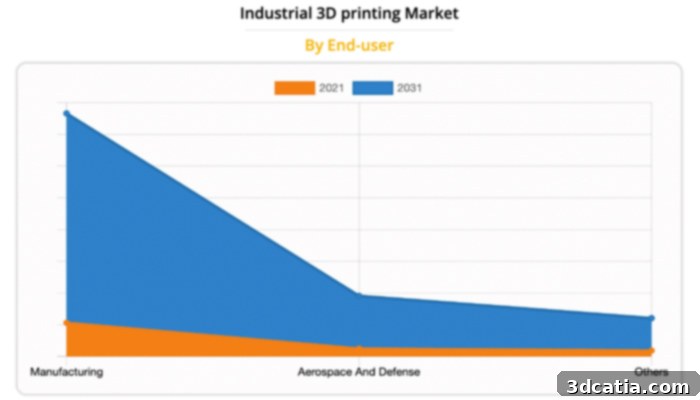
Industrial additive manufacturing end-users (photo credits: Allied Market Research)
Emerging Trends and Key Segments in Industrial 3D Printing
As visually represented in the preceding graph, the report meticulously dissects the additive manufacturing market based on the diverse array of end-users adopting this technology as a primary production method. Additive manufacturing’s inherent ability to create highly affordable, intricate, and significantly lighter components compared to conventional manufacturing techniques makes it incredibly appealing across numerous sectors. Unsurprisingly, the general industrial sector emerges as the most prominent adopter, leveraging 3D printing for a wide range of applications, from rapid prototyping and creating custom tooling to producing complex, functional final parts. Its versatility in this segment underscores its transformative potential for manufacturing flexibility and efficiency.
While the industrial sector leads, it’s crucial to acknowledge the robust and accelerating growth within the aerospace and defense sector, which holds a strong second position. This industry is increasingly relying on additive manufacturing for lightweighting critical components, producing complex geometries that enhance performance, and streamlining supply chains for spare parts and MRO (Maintenance, Repair, and Overhaul) operations. The aerospace and defense sector is projected to continue its significant expansion in the foreseeable future, driven by stringent performance requirements and the need for innovation. From a regional perspective, North America historically held the largest market share in 2021, contributing nearly half of the total market, owing to its early adoption, extensive R&D investments, and a well-established industrial ecosystem. However, a compelling narrative of rapid emergence is unfolding in the Latin America, Middle East, and Africa (LAMEA) region, which is anticipated to register an impressive CAGR of 24.1% during the forecast period. This accelerated growth is likely fueled by increasing industrialization, government initiatives supporting technological adoption, and a growing awareness of the benefits of additive manufacturing in developing economies.
Technological Advancements and Component Landscape
Delving deeper into the ecosystem of 3D printing solutions, the study meticulously highlights two pivotal aspects: components and technologies. Components refer to the essential elements that form the backbone of any additive manufacturing system, primarily encompassing hardware and software. In this segment, the hardware category – comprising the actual 3D printers, their mechanical parts, and control systems – accounted for a dominant share, exceeding two-thirds of the total market in 2021. This segment is robustly positioned to maintain its leadership through 2031, reflecting the ongoing innovation in printer capabilities, speed, precision, and multi-material functionality. The increasing sophistication and reliability of 3D printing hardware are crucial for meeting industrial demands for repeatability and scalability. Complementing hardware, advancements in software for design, simulation, build preparation, and post-processing are equally vital, enabling users to fully leverage the capabilities of their machines and optimize workflows.
When examining the diverse array of 3D printing technologies employed by market players, a clear picture emerges. Stereolithography (SLA), renowned for its exceptional surface finish, fine detail capabilities, and accuracy, held a significant market share, exceeding a quarter of the total. SLA is expected to continue leading in applications requiring high precision and aesthetic quality, especially for prototyping, master patterns, and medical models. However, the report forecasts that Fused Deposition Modeling (FDM) 3D printing will register the highest Compound Annual Growth Rate (CAGR) during the forecast period. This anticipated surge for FDM is driven by its accessibility, cost-effectiveness, and the increasing variety of engineering-grade thermoplastics it can process. FDM is becoming an increasingly popular choice for functional prototypes, jigs, fixtures, and even certain end-use parts, particularly where robustness and affordability are paramount. Other technologies like Selective Laser Sintering (SLS) for strong, functional polymer parts, and various metal additive manufacturing processes such as Direct Metal Laser Sintering (DMLS) and Selective Laser Melting (SLM), also contribute significantly to the market, each carving out niches based on their unique material and performance characteristics.
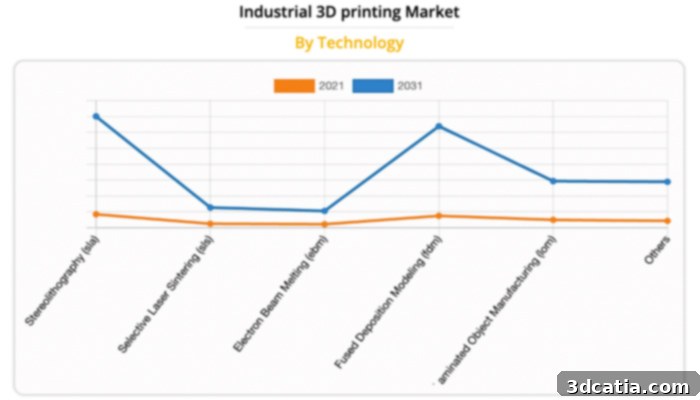
Comparison of the most widely used 3D technologies and their growth in the coming years (photo credits: Allied Market Research)
Addressing Barriers and Seizing Growth Opportunities
While the industrial 3D printing market’s future appears bright, the report candidly points out persistent barriers to widespread adoption that could potentially impede its full market value realization. Prominent among these is the inherently high cost associated with advanced additive manufacturing technology. This includes not only the substantial initial investment required for sophisticated machinery and ancillary equipment but also the ongoing expenditure on specialized materials, which often carry a premium compared to traditional manufacturing inputs. Furthermore, the imperative need for a highly skilled professional workforce—encompassing designers proficient in “design for additive manufacturing,” skilled machine operators, and maintenance technicians—presents another significant hurdle. The shortage of such specialized talent can indeed explain some of the difficulties in accelerating market growth to its absolute maximum potential.
In stark contrast to these challenges, a multitude of compelling opportunities are poised to drive substantial growth for industrial 3D printing by 2031. The expanding range of applications across an ever-growing list of diverse industries offers immense potential. From medical devices and prosthetics that can be customized to individual patient needs, to automotive components that optimize weight and performance, and consumer goods offering unprecedented personalization, additive manufacturing is finding new and impactful uses. Simultaneously, continuous improvements in manufacturing processes—such as enhanced speed, precision, automation, and material diversity—are making 3D printing more efficient, reliable, and cost-effective. These advancements, coupled with the ability to foster more agile supply chains and enable localized production, offer a powerful antidote to traditional manufacturing constraints and solidify the industry’s growth trajectory. As we can clearly discern, Allied Market Research’s comprehensive report is an indispensable resource. It provides critical information for both new entrants seeking to understand the landscape and established companies aiming to refine their future strategies and fortify their position within the rapidly evolving 3D printing market. To delve deeper into these insights and obtain the full report, interested parties can visit the website HERE.
What are your thoughts on the projected market value and the future of industrial 3D printing? We invite you to share your insights in a comment below or join the conversation on our LinkedIn, Facebook, and Twitter pages! Don’t miss out on the latest advancements and sign up for our free weekly Newsletter here, delivering the most up-to-date 3D printing news straight to your inbox! You can also explore all our videos and expert interviews on our YouTube channel for more in-depth content.
*Cover Photo Credits: Proto3000 Inc.