
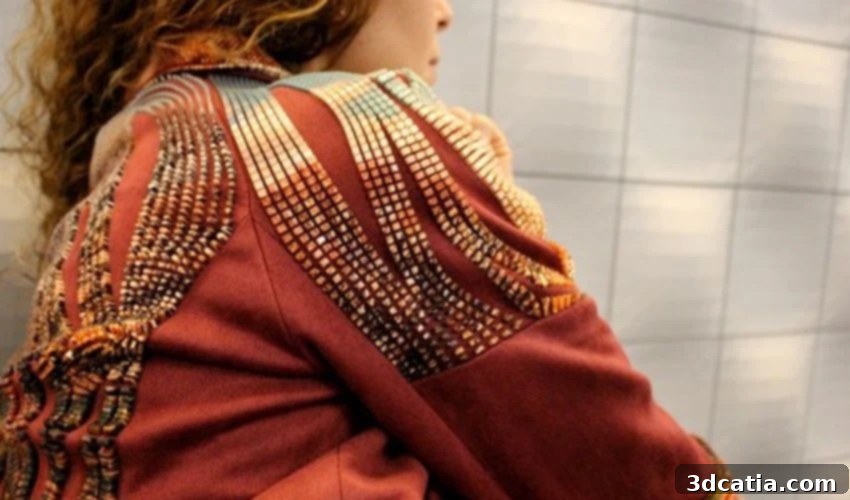
Revolutionizing Fashion: How 3D Printing is Customizing Clothing and Textiles
In an era dominated by rapid fashion cycles and mass-produced apparel, the demand for individuality and personalization in clothing has never been more pronounced. Consumers are increasingly seeking unique garments that reflect their personal style, standing apart from the widespread uniformity often seen across brands. This growing desire for bespoke fashion is driving innovation, particularly in the realm of advanced manufacturing techniques. One of the most promising frontiers is additive manufacturing, commonly known as 3D printing, which is now demonstrating its transformative potential within the textile industry.
Leading this charge in high-tech fashion innovation is the Hong Kong Polytechnic University, through its state-of-the-art 3D Printing Technology Center Laboratory (U3DP). Established in 2017, the U3DP serves as a vital hub, providing researchers, faculty, and students with unparalleled access to cutting-edge academic research and optimized technological advancements. Their mission encompasses a broad spectrum of applications, and a significant focus has recently been placed on exploring the intricacies of 3D printing for garment design and production.
Pioneering Research: Merging Rigid Polymers with Soft Fabrics
The U3DP’s ambitious research project, aptly named “Exploration of Fashion Design, Based on Textile 3D Printing,” delves into a critical challenge within additive manufacturing: the seamless integration of rigid polymers with soft, pliable fabrics. This endeavor aims not only to overcome existing material limitations but also to unlock unprecedented design possibilities. The core vision behind this research is to empower anyone – from individual designers to large fashion houses – to produce highly customized designs that incorporate diverse fabrics and garment types with ease and precision. Moreover, a key objective for the research team was to ensure that any 3D-printed elements on textiles would be durable enough to withstand conventional washing, a fundamental requirement for practical, wearable fashion.
To bring this intricate vision to life and achieve their challenging goals for directly washable, 3D-printed clothing, the Hong Kong Polytechnic University’s U3DP partnered with a global leader in additive manufacturing: Stratasys. Specifically, their collaboration leveraged Stratasys’s revolutionary J850™ TechStyle™ 3D printer, a machine specifically engineered for high-end fashion applications. This partnership signifies a crucial step forward, combining academic rigor with industrial-grade technology to push the boundaries of what is possible in textile customization.
Overcoming Challenges: 3D Printing on Diverse Textiles with Precision
The journey into textile 3D printing is not without its hurdles. When the U3DP research team embarked on the initial phases of their project, one of the primary technical challenges that quickly emerged was achieving consistent and robust surface adhesion of the printed materials onto various fabric textures. Textiles, by their very nature, present diverse surfaces – from the smooth weave of silk to the ruggedness of denim, each posing unique challenges for direct 3D printing. Ensuring that printed designs adhere securely and durably, without compromising the fabric’s integrity or feel, is paramount for creating wearable garments.
Fortunately, the Stratasys J850 TechStyle 3D printer has a proven track record of excellence in the fashion industry. This advanced machine has repeatedly demonstrated its capabilities, producing stunning additively manufactured designer pieces that have graced prestigious events like Milan Fashion Week earlier this year. Such showcases underscore the printer’s ability to deliver high-quality, intricate designs that meet the exacting standards of haute couture. As a multifunctional, end-to-end printer, the J850 TechStyle played an instrumental role in enabling the Hong Kong research team to successfully print onto a wide array of soft and flat substrates. This included challenging materials such as denim, polyester, cotton, and even canvas, without sacrificing precision or quality. Beyond mere adhesion, the J850 TechStyle is also renowned for its capacity to produce exceptionally strong, vibrant colors and remarkably lifelike textures, adding a new dimension of realism and aesthetic appeal to 3D-printed textile designs.
Empowering Designers: The Role of Accessible Technology
While the U3DP boasts an impressive array of different 3D printers, each tailored for specific industrial applications, the integration of the J850 TechStyle has significantly expanded their capabilities, allowing them to delve deeper into the burgeoning fashion sector with unprecedented flexibility. The U3DP team explicitly highlighted their reasons for choosing Stratasys, commenting, “Stratasys PolyJet™ 3D printers have always been known for their ease of operation and excellent user experience, enabling teaching and research staff to master the use of this new 3D printer in a short period of time.” This ease of use is not merely a convenience; it is a critical factor in accelerating research and development, allowing academics and students to focus more on creative exploration and less on technical complexities.
The accessibility and intuitive nature of the Stratasys PolyJet technology mean that custom patterns and an extensive palette of colors can now be instantly printed directly onto fabrics of varying thicknesses and material compositions. This breakthrough fundamentally eliminates many traditional creative limitations faced by designers, opening up a universe of possibilities for textile ornamentation and functional integration. Furthermore, the ability to selectively apply materials with varying durometers (hardness) allows for the addition of a unique three-dimensional feel and structure to garments, transforming flat textiles into dynamic, tactile experiences. This capability supports the creation of intricate textures, functional elements like flexible sensors, or even structural components directly onto fabric, paving the way for truly innovative and personalized fashion pieces.
The Broader Impact: Sustainability and the Future of Personalized Fashion
The implications of this research extend far beyond mere aesthetics. The ability to directly 3D print onto textiles with washability ensures that these customized garments are not just prototypes but practical, consumer-ready products. This shift has profound implications for the entire fashion value chain. For designers, it means faster prototyping, greater creative freedom, and the ability to produce highly niche or personalized collections on demand, reducing waste associated with mass production and unsold inventory. For consumers, it signifies a future where clothing is not just purchased, but truly customized and reflective of individual taste, moving away from the “one size fits all” mentality of fast fashion.
Moreover, additive manufacturing in textiles holds significant promise for sustainability. By printing only what is needed, when it is needed, manufacturers can minimize material waste, optimize resource consumption, and reduce the carbon footprint associated with traditional textile dyeing and embellishment processes. This technology also opens doors for the repair and revitalization of existing garments, allowing individuals to add new life to old clothes with custom 3D-printed elements, thereby extending product lifecycles and combating the throwaway culture.
The collaboration between Hong Kong Polytechnic University and Stratasys serves as a powerful testament to the synergistic potential when academic research meets industrial innovation. It demonstrates how cutting-edge technology can be harnessed to address contemporary challenges in the fashion industry, fostering creativity, sustainability, and unparalleled personalization. This project is not just about printing patterns; it’s about redefining the very essence of garment design and production for the 21st century. To learn more about the specific applications of 3D printing in clothing at Hong Kong Polytechnic University, please click HERE.
Would you embrace the future of fashion by wearing clothes made using a 3D printer? We’d love to hear your thoughts! Let us know in a comment below or join the conversation on our LinkedIn, Facebook, and Twitter pages! Don’t forget to sign up for our free weekly Newsletter here, to get the latest 3D printing news straight to your inbox! You can also find all our videos and more insightful content on our YouTube channel.
*Cover Photo Credits: Stratasys