
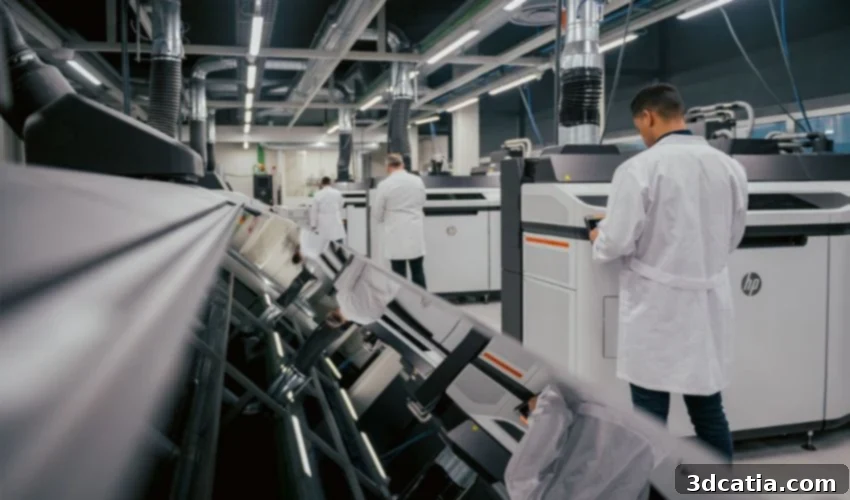
Revolutionizing Manufacturing: How HP Additive Manufacturing is Driving Local Production
The manufacturing landscape is undergoing a significant transformation. The traditional model of relocating production to find the cheapest labor is being replaced by a focus on building faster, more agile, and localized manufacturing ecosystems. Recent global events, including the pandemic and evolving geopolitical dynamics, have highlighted the critical need for responsive and adaptable workflows. In this evolving environment, additive manufacturing (AM) has emerged as a pivotal technology, accelerating development cycles and time to market without sacrificing product performance or quality. HP Additive Manufacturing Solutions (HP AM) is at the forefront of this revolution, demonstrating the ability of AM to deliver speed, reliability, and scalability.
HP AM continues to refine its Multi Jet Fusion (MJF) technology while expanding its reach into the filament market with high-temperature industrial solutions designed to meet the most demanding requirements. At Formnext 2025, HP AM showcased these advancements, along with new materials and strategic partnerships, all aimed at fostering local manufacturing sovereignty. The overarching goal is to democratize AM across various industries, empowering engineers and creators to design and produce superior products, regardless of their location.
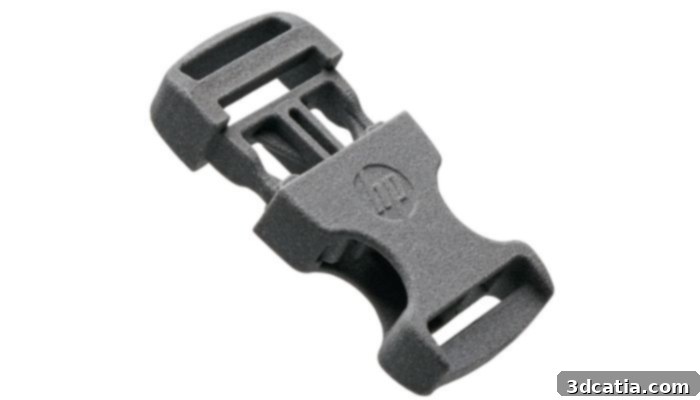
3D printed part with the HP 3D HR PA 11 Gen2 material
Driving Additive Manufacturing Adoption Through Advanced Materials
A key element of HP AM’s strategy is lowering the total cost of ownership (TCO) for additive manufacturing solutions. The company is actively reducing the cost per part, with current reductions of up to 20%, primarily through the development and introduction of innovative materials. The HP 3D HR PA 11 Gen2 material exemplifies this commitment, offering up to 80% powder reusability and a potential reduction of up to 40% in variable part costs. Notably, this material boasts the lowest carbon footprint among all MJF materials to date, further contributing to a reduced TCO for high-volume production applications. This focus on sustainable and cost-effective materials is critical for driving the widespread adoption of additive manufacturing.
In the realm of metal additive manufacturing, HP AM is dedicated to enhancing its Metal Jet technology through new material qualifications and alloy innovations. A prime example is the OptiPowder Ni718, which has recently been certified by both Continuum Powders and INDO-MIM Inc. for use with the HP Metal Jet S100 printer. This powder exhibits exceptional properties, including a density exceeding 98% after sintering, consistent hardness, and a low carbon content. These characteristics make it suitable for demanding applications in industries such as energy, defense, and aerospace, where performance and reliability are paramount.
HP AM’s commitment to material innovation extends beyond existing solutions. The company has announced the development of OptiPowder M247LC, a low-carbon, nickel-based superalloy, in collaboration with TECNALIA and Continuum Powders. This advanced material is engineered to withstand high temperatures and resist corrosion, making it an ideal choice for critical components in aerospace and energy applications. The development of such specialized materials is crucial for expanding the applicability of metal additive manufacturing and enabling the production of high-performance parts.
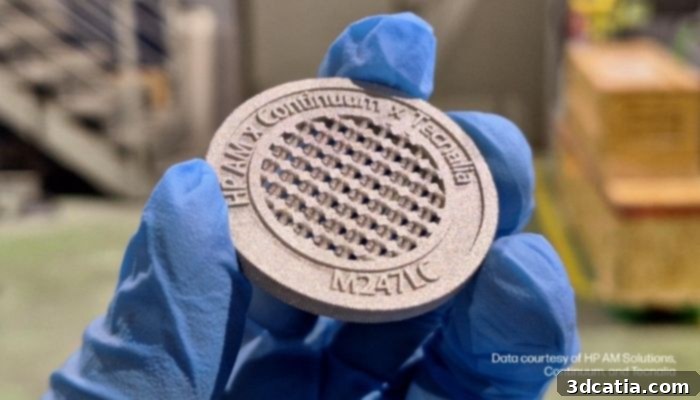
Metal 3D printed part with the OptiPowder M247LC
Strategic Partnerships for a Comprehensive Ecosystem
Beyond expanding material options and reducing TCO, HP AM is fostering the adoption of additive manufacturing through strategic partnerships that contribute to a fully integrated ecosystem, ultimately reshaping the future of production. A notable example is the collaboration with Würth Additive Group. This partnership aims to integrate HP’s advanced manufacturing solutions with Würth’s Digital Inventory Services and its extensive global logistics network. This synergistic integration empowers manufacturers to transition from traditional physical inventory management to on-demand spare parts production, regardless of their geographic location.
This collaborative effort ensures that validated parts are readily available in real-time, eliminating the delays associated with traditional sourcing and long lead times. Furthermore, the secure workflows implemented on HP printers provide users with a more agile and sustainable value chain. The partnership with Würth Additive Group highlights HP AM’s commitment to providing a comprehensive solution that extends beyond the printing process itself.
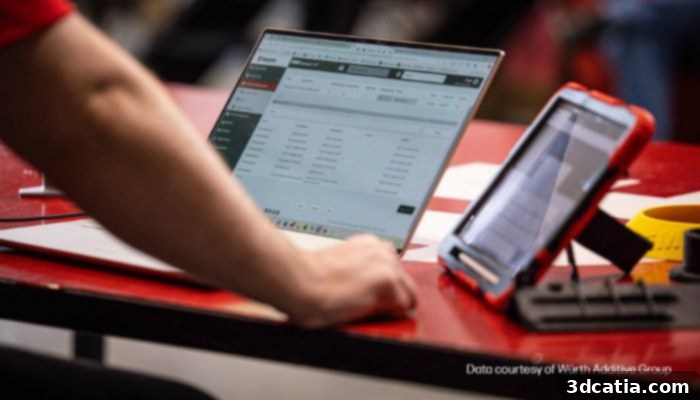
The integration allows manufacturers to transition from having a physical inventory to on-demand spare parts management
HP’s overarching objective is to create an end-to-end solution that promotes localized, on-demand production in a rapidly evolving global landscape. Alex Moñino, Vice President and General Manager of HP Additive Manufacturing Solutions, encapsulates this vision:
“What sets us apart is that we are not just selling machines; we are delivering end-to-end solutions for agile, on-demand production at scale. Our Multi Jet Fusion technology is built for speed, quality, and consistency, but our unique strength lies in seamless integration with design tools, a global support ecosystem, and the ability to help customers think beyond just part printing. From advanced material science to digital workflows and production-grade repeatability, HP AM is redefining what’s possible.”
HP AM’s presence at Formnext 2025 left a lasting impression, showcasing its dedication to delivering more than just a machine. The company’s goal is to offer a complete workflow that integrates seamlessly into existing manufacturing and design processes, enabling maximum agility – a capability that HP now refers to as a “competitive mandate.” This seamless integration is crucial for enabling businesses to adapt quickly to changing market demands and maintain a competitive edge.
The emphasis on creating an integrated ecosystem, from material development to digital workflows and global support, highlights HP AM’s holistic approach to additive manufacturing. By addressing the various challenges associated with adopting AM, HP AM aims to make the technology accessible to a wider range of businesses and industries.
The development of innovative materials like the HP 3D HR PA 11 Gen2 and the OptiPowder series is critical for expanding the application possibilities of additive manufacturing. These materials offer improved performance, reduced costs, and enhanced sustainability, making AM a more attractive option for a wider range of applications.
The strategic partnerships with companies like Würth Additive Group demonstrate HP AM’s commitment to building a robust ecosystem that supports the entire manufacturing process. These partnerships provide customers with access to a wider range of services and expertise, making it easier to adopt and implement additive manufacturing solutions.
The vision of localized, on-demand production aligns with the growing trend towards reshoring and regionalization of manufacturing. By enabling businesses to produce parts closer to their customers, HP AM is helping to reduce lead times, lower transportation costs, and improve responsiveness to market demands.
The ability to seamlessly integrate AM into existing manufacturing processes is crucial for its widespread adoption. HP AM’s focus on digital workflows and design tools makes it easier for businesses to incorporate AM into their existing operations.
Interested in learning more about HP AM’s solutions? Click HERE!
What do you think of HP’s strategy to prioritize local manufacturing? Let us know in a comment below or on our LinkedIn and Facebook pages. Don’t forget to sign up for our free weekly Newsletter here, the latest 3D printing news straight to your inbox! You can also find all our videos on our YouTube channel.
*Cover Image Credit: HP Additive Manufacturing Solutions