
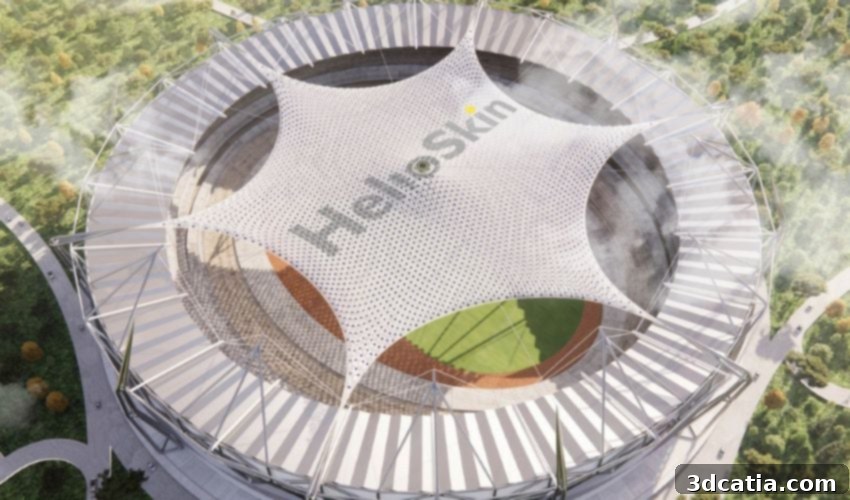
HelioSkin: Revolutionizing Solar Energy with 3D Printed, Biology-Inspired Flexible Panels
Traditional solar panels, with their rigid, flat, and often dark aesthetic, frequently present significant design challenges. Their static nature and visual impact can limit placement options and deter broader public adoption, especially in urban or architecturally sensitive environments. Recognizing these limitations, a visionary team of researchers at Cornell University embarked on a groundbreaking endeavor known as the HelioSkin project. Their innovative approach aims to fundamentally transform solar energy collection by making photovoltaic technology not only more attractive but also significantly more efficient and adaptable. Through cutting-edge 3D printing techniques, they are developing lightweight, fabric-like solar panels that can be seamlessly hinged together and conform to complex architectural shapes, thereby maximizing sunlight absorption and integrating harmoniously into diverse settings.
The ambitious HelioSkin project is a testament to interdisciplinary collaboration, bringing together leading experts from various fields. It is spearheaded by Jenny Sabin, the distinguished Arthur L. and Isabel B. Weisenberger Professor in Architecture within the College of Architecture, Art and Planning. Professor Sabin works closely with Itai Cohen, a revered professor of physics in the College of Arts and Sciences, and Adrienne Roeder, a prominent professor in the Section of Plant Biology within the School of Integrative Plant Science, part of the College of Agriculture and Life Sciences and the Weill Institute for Cell and Molecular Biology. This unique synergy of architecture, physics, and plant biology underpins HelioSkin’s innovative design and functional principles. United by a shared commitment to combating climate change, their overarching goal is to accelerate the reduction of global greenhouse gas emissions through advanced renewable energy solutions. Their promising start has been recognized with substantial support: in 2024, the team secured $650,000 from the National Science Foundation’s prestigious Convergence Accelerator program. Building on this momentum, they have applied for an impressive $5 million in funding over the next three years, underscoring the project’s potential and the confidence placed in its trajectory.

Jenny Sabin with the rest of the team behind HelioSkin (photo credits: Ryan Young/Cornell University)
The significance of projects like HelioSkin extends far beyond mere aesthetic improvements; it addresses a critical global challenge: the massive energy consumption and associated emissions from the built environment. According to estimates from the International Energy Agency (IEA), a staggering 40% of total greenhouse gas emissions in the United States alone originates from buildings. This encompasses everything from the construction process to the energy required for heating, cooling, and lighting throughout a building’s lifespan. By widely adopting solar energy technologies, particularly those that are integrated seamlessly into building design, there is a profound potential to reduce CO2 emissions from these sources by an estimated 28%. This figure is far from insignificant; it represents a substantial contribution to national and global climate goals. HelioSkin’s approach, which focuses on integrating photovoltaic capabilities into architectural surfaces, positions it as a pivotal solution for enhancing building energy efficiency and sustainability on an unprecedented scale, making buildings active participants in renewable energy generation rather than just passive consumers.
Biology-Inspired for Better Solar Products With HelioSkin: Embracing Biomimicry for Sustainable Design
A core philosophy driving Professor Sabin’s research, and a unifying thread across her various projects, revolves around a provocative question: How can buildings behave more like living organisms? This inquiry goes beyond superficial resemblance, delving into the adaptive, resilient, and resource-efficient strategies found in nature. The goal is to design structures that not only respond dynamically to their environments but also address pressing human needs for sustainability and energy. As Sabin articulated in an interview with the Cornell Chronicle, “Nature is not efficient; it’s resilient, and biology is in it for the long game, over much longer time scales.” This profound observation highlights a critical distinction: while human engineering often seeks peak efficiency at a single point, nature optimizes for long-term survival, adaptability, and regeneration. She further emphasized, “Additionally, it has been demonstrated that plants that track the sun exhibit a photosynthetic advantage. And we think that’s a pretty powerful way to think about sustainability and resiliency in architecture.” This perspective forms the bedrock of HelioSkin, drawing deep inspiration from the sophisticated, time-tested mechanisms of the natural world to create truly resilient and sustainable architectural solutions.
The project’s very name, HelioSkin, reflects this profound biological inspiration. The prefix “helio-” is derived from the Greek word hēlios, meaning “sun.” This directly points to one of the central pillars of the HelioSkin project: the rigorous study of heliotropism. Heliotropism is a fascinating botanical phenomenon referring to the directional growth or movement of a plant in response to sunlight. Iconic examples include sunflowers turning their heads to follow the sun across the sky, a process that maximizes their exposure to solar radiation and, consequently, their photosynthetic efficiency. HelioSkin aims to replicate this adaptive capability in built environments, allowing solar collection surfaces to dynamically orient themselves for optimal energy capture throughout the day. To achieve this, the project meticulously integrates insights from architecture, engineering, mathematics, and, crucially, biology. For the latter, the unassuming yet scientifically significant plant known as Arabidopsis thaliana (a common model organism in plant biology) has been of particular use. Researchers have delved into its cellular mechanics, studying at a microscopic level how its cells facilitate changes in the curvature of the plant’s stem, enabling it to angle precisely towards sunlight. This fundamental biological understanding is being translated into the design of responsive materials and structures for solar energy collection, offering an unprecedented level of adaptability.
The tangible results of this groundbreaking research are already taking shape. For now, the HelioSkin project has successfully produced small-scale solar canopies designed for residential backyards, offering an attractive and functional way for homeowners to generate clean energy. Crucially, these prototypes are engineered with scalability in mind, meaning their design principles and fabrication methods can be expanded to create much larger installations suitable for urban parks and other public spaces. The creation of these innovative structures involves a sophisticated fusion of computational design, digital fabrication, and advanced 3D printing technologies. This tripartite approach allows the team to generate highly customized filters and photovoltaic panel assemblies. These aren’t just energy collectors; they are designed to boost both light absorption through their dynamic forms and overall architectural beauty, transforming functional elements into aesthetic features. The ambitious ultimate goal of HelioSkin is to develop a mechanically tracking, solar-collection “skin” that can be applied to a wide array of large-scale architectural forms, including retractable stadium roofs, the expansive surfaces of modern skyscrapers, and adaptable building facades. Such a system would enable these structures to actively respond to solar conditions, significantly enhancing energy generation and contributing to a more sustainable built environment.

A closer look at HelioSkin which is a lightweight, stretchable architectural fabric (photo credits: Ryan Young/Cornell University)
Professor Sabin’s vision for HelioSkin transcends mere technological advancement; it encapsulates a holistic approach to sustainability that integrates performance, function, and aesthetic appeal. “What we’re really passionate about is how the system could not only produce energy in a passive way, but create transformational environments in urban or urban-rural settings,” Sabin passionately concludes. This statement underscores the project’s ambition to foster spaces that are not only energy-independent but also enrich the lives of inhabitants and enhance the ecological balance of their surroundings. She articulates a vital truth about public engagement with sustainable solutions: “Sustainability is about performance and function, but equally, it’s about beauty and getting people to get excited about it, so they want to participate.” This insight highlights the critical role of design in driving widespread adoption. If sustainable technologies are beautiful, engaging, and seamlessly integrated into our daily lives, people are far more likely to embrace them. The “grand goal” for HelioSkin, therefore, is not just to refine solar panel technology, but “to inspire widespread adoption of solar for societal impact.” This means creating a future where solar energy is not an industrial eyesore but an integral, elegant, and celebrated component of our architectural landscape, actively contributing to a healthier planet and more vibrant communities.
The innovative spirit behind the HelioSkin project resonates strongly with other pioneering initiatives in sustainable architecture and material science. It is notably reminiscent of Solar Gate, another groundbreaking project where researchers from the University of Stuttgart and Freiburg drew inspiration from nature to develop a self-sufficient façade system capable of adapting dynamically to changing weather conditions. Both projects exemplify a distinct and rapidly accelerating trend: the powerful combination of 3D printing and biomimicry for creating superior, more resilient, and environmentally harmonious designs. 3D printing, with its unparalleled ability to create complex geometries and intricate internal structures, is uniquely suited to translate the intricate designs found in nature into functional products. This enables engineers and designers to mimic biological processes and forms, leading to breakthroughs in efficiency, material usage, and adaptability that conventional manufacturing methods cannot achieve. HelioSkin stands at the forefront of this exciting intersection, pushing the boundaries of what is possible in renewable energy and sustainable design. You can find out more detailed information about the HelioSkin project and its ongoing research HERE.
We’d love to hear your thoughts on HelioSkin and its potential to reshape our cities and energy infrastructure! Let us know what you think in a comment below or join the conversation on our LinkedIn, Facebook, and Twitter pages! Don’t forget to sign up for our free weekly Newsletter here to receive the latest 3D printing news straight to your inbox! You can also find all our compelling videos and project spotlights on our YouTube channel.
*Cover Photo Credits: Jenny Sabin/Cornell University