
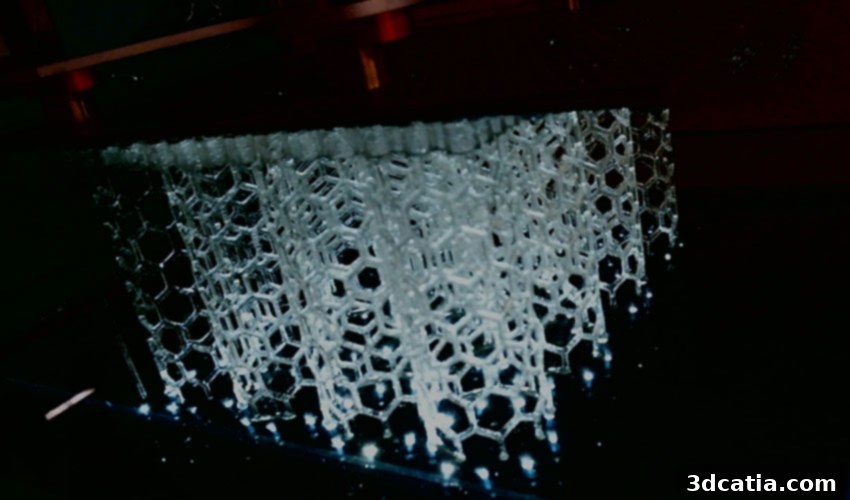
HARP 3D Printer: Northwestern University’s Breakthrough in High-Speed, Large-Scale Additive Manufacturing
The landscape of additive manufacturing is constantly evolving, with researchers and innovators pushing the boundaries of what’s possible in terms of speed, size, and material versatility. For years, one of the primary challenges in 3D printing has been the inherent trade-off between print speed and the size of the objects being produced. High-speed printers often sacrifice the ability to create larger parts, while printers designed for large-scale production tend to operate at significantly slower rates. This fundamental limitation has constrained the widespread industrial adoption of 3D printing for certain applications, particularly those requiring mass production or the creation of substantial components.
However, a groundbreaking development from Northwestern University in Illinois promises to redefine these boundaries. Researchers have engineered a revolutionary new 3D printer, known as HARP (High-Area Rapid Printing), that boasts an unprecedented print speed of approximately half a yard (46 cm) per hour. This remarkable throughput represents a significant leap forward in the world of 3D printing, potentially unlocking new industrial applications and accelerating manufacturing processes. HARP’s innovative system is built upon a patent-pending version of SLA (Stereolithography) technology, a widely recognized method known for its high resolution and detailed output, but traditionally limited in speed and size.
Understanding the Current State: Carbon’s CLIP Technology and its Limitations
To appreciate the magnitude of HARP’s achievement, it’s essential to understand the existing benchmarks in rapid 3D printing. Today, Carbon’s CLIP (Continuous Liquid Interface Production) technology is widely regarded as one of the fastest and most sophisticated solutions available on the market. CLIP operates by shining ultraviolet (UV) light through an oxygen-permeable window into a vat filled with liquid photopolymer resin. This innovative approach creates a “dead zone” or unpolymerized layer of resin at the bottom, directly above the oxygen-permeable window. The oxygen inhibits the resin from curing in this specific region, allowing a continuous flow of liquid resin to be supplied to the growing part.
Above this dead zone, where oxygen levels are lower, the resin hardens instantly when it comes into contact with the ultraviolet light. Simultaneously, a robotic arm continuously pulls the solidified resin upwards, out of the resin tank, creating a seamlessly formed object. The continuous nature of this process, without the need for traditional layer-by-layer lifting and re-dipping, is what grants CLIP its impressive speed and ability to produce strong, isotropic parts. The efficiency and reliability of this technology have led many prominent companies, such as Adidas, Riddell, and Ford, to collaborate with Carbon for the manufacturing of complex and functional components, ranging from athletic footwear midsoles to automotive parts and protective gear.
However, even with its advanced capabilities, Carbon’s CLIP technology faces a significant limitation: the size of the objects it can produce. Due to the inherent mechanics of its heat management system and the design of its oxygen-permeable window, objects printed with CLIP technology cannot exceed a cross-sectional area of approximately 41.4 cm by 25.9 cm. This restriction, while suitable for many applications, means that industries requiring larger components or higher production volumes of substantial parts still seek faster and more efficient solutions. This is precisely the gap that Northwestern University’s HARP technology aims to fill, promising to overcome the long-standing compromise between speed and scale in additive manufacturing.
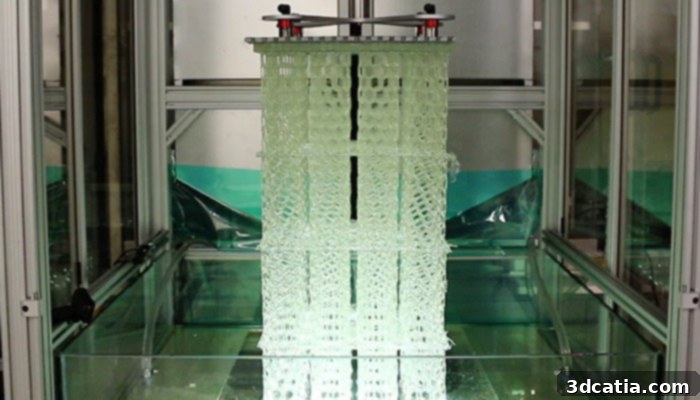
HARP 3D printing process | Credits: Northwest University
HARP’s Revolutionary Technology: Unleashing Throughput in 3D Printing
The introduction of HARP’s 3D printing process marks a potential paradigm shift in the industry. Traditionally, the quest for larger printed parts has often come at a significant cost, whether in terms of dramatically reduced printing speed, diminished throughput, or compromised resolution and surface finish. The brilliance of HARP lies in its ability to defy this conventional trade-off. The new technology promises to deliver both high speed and large part capabilities without sacrificing the quality or intricacy of the printed objects.
The prototype HARP system is an impressive piece of engineering, standing at an imposing 13 feet tall and featuring a substantial 2.5 square-foot print bed. This large build volume, combined with its record-breaking speed of approximately half a yard (46 cm) per hour, positions HARP as a game-changer for industrial applications. Chad A. Mirkin, the visionary leader behind the product’s development, eloquently encapsulates its potential: “3D printing is conceptually powerful but has been limited practically. If we could print fast without limitations on materials and size, we could revolutionize manufacturing. HARP is poised to do that.” This statement highlights the core ambition of HARP: to liberate 3D printing from its historical constraints and unlock its full potential as a transformative manufacturing tool.
Overcoming the Heat Hurdle: HARP’s Innovative Cooling System
Like Carbon’s CLIP technology, HARP’s system prints vertically, leveraging ultraviolet light to cure liquid resins into hardened plastic. This method allows HARP to produce a diverse range of materials, including hard, elastic, and even ceramic parts, opening doors to myriad applications across various industries such as aerospace, automotive, medical, and consumer electronics. The ability to print with such material versatility at high speeds and large scales makes HARP particularly attractive for advanced manufacturing processes.
However, a critical factor that often limits the performance of high-speed 3D printers, especially those utilizing photopolymerization, is heat generation. The curing process itself is exothermic, and at higher printing speeds, the accumulation of heat can quickly become problematic. This excess heat can cause printed parts to warp, crack, or delaminate, compromising their structural integrity and dimensional accuracy. Consequently, traditional 3D printers have been forced to operate within strict speed or size limits to effectively dissipate this heat. When pushed for great speed, the objects invariably need to remain small to manage thermal stress.
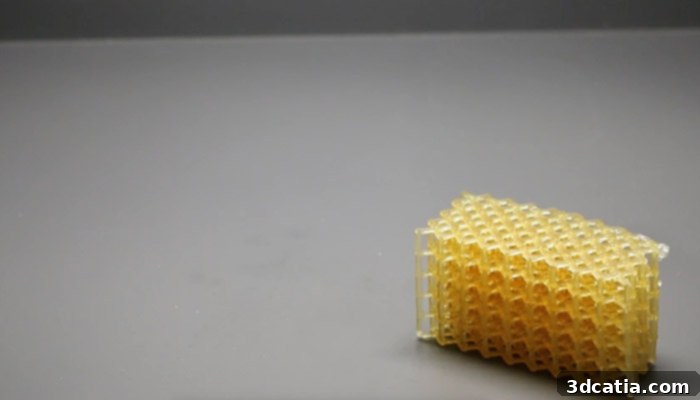
It can print pieces that are hard, elastic or even ceramic | Credits: Northwest University
This is where HARP’s true ingenuity shines. To ingeniously circumvent the pervasive issue of heat accumulation, researchers at Northwestern University developed a novel and highly effective heat dissipation system. They utilize a specialized nonstick liquid, which behaves remarkably like liquid Teflon, an exceptional material known for its thermal management properties. This unique liquid is designed to flow continuously over the printer’s projection window, actively drawing heat away from the curing resin and the print area. Once it has absorbed the heat, the liquid then circulates through a dedicated cooling unit, where the thermal energy is efficiently removed before the liquid is recirculated back into the system.
Chad Mirkin further elaborated on this critical innovation, explaining, “Our technology generates heat just like the others. But we have an interface that removes the heat.” This simple yet profound statement underscores the core principle behind HARP’s breakthrough. Instead of trying to prevent heat generation—an impossible task with exothermic reactions—the HARP system focuses on managing and removing it with unprecedented efficiency. This active cooling mechanism is the cornerstone that allows HARP to print at exceptionally high speeds and produce large-volume parts simultaneously, without succumbing to the thermal limitations that plague other additive manufacturing technologies. The ability to control and dissipate heat effectively means that the structural integrity, resolution, and material properties of the printed objects are maintained, even under rapid production conditions.
The Future of Manufacturing: HARP’s Impact and Commercialization
By successfully tackling the long-standing challenge of heat management, HARP distinguishes itself as the first 3D printer capable of handling not only small, intricate parts but also large batches and substantial components with equal ease and speed. This capability represents a significant leap forward for industrial manufacturing, where the production of large, functional parts quickly and economically has remained a holy grail. For industries requiring prototyping of full-scale models, production of end-use parts, or even the creation of molds and tooling, HARP offers an unprecedented advantage.
Mirkin’s vision for the impact of this technology is clear and ambitious: “When you can print fast and large, it can really change the way we think about manufacturing.” This change could manifest in several ways: enabling on-demand production of large customized parts, reducing lead times for complex components, decentralizing manufacturing closer to the point of need, and fostering new design possibilities that were previously uneconomical or technically infeasible. The potential for mass customization of large items, from furniture to industrial machinery components, becomes a tangible reality with HARP.
The implications for sectors such as automotive, aerospace, defense, and construction are particularly profound. Imagine rapidly printing bespoke vehicle parts, large structural components for aircraft, or customized medical devices that perfectly fit individual patient needs, all at speeds that rival traditional manufacturing methods. HARP’s capacity to work with diverse materials, including robust ceramics and flexible elastomers, further broadens its appeal, offering solutions for demanding engineering applications. This versatility ensures that HARP is not just a faster printer, but a more adaptable and powerful manufacturing tool overall.
The excitement surrounding HARP is not merely academic; there are concrete plans for its commercial deployment. It is predicted that this novel 3D printer will be made commercially available to industries and businesses within the next 18 months. This timeline suggests a rapid transition from advanced research to market-ready product, indicating strong confidence in the technology’s readiness and its potential to disrupt the manufacturing landscape. The introduction of HARP could herald a new era of additive manufacturing, characterized by unparalleled speed, expansive scale, and versatile material capabilities, ultimately pushing the boundaries of what industries can achieve with 3D printing.
What are your thoughts on this incredible new technology and its potential to revolutionize industries? Do you believe HARP will truly bridge the gap between speed and size in 3D printing? Share your insights and predictions in a comment below, or join the conversation on our Facebook and Twitter pages! Don’t forget to sign up for our free weekly Newsletter to stay updated with all the latest news, innovations, and breakthroughs in the dynamic world of 3D printing, delivered straight to your inbox!