

Revolutionizing Additive Manufacturing: University of Toronto Transforms Used Cooking Oil into Sustainable 3D Printing Resin
In a groundbreaking stride towards sustainable innovation, a dedicated team of researchers at the University of Toronto has achieved a remarkable feat: successfully transforming used cooking oil, sourced directly from a local McDonald’s restaurant, into a high-resolution, biodegradable 3D printing resin. This pioneering project not only highlights the immense potential of 3D printing technologies in addressing contemporary environmental challenges but also brilliantly showcases how creative science can add significant value to what was once considered mere food waste. The process yielded an impressive 420 mL (approximately 14 fluid ounces) of liquid resin from just one liter of used oil, which the team then utilized to elegantly 3D print a collection of intricate butterflies. Crucially, the developed resin demonstrated robust physical properties, remaining stable and exhibiting no signs of crumbling or melting even above standard room temperatures, proving its viability as a functional material for additive manufacturing. This initiative stands as a powerful testament to the circular economy, transforming a common waste product into a cutting-edge resource for advanced manufacturing.
Beyond its nutritional implications, frying oil carries significant environmental burdens, particularly after its initial use. Globally, a substantial amount of used cooking oil is improperly disposed of, often being poured down residential and commercial sinks. This seemingly innocuous act contributes to widespread issues such as clogged pipes due to the accumulation of grease, which can lead to costly plumbing repairs and environmental pollution if it enters waterways. Recognizing these challenges, various initiatives have emerged to promote the recycling and beneficial reuse of this ubiquitous waste product. The fast-food industry giant, McDonald’s, for instance, has demonstrated a commitment to sustainability by implementing programs to convert its used frying oil into biofuel. This impressive undertaking processes a staggering 35,000 liters (equivalent to 9,245 gallons) of used oil each month, resulting in an annual saving of 420,000 liters (approximately 110,950 gallons) of crude oil. Originating in India, this biofuel initiative has met with considerable success, serving as a powerful example of corporate environmental responsibility. Such projects are vital in drawing greater public and industry attention to these critical environmental issues, which are regrettably often overlooked or forgotten by the average consumer.
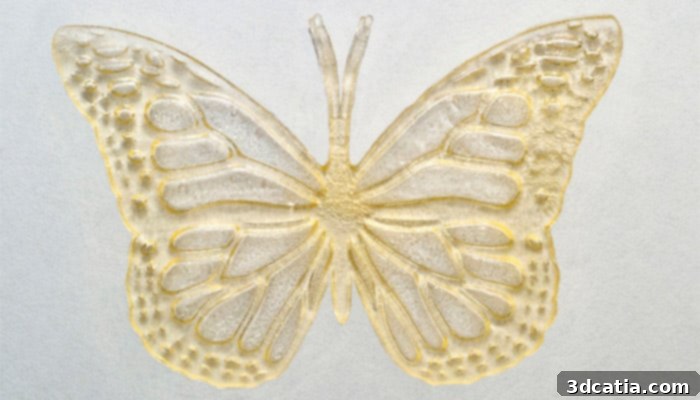
One of the stunning 3D printed butterflies, showcasing the resin’s detail | Credits: Don Campbell
From Fryer to Fabricator: The Scientific Breakthrough Behind McDonald’s 3D Printing Resin
The innovative spirit driving this University of Toronto project began with a fundamental observation about the nature of materials. Professor Andre Simpson, a leading figure in the university’s Department of Physical and Environmental Sciences and a key mind behind this research, noted that the vast majority of conventional plastics are derived from synthetic, man-made components. These artificial polymers pose a significant challenge for natural ecosystems to break down and assimilate. Professor Simpson articulates this critical distinction: “If plastics are a problem, it’s because nature has not evolved to process man-made chemicals. Because we use what is essentially a natural product – in this case fats from cooking oil – nature can handle them much better.” This insight formed the cornerstone of their research, guiding them towards a solution rooted in natural biodegradability.
The researchers meticulously analyzed the chemical composition of used frying oil and made a pivotal discovery: the grease molecules within the oil possessed fundamental characteristics strikingly similar to those found in commercial resins. This crucial finding confirmed the feasibility of their ambitious project. With this scientific validation, the team embarked on the next phase, reaching out to various restaurants and fast-food chains in search of used frying oil. McDonald’s was the only establishment to enthusiastically agree to participate, providing the essential raw material for this groundbreaking research. Employing a remarkably simple, one-step chemical process, the University of Toronto researchers successfully transformed one liter of used cooking oil into 420 mL of a novel plastic resin. This newly developed material was not only compatible with standard 3D printers but also demonstrated exceptional promise. To unequivocally showcase the transformative potential of this chemical innovation, the team proceeded to 3D print several delicate butterflies. These intricate models exhibited impressive physical and chemical properties, conclusively proving that the material is as effective and versatile as established resins currently available in the rapidly expanding additive manufacturing market. This ease of conversion and the robust performance of the resulting resin represent a significant leap forward in creating accessible and sustainable materials for 3D printing.
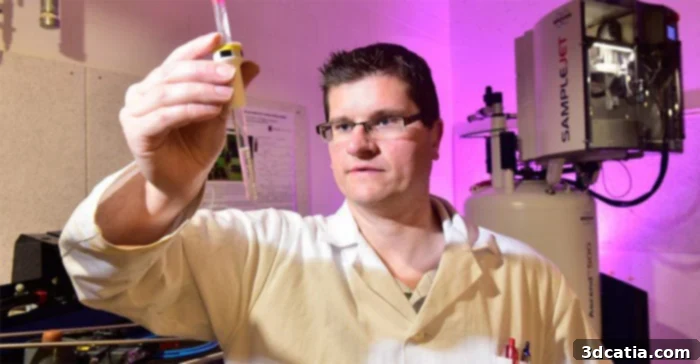
Professor Andre Simpson, the visionary behind the novel 3D printing resin derived from used cooking oil | Credits: Don Campbell
Sustainable Solutions: Economic and Ecological Benefits
Beyond its environmental credentials, this revolutionary resin offers compelling economic advantages. The production cost of this bio-derived resin is significantly lower than that of its conventional counterparts. According to the research team, manufacturing this sustainable resin costs merely $300 per tonne. This stands in stark contrast to commercial resins derived from fossil fuels, which can escalate to prices as high as $525 per liter, largely due to their more intricate and energy-intensive production processes, coupled with the fluctuating costs of petrochemical raw materials. This dramatic cost reduction makes the used-oil-derived resin an incredibly attractive alternative, potentially democratizing access to 3D printing materials and fostering wider adoption of additive manufacturing in various sectors, from education and prototyping to specialized industrial applications. The economic viability further bolsters the argument for transitioning towards more sustainable material sources, promising a win-win for both the planet and manufacturers’ bottom lines.
Perhaps the most impactful characteristic of this new material is its inherent biodegradability. Unlike traditional plastics that persist in the environment for hundreds, if not thousands, of years, this resin is designed to naturally decompose. To demonstrate this crucial feature, the researchers conducted a simple yet effective experiment: they buried one of the 3D printed butterflies in the ground. A mere two weeks later, the buried butterfly had already lost a remarkable 20% of its initial weight. This rapid decomposition is attributed to the resin’s primary composition of fat. As Professor Andre Simpson explains, “Microbes like fat, they like to eat it so they do a good job of breaking it down.” The microorganisms present in the soil readily consume the fatty acids, effectively breaking down the resin’s molecular structure and returning its components to the natural carbon cycle. This accelerated biodegradation offers a robust solution to the pervasive problem of plastic waste, significantly reducing landfill burden and preventing long-term ecological damage. The ability to create complex, functional objects that can naturally return to the earth after their useful life cycle represents a paradigm shift in material science and sustainable manufacturing, moving us closer to a truly circular economy.
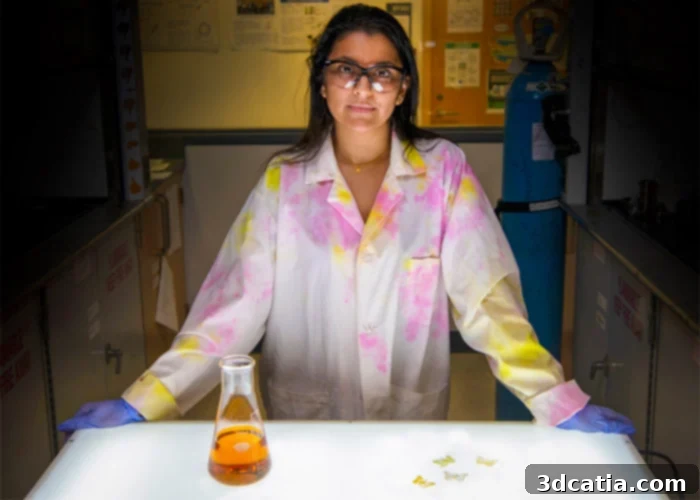
Rajshree Biswas, a PhD student in Professor Simpson’s lab, proudly displays the 3D printed butterflies | Credits: Don Campbell
Pioneering a Greener Future in Additive Manufacturing
The University of Toronto has established itself as a hub for innovative research into the recycling of food waste and its application in advanced manufacturing. This latest breakthrough involving used cooking oil is not an isolated incident but rather part of a broader institutional commitment to sustainability. Just a few months prior, former students from the university successfully launched a startup named Genecis. This pioneering company is dedicated to designing and producing 3D printing filaments derived directly from various food waste streams. Such initiatives underscore a concerted effort within the university community to explore and develop novel solutions for transforming waste into valuable resources, thereby fostering a more circular and sustainable economy. These parallel projects demonstrate a strong and consistent institutional focus on developing eco-friendly alternatives for the additive manufacturing industry, paving the way for a future where waste is not simply discarded but reimagined as a raw material.
The implications of the University of Toronto’s discovery extend far beyond merely creating another material. This development offers a truly viable and scalable solution for recycling one of the most common and problematic waste products: used cooking oil. Imagine the global impact if every fast-food restaurant, every commercial kitchen, and even every household could contribute to this cycle, transforming their waste into a resource for manufacturing, prototyping, and even art. This technology could significantly reduce the environmental footprint associated with both waste disposal and plastic production, moving us closer to a world where industrial processes work in harmony with natural cycles. The potential for this biodegradable resin to revolutionize various industries, from consumer goods to specialized medical applications, is immense. It provides a blueprint for how academic research, coupled with industrial partnerships like that with McDonald’s, can drive meaningful change. We eagerly anticipate the further advancements and widespread adoption of this incredible innovation, hoping it sets a precedent for a new generation of sustainable materials.
What are your thoughts on this inspiring initiative? Do you envision other waste streams that could be similarly valorized through 3D printing technologies? We invite you to share your perspectives and comments below, or engage with us on our vibrant Facebook and Twitter pages! Don’t forget to sign up for our free weekly Newsletter to receive all the latest news, breakthroughs, and exciting developments in the world of 3D printing delivered straight to your inbox!