
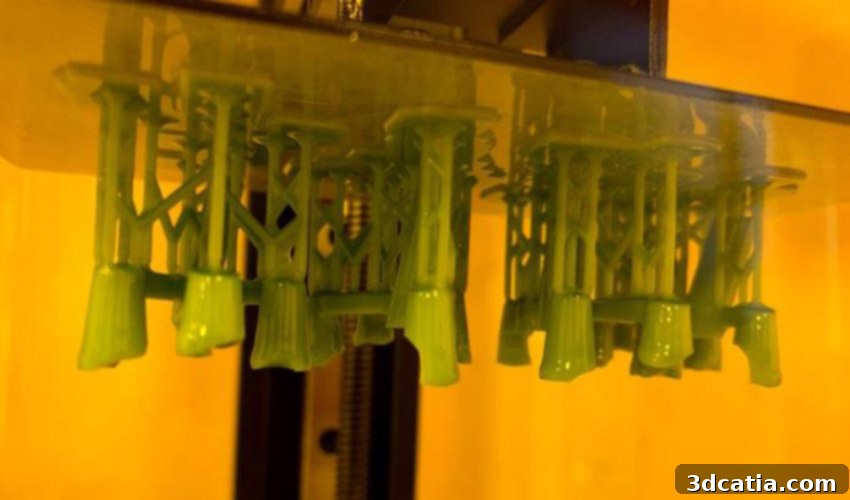
Copper3D Unveils Glaciarys AR3: Revolutionizing Medical 3D Printing with Advanced Antiviral Resin
In a significant stride towards enhancing patient safety and advancing medical technology, Copper3D, the pioneering Chilean-American company, has once again demonstrated its unwavering commitment to innovation within the healthcare sector. Building on its impactful research into antiviral and antimicrobial materials, Copper3D has officially launched Glaciarys AR3, a groundbreaking antiviral resin designed to meet the stringent demands of medical applications. This latest development underscores the critical intersection of advanced 3D printing techniques and medicine, offering a tangible solution to ongoing challenges in infection control and personalized healthcare.
Copper3D is no stranger to developing materials that tackle pressing global health concerns. The company previously garnered international recognition for its innovative 3D printed breast pump tip, a device engineered to combat HIV transmission during breastfeeding. This earlier success set a precedent for their dedication to leveraging additive manufacturing for critical medical interventions. With Glaciarys AR3, Copper3D expands its portfolio beyond antimicrobial FDM (Fused Deposition Modeling) materials, strategically pivoting towards Stereolithography (SLA) technology. This shift is driven by the unparalleled precision, intricate detail, and superior resolution that SLA offers, which are increasingly vital for complex biomedical applications.
The Strategic Shift to SLA: Precision for Medical Excellence
The decision by Copper3D to embrace SLA technology was not made lightly. It emerged from direct feedback and specific requirements from leading surgeons and dentists who sought materials of exceptional quality for highly sensitive procedures. These medical professionals require materials that are not only high-performing but also inherently safe and effective in surgical environments. Daniel Martinez, Director of Innovation at Copper3D, articulates the motivation behind this strategic evolution: “The new Glaciarys AR3 resin that we are about to launch responds directly to very specific requests from some surgeons and dentists who asked us for a high-performance antimicrobial material that could be used safely in surgical conditions.”
Martinez further elaborated on why SLA technology became the focus for this next-generation material: “This is how we thought of a solution beyond FDM technology and focused on SLA due to its high quality characteristics, excellent resolution, and the ability to prototype different formulations of resins and concentrations of additives that resulted in an ‘all-terrain’ resin, with an accessible price, but at the same time, ideal for this type of request in the field of biomedical 3D printing.” This statement highlights several critical advantages. SLA’s ability to produce parts with extremely fine features and smooth surface finishes is paramount for medical devices that interact with biological tissues. Furthermore, the capacity to rapidly prototype and test diverse resin formulations allowed Copper3D to fine-tune Glaciarys AR3, ensuring it met the rigorous performance and safety standards required by the medical community while remaining economically viable.
The transition from FDM, a technology known for its robustness and cost-effectiveness in many industrial applications, to SLA signifies a deliberate choice to prioritize precision and material versatility for medical-grade products. FDM, while excellent for many prototyping and functional part applications, often struggles to achieve the fine details and smooth finishes crucial for devices that require intimate contact with human anatomy or sterile surgical environments. SLA, conversely, uses a light source to cure liquid resin, enabling the creation of intricate geometries with superior surface quality, making it an ideal choice for medical models, guides, and patient-specific instruments where accuracy is non-negotiable.
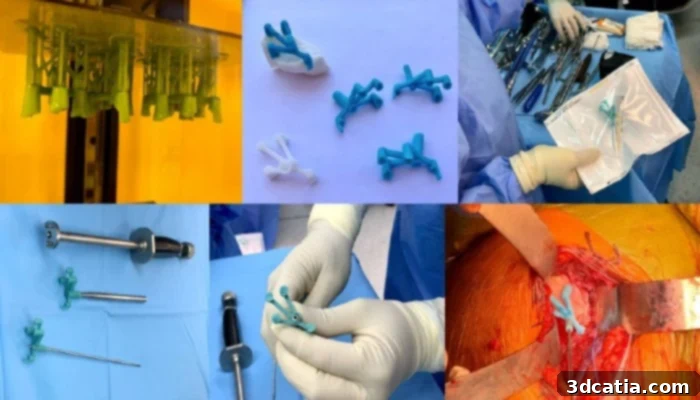
Several medical devices designed with Glaciarys AR3 resin (photo credits: Copper3D)
Glaciarys AR3 in Action: A Game-Changer for Surgical Planning
The practical utility of Glaciarys AR3 has already been successfully demonstrated in a real-world medical scenario, showcasing its immense potential. Orthopedic surgeon Reinares and his dedicated team were among the first to rigorously test the new resin. Their application involved designing and 3D printing a custom surgical guide specifically for a complex shoulder arthroplasty operation. This intricate procedure demands extreme precision, as even minor misalignments can lead to adverse patient outcomes and necessitate revision surgeries.
The ability to 3D print patient-specific surgical guides offers profound benefits. These guides act as templates during surgery, ensuring that bone cuts, implant placements, and other critical steps are executed with unparalleled accuracy. By using Glaciarys AR3, Surgeon Reinares and his team were able to create a guide that not only fit the patient’s unique anatomy perfectly but also possessed inherent antiviral and antimicrobial properties, adding an extra layer of safety to the surgical environment. The successful execution of this first step confirmed Glaciarys AR3’s exceptional suitability for such demanding applications, demonstrating its reliability and effectiveness in a clinical setting.
The success in orthopedics also strongly suggests that Glaciarys AR3 is not limited to a single medical specialty. Its properties make it an ideal candidate for a broad spectrum of other areas, most notably dentistry. In dentistry, applications could include custom dental models for diagnostic purposes, highly accurate surgical guides for implant placement, temporary crowns or bridges, and even patient-specific orthodontic appliances. The material’s “all-terrain” nature, as described by Copper3D, means it is robust enough for functional use while offering the detailed resolution needed for intricate medical and dental devices. Beyond specialized medical practitioners, Glaciarys AR3 is also poised to empower a wider community, including innovative makers, advanced FabLabs, and other professional teams involved in custom medical device prototyping and production. This broader accessibility could catalyze further innovation, allowing more individuals and organizations to develop and test patient-specific solutions with enhanced safety features.
Ensuring Uncompromised Safety: Biocompatibility and ISO Certification
Perhaps one of the most critical aspects of any material intended for medical use is its biocompatibility and safety profile. Glaciarys AR3 excels in this regard, having already undergone and successfully passed stringent ISO22196 tests, yielding outstanding results. ISO22196 is an international standard that specifies a method of evaluating the antimicrobial activity of plastics and other non-porous surfaces. For medical devices, this certification is paramount, as it provides verifiable proof that the material actively inhibits microbial growth and is safe for human contact, particularly in environments where sterility and infection control are critical.
The new resin particularly distinguished itself with its remarkable ability to eliminate common and often dangerous pathogens: Escherichia coli (E. coli) and Staphylococcus aureus. E. coli is a bacterium commonly associated with various infections, including urinary tract infections and gastrointestinal illnesses, while Staphylococcus aureus is a leading cause of hospital-acquired infections (HAIs), including dangerous MRSA (Methicillin-resistant Staphylococcus aureus) infections. The effectiveness of Glaciarys AR3 against these formidable bacteria is a significant achievement, offering a proactive defense against cross-contamination and reducing the risk of infection in clinical settings. This capability is not just an added feature; it is a fundamental safety mechanism that can contribute significantly to reducing healthcare-associated infections, thereby improving patient outcomes and alleviating the burden on healthcare systems.
By incorporating antiviral and antimicrobial properties directly into the material, Glaciarys AR3 mitigates the risk of pathogens colonizing the surface of 3D printed medical devices. This inherent protective quality is particularly valuable for instruments, guides, and models used in or near sterile fields, ensuring that the devices themselves do not become vectors for infection. Copper3D’s commitment to rigorous testing and international certification underscores their dedication to producing materials that are not only innovative but also meet the highest standards of safety and efficacy required for global medical applications.
Availability and The Future Landscape of Medical 3D Printing
The introduction of Glaciarys AR3 marks a pivotal moment in the evolution of medical 3D printing. This antiviral resin is poised to redefine the standards for safety and functionality in patient-specific medical devices and instruments. According to Copper3D, Glaciarys AR3 will soon be widely available throughout its extensive global distributor network. This widespread availability means that medical facilities, research institutions, and advanced manufacturing hubs worldwide will be able to access this innovative material, integrating it into their workflows for improved patient care and advanced medical solutions. A comprehensive list of authorized distributors can be found HERE, making it convenient for interested parties to procure this cutting-edge resin.
The implications of Glaciarys AR3 extend far beyond its immediate applications. It represents a significant step forward in making additive manufacturing an even more integral part of modern medicine. As the demand for personalized medicine and on-demand manufacturing of medical devices grows, materials like Glaciarys AR3 will be crucial in enabling healthcare providers to deliver tailor-made solutions with unprecedented levels of safety and efficiency. Copper3D continues to position itself at the forefront of this technological revolution, consistently pushing the boundaries of what is possible with 3D printing in the medical sector. Their ongoing research and development promise a future where advanced materials play an even greater role in safeguarding health and improving quality of life globally.
What are your thoughts on Copper3D’s Glaciarys AR3 antiviral resin and its potential impact on medical 3D printing? Share your insights in a comment below or join the conversation on our Facebook, Twitter, and LinkedIn pages. Don’t miss out on the latest advancements in additive manufacturing – sign up for our free weekly Newsletter here to receive the freshest 3D printing news directly in your inbox!