
HV-001: A Generative Design Supercar Concept Redefining 3D Printed Mobility
The automotive world is constantly pushing the boundaries of design, engineering, and manufacturing. Today, we delve into a concept that embodies this forward-thinking spirit: the HV-001. Far from being a tangible 3D-printed car in existence right now, this is a visionary concept born from the powerful synergy of advanced algorithms and generative design principles. The HV-001 represents a hypothetical hybrid supercar, meticulously envisioned to leverage the unparalleled capabilities of modern 3D printing technology. At the helm of this groundbreaking project is architect and 3D designer Ayoub Ahmad, whose innovative approach utilizes highly organic forms, intricate meshes, and complex geometries to craft a truly unique vehicle. The stunning result is a futuristic car that immediately captures attention, sparking curiosity and wonder in anyone who encounters its extraordinary design.
At the heart of the HV-001’s innovative design methodology lies generative design, a revolutionary computational technique that allows engineers and designers to rapidly generate multiple design iterations based on a predefined set of constraints and performance objectives. This powerful tool enables an incredibly swift exploration of numerous design options, often revealing solutions that would be impractical or impossible to discover through traditional manual design processes. Generative design has gained immense popularity across a wide spectrum of manufacturing industries because of its profound ability to optimize various aspects of a part’s performance, including its lightness, structural strength, material efficiency, and overall functionality. It opens up entirely new design avenues, inspiring designers to push the limits of creativity and engineering, often leading to shapes and structures previously deemed unattainable. In the realm of additive manufacturing, or 3D printing, generative design amplifies this freedom even further. Since 3D printing technology is capable of reproducing virtually any complex shape or internal lattice structure, the constraints typically associated with conventional manufacturing methods are significantly reduced. It is with this profound potential in mind that Ayoub Ahmad conceptualized the HV-001, employing generative design to propose a truly futuristic supercar that is not just aesthetically radical but also theoretically optimized for additive manufacturing.
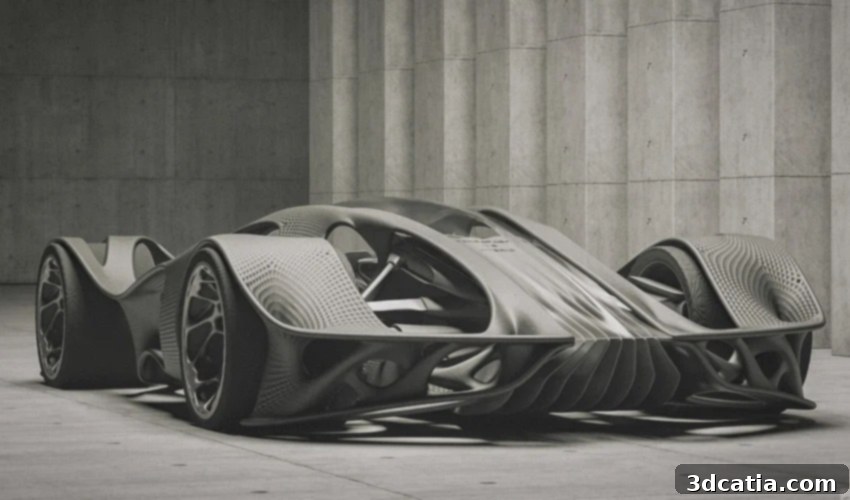
The design of the HV-001 is strikingly futuristic, inspired by organic forms and optimized for advanced manufacturing techniques (photo credits: Ayoub Ahmad)
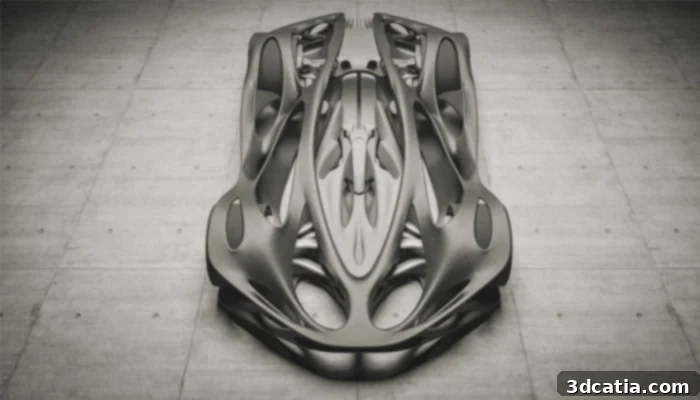
Ayoub Ahmad elaborates on the core philosophy behind his creation, stating, “The idea was to imagine what a futuristic sports car might look like in the near future, featuring a bio-inspired design that could be manufactured with revolutionary new 3D printing processes, and powered by advanced electric motors combined with a combustion engine.” He further explained the intricate workflow involved in bringing such a complex vision to life: “The workflow was a mix of polygonal mesh modeling and procedural modeling, which allows for the creation of certain geometries that are difficult to achieve manually, such as the body and wheels, for example.” This sophisticated blend of modeling techniques is crucial for realizing the intricate details and flowing curves that define the HV-001. As evident from the detailed renderings, the design showcases an extraordinary level of intricacy where numerous curves seamlessly blend into one another, culminating in profoundly complex geometries. The car’s wheels, for instance, are not merely functional components but rather artistic statements, immediately evoking images of a dynamic swirl, an intricate web, or a delicate mesh. This imaginative approach is deeply ingrained throughout every aspect of the vehicle, demonstrating a profound fusion of artistic vision and engineering ingenuity. The HV-001 doesn’t just look like a car; it looks like a sculpted piece of art, dynamically shaped by unseen forces, yet grounded in the principles of cutting-edge manufacturing.
Ayoub Ahmad’s profound inspiration from nature is a defining characteristic of his work, manifesting in the fluid forms and intricate bio-structures that are often found in biological systems. This core philosophical idea is strikingly evident in the HV-001 concept car. The vehicle doesn’t merely present as a static machine; it conveys the distinct impression of being “alive,” almost as if it has grown organically into its complex shape. This biomimetic approach is not just an aesthetic choice; it often translates into functional advantages, as natural designs are inherently optimized for efficiency, strength, and adaptability. The organic flow of lines and surfaces on the HV-001 hints at potential aerodynamic prowess and structural integrity derived from nature’s own solutions to engineering challenges. Regarding the projected performance of this visionary supercar, the designer specifies an ambitious powertrain configuration. The HV-001 is envisioned to be equipped with a potent V8 twin-turbo engine, meticulously combined with two powerful electric motors strategically placed on the front axle. This sophisticated hybrid setup is further supported by advanced supercapacitors, which are crucial for enhancing overall efficiency, providing instantaneous power boosts, and maintaining consistently high performance levels, particularly during rapid acceleration and dynamic driving maneuvers. This blend of traditional combustion power with cutting-edge electric propulsion underscores the concept’s commitment to pushing the boundaries of automotive engineering in every dimension.
The integration of generative design and 3D printing offers an unprecedented opportunity to create vehicles that are lighter, stronger, and more efficient than those produced with conventional manufacturing methods. By optimizing material usage and creating complex internal lattice structures, 3D printing can drastically reduce weight without compromising structural integrity. This is particularly vital for high-performance supercars like the HV-001, where every gram saved contributes to enhanced speed, agility, and fuel efficiency. Furthermore, the ability to rapidly iterate and produce bespoke components means that future production runs could offer a level of customization previously unimaginable, allowing each vehicle to be tailored precisely to the owner’s preferences or specific performance requirements. The HV-001 exemplifies how these technologies can converge to create a product that is not only visually stunning but also engineered for peak performance and sustainability. The bio-inspired elements also play a role in this optimization, as natural forms often represent highly efficient solutions to structural and aerodynamic challenges. This concept car is more than just a rendering; it’s a detailed proposal for how the automotive industry can harness the power of digital design and additive manufacturing to create the next generation of supercars.

The HV-001’s wheels feature intricate, organic forms, demonstrating the aesthetic and functional potential of generative design for additive manufacturing (photo credits: Ayoub Ahmad)
The HV-001 concept stands as a powerful testament to the transformative potential of generative design and additive manufacturing in the automotive sector. While it remains a visionary concept for now, the question that lingers is whether this groundbreaking supercar model will one day transition from digital rendering to physical reality. And even more excitingly, will it be fully realized through the very 3D printing processes it was designed for? The realization of such a complex vehicle would undoubtedly require further advancements in material science, large-scale industrial 3D printing capabilities, and sophisticated post-processing techniques. However, concepts like the HV-001 serve as crucial catalysts, inspiring engineers, designers, and manufacturers to push the boundaries of what is currently possible. They demonstrate a clear roadmap for how future vehicles can be conceived, developed, and produced, emphasizing innovation, customization, and performance. Until we see the HV-001 roar to life on a test track, enthusiasts and industry professionals alike can explore more of Ayoub Ahmad’s captivating designs and visionary projects. You can find more of his incredible work HERE. We encourage you to join the conversation and share your thoughts on this revolutionary concept! Let us know what you think in a comment below or connect with us on our social media platforms, including Linkedin, Facebook, and Twitter. Don’t miss out on the latest advancements and insights in the world of 3D printing by signing up for our free weekly Newsletter here, delivering the most pertinent news straight to your inbox! Additionally, you can explore all our engaging videos and in-depth content on our official YouTube channel, where we continually highlight the cutting edge of additive manufacturing.