
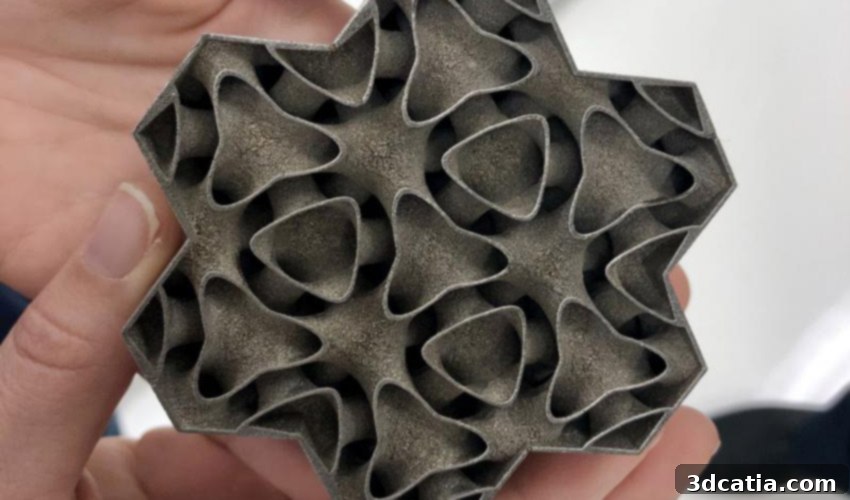
Revolutionizing Energy: GE Research 3D Prints High-Performance, Ultra-Compact Heat Exchangers
In a significant stride towards sustainable and efficient energy production, GE Research has spearheaded an ambitious $2.5 million project aimed at designing and 3D printing a groundbreaking high-temperature, high-pressure, and super-compact heat exchanger. This initiative, part of a two-and-a-half-year mission led by the Advanced Research Projects Agency, is set to revolutionize energy platforms by delivering cleaner and more efficient power generation capabilities for both existing infrastructure and future power plants. To achieve this challenging goal, GE’s renowned research division has forged a powerful alliance with the esteemed University of Maryland and the Oak Ridge National Laboratory (ORNL). This collaborative effort has already yielded promising results, with the partners successfully presenting a compelling first prototype that showcases the immense potential of their innovative approach.
At its core, a heat exchanger is an essential device engineered to facilitate the transfer of thermal energy between two or more fluids that are at different temperatures, critically ensuring that these fluids do not intermix. These devices are ubiquitous in various industries, from power generation and HVAC systems to chemical processing and automotive applications, playing a pivotal role in controlling temperature and optimizing energy usage. Traditionally manufactured using conventional methods, heat exchangers are now entering a new era thanks to additive manufacturing, commonly known as 3D printing. This transformative method unlocks unprecedented design complexity for parts that were previously impossible to create, while simultaneously offering substantial reductions in production times and associated costs. The ability to craft intricate internal geometries and highly efficient fluid pathways through 3D printing is fundamentally changing what’s achievable in heat exchanger design and performance.
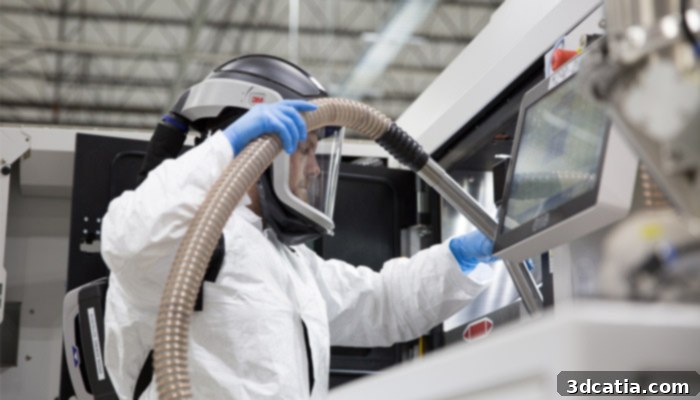
Credits: GE Research
Unleashing Unprecedented Performance: GE Research’s 3D Printed Heat Exchanger
The ambition of GE and its partners is to develop heat exchangers capable of operating in extreme environments, specifically enduring temperatures up to a staggering 900°C and pressures reaching 248 bar. These are conditions far exceeding the capabilities of most current heat exchange technologies. Peter deBock, a leading thermal engineer at GE Research, articulates the essence of this breakthrough: “We are leveraging our extensive, decades-long knowledge in advanced metal management and thermal management and applying it in ways never before possible, all thanks to the transformative power of 3D printing. This methodology empowers us to realize entirely new architectural designs – intricate structures and pathways – that were previously beyond the realm of manufacturing feasibility. This innovation is crucial for us to create a revolutionary ‘UPHEAT’ device, engineered to operate cost-effectively at temperatures significantly higher than those of existing heat exchangers, potentially an increase of over 250°C.” This advancement promises not only superior performance but also a tangible reduction in operational costs, making high-efficiency energy generation more accessible and sustainable.
Biomimicry in Design: Learning from Nature’s Best
A fascinating aspect of this project is the inspiration drawn from natural biological systems. DeBock highlights a powerful analogy: “The human lungs are, without a doubt, the ultimate heat exchanger. They masterfully circulate the air we breathe, enabling the body to function at its peak while meticulously regulating its internal temperature. Heat exchangers found in power generation equipment, such as gas turbines, perform an essentially identical function, albeit under vastly more demanding conditions of temperature and pressure.” This profound insight forms the cornerstone of GE’s design philosophy. Through the unparalleled flexibility offered by additive manufacturing, GE and the University of Maryland are now deeply exploring more complex, nature-inspired biological shapes and designs. They are looking beyond traditional engineering constraints to mimic the intricate, branching structures and highly efficient fluid networks found within human lungs and other physiological systems. This biomimetic approach is anticipated to lead to a radical paradigm shift in heat exchanger performance, promising not only significantly increased thermal efficiency but also a substantial reduction in harmful emissions. By learning from millions of years of natural evolution, the teams aim to create devices that are inherently more optimized for heat transfer and fluid dynamics than anything previously conceived through conventional manufacturing methods.
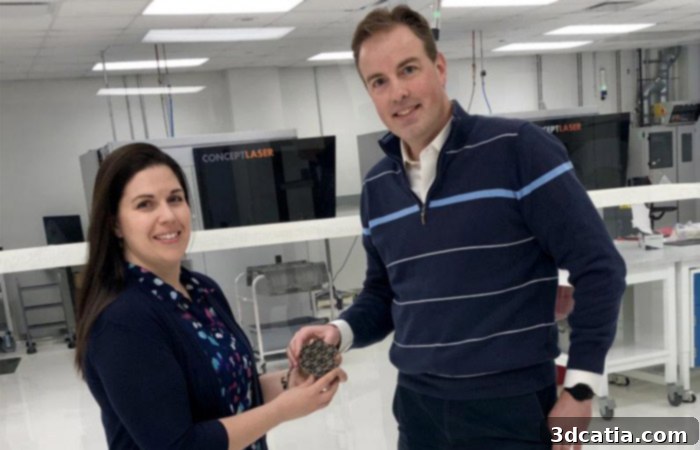
Laura Dial (Materials Scientist at GE Research) and Peter DeBock | Credits: GE Research
Advanced Materials and Expertise for Extreme Conditions
The successful operation of these cutting-edge heat exchangers at such extreme temperatures and pressures necessitates the use of extraordinarily robust materials. The device will be 3D printed from a specialized nickel superalloy, a material renowned for its exceptional resistance to breakage, creep, and corrosion even under severe thermal stress. Crucially, this superalloy has been specifically designed by GE Research’s expert team for the unique demands of the additive manufacturing process, ensuring optimal printability and performance. This highlights GE’s integrated approach, combining material science with advanced manufacturing techniques. For the additive manufacturing process itself, solutions developed by Concept Laser, a leader in metal 3D printing technology, are being utilized. Specifically, the M2 Cusing machine is expected to play a vital role, known for its precision and capability in handling high-performance alloys. Furthermore, the critical task of ensuring the long-term reliability and durability of these materials falls to the Oak Ridge National Laboratory (ORNL). With its unparalleled expertise in corrosion science, ORNL is tasked with rigorously testing and validating the performance of these advanced alloys under simulated operational conditions. This meticulous validation process is essential to guarantee that the 3D printed heat exchangers can withstand the demanding environments of future power plants, providing consistent and safe operation over their intended lifespan.
Transformative Impact on Energy and Aerospace
The collaborative partners confidently project that upon its completion, this innovative 3D printed heat exchanger will usher in a new era of efficiency for indirect power cycles. A primary focus is its application in Brayton’s supercritical carbon dioxide (sCO2) power generation, a highly promising technology for its ability to achieve significantly higher thermal efficiencies than conventional steam cycles, often with a much smaller physical footprint. By integrating these advanced heat exchangers, the overall thermal efficiency of sCO2 power generation systems is expected to increase dramatically, leading directly to substantial reductions in energy consumption and a corresponding decrease in greenhouse gas emissions. This aligns perfectly with global efforts to decarbonize the energy sector and move towards more sustainable power solutions.
Beyond power generation, the potential applications of this breakthrough extend far and wide, opening up exciting new opportunities, particularly within the aerospace sector. The development of lightweight, compact, and highly efficient heat exchangers is a long-sought-after goal for advanced aerospace applications. These devices could be critical for thermal management in next-generation aircraft engines, optimizing performance and fuel efficiency. They could also play a crucial role in spacecraft thermal control systems, enabling more ambitious missions and extending operational lifespans in extreme extraterrestrial environments. Furthermore, industries like high-performance automotive, chemical processing, and concentrated solar power could also benefit immensely from this technology, leveraging its ability to operate at higher temperatures and pressures while offering superior heat transfer capabilities. This project truly represents a convergence of advanced manufacturing, material science, and thermal engineering, poised to drive innovation across multiple high-tech sectors.
The successful development of this efficient 3D printed heat exchanger by GE Research, in partnership with the University of Maryland and Oak Ridge National Laboratory, marks a monumental step forward in the quest for cleaner, more efficient, and more robust energy solutions. By harnessing the power of additive manufacturing and biomimetic design, the team is not just improving existing technology but is creating entirely new possibilities for energy generation and beyond. This collaborative spirit and innovative approach promise to reshape the future of industrial thermal management, proving that the synergy of expert knowledge and cutting-edge technology can overcome even the most daunting engineering challenges. For more comprehensive details about this groundbreaking project, you can find additional information HERE.
What are your thoughts on this revolutionary 3D printed heat exchanger and its potential impact on future energy systems and other industries? We invite you to share your insights in a comment below or join the conversation on our Facebook and Twitter pages! Don’t forget to sign up for our free weekly Newsletter, to receive all the latest news and advancements in 3D printing delivered straight to your inbox!