
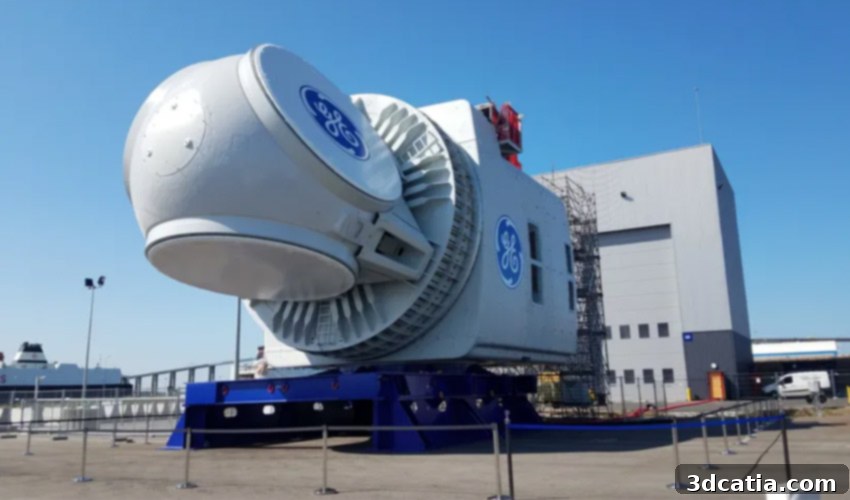
GE Haliade-X: Revolutionizing Offshore Wind Turbine Manufacturing with Advanced 3D Printing
The global transition towards sustainable energy sources is accelerating, with offshore wind power emerging as a critical pillar of this movement. At the forefront of this innovation is General Electric (GE), an American industrial giant, which has announced a groundbreaking partnership set to redefine the manufacturing landscape for colossal wind turbines. Collaborating with Fraunhofer IGCV and Voxeljet, GE is spearheading the development of a pioneering 3D printer. This innovative machine is specifically engineered to design and produce large-scale sand molds for the intricate components of its flagship Haliade-X offshore wind turbine, a marvel of modern engineering.
The Haliade-X stands as a testament to humanity’s ambition in renewable energy. With an awe-inspiring height of 260 meters (approximately 853 feet), it dwarfs many iconic structures, such as the Statue of Liberty (93 meters or ~305 feet tall). Its three massive blades, each stretching an incredible 107 meters (around 351 feet) in length, sweep an area larger than three football fields. To put its scale into perspective, while not as tall as the Empire State Building at 381 meters (1250 feet), the sheer rotational diameter and power generation capacity of the Haliade-X are unparalleled. This ambitious project, slated for initial testing in early 2022, will leverage the transformative power of 3D printing for sand molds through the advanced Binder Jetting process. This strategic adoption aims to cast the critical, large-scale components of the wind turbine’s nacelle, promising a dramatic reduction in mold development time – from an arduous 10 weeks down to a mere two.
The Haliade-X offshore wind turbine is not just impressive in size; its energy generation capabilities are equally astounding. Engineered to produce up to 310 MWh in a single day, this single turbine can generate enough clean energy to power a city of 250,000 inhabitants for 24 hours. This immense capacity underscores its potential to make a significant contribution to global energy grids and reduce reliance on fossil fuels. Manufactured across multiple key locations, including Saint-Nazaire and Cherbourg, France, the Haliade-X is poised to become the most powerful wind turbine on Earth, setting a new benchmark for renewable energy infrastructure. For engineers, manufacturers, and environmental advocates alike, its production process is particularly fascinating due to its pioneering integration of additive manufacturing, specifically the sophisticated binder jetting technology, into the fabrication of its massive parts.
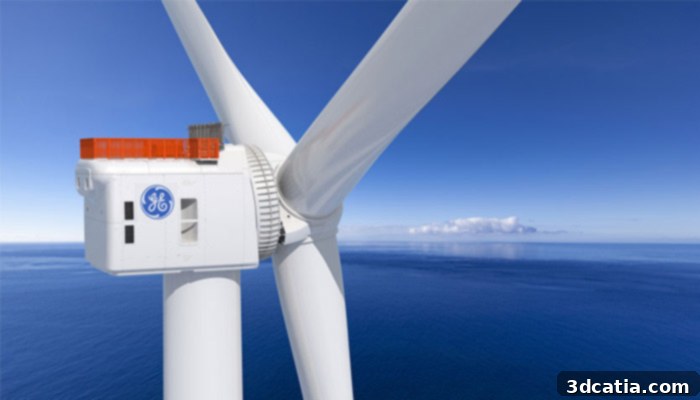
The wind turbine is equipped with 3 blades of 107 meters (photo credits: GE Renewable Energy)
The Power of Collaboration: Developing the Advance Casting Cell (ACC)
The partnership between GE, Fraunhofer IGCV, and Voxeljet is a powerful synergy, bringing together expertise from turbine design, materials research, and advanced 3D printing technology. These three entities are diligently working on the development of a revolutionary new machine dubbed the Advance Casting Cell (ACC). This state-of-the-art system is designed to facilitate the rapid and precise production of sand molds, which are absolutely essential for casting the large, complex metal components that form the core of the Haliade-X nacelle. The nacelle itself houses the generator, gearbox, and other crucial mechanisms, making the quality and efficiency of its components paramount to the turbine’s overall performance and longevity.
The core of this innovation lies in the utilization of powder bonding technology, also known as binder jetting. This additive manufacturing process involves selectively depositing a liquid binding agent onto a layer of powdered material – in this case, sand – to create a solid object, layer by layer. Unlike traditional manufacturing methods that rely on expensive and time-consuming tooling, binder jetting allows for immense design freedom and rapid iteration. This advanced technique empowers the project teams to significantly accelerate their production cycles, enabling them to produce complex molds in an astonishing two weeks. This represents a five-fold acceleration compared to conventional molding processes, dramatically reducing lead times and fostering greater agility in the supply chain for these massive renewable energy systems.
Juan Pablo Cilia, a Senior Additive Design Engineer at GE Renewable Energy, elaborated on the profound impact of this technological shift. He explained, “The 3D printed molds will bring many benefits including improved casting quality through improved surface finish, part accuracy and consistency. Furthermore, sand binder jet molds or additive molds provide cost savings by reducing machining time and other material costs due to optimized design.” This statement highlights several critical advantages. Firstly, the precision inherent in 3D printing ensures a superior surface finish and exceptional accuracy in the resulting metal castings. This translates to less post-processing, reduced material waste, and ultimately, higher quality components for the Haliade-X. Secondly, the ability to create molds with optimized internal geometries, which are often impossible or prohibitively expensive with traditional methods, allows for components that are lighter, stronger, and more efficient, directly contributing to the turbine’s overall performance and lifespan.
Enhancing Sustainability and Supply Chain Efficiency
Beyond the immediate benefits of speed and precision, the adoption of additive manufacturing in this project is poised to deliver significant environmental advantages and transform supply chain logistics. A key challenge in manufacturing large components is the carbon footprint associated with transporting molds and finished parts across vast distances. By enabling localized production, this initiative drastically reduces the need for long-haul transportation of heavy molds. Instead of shipping molds from various remote locations, the new process facilitates on-site or near-site manufacturing, substantially cutting down logistical flows, associated travel, and shipping costs. This localized production strategy not only slashes carbon emissions but also strengthens regional manufacturing capabilities and creates a more resilient supply chain.
The ACC machine, built upon Voxeljet’s robust binder jetting technology, is designed to bring to life molds for metal castings with an impressive maximum diameter of 9.5 meters. This colossal capacity ensures that even the largest and most complex components of the Haliade-X nacelle can be produced with unprecedented efficiency and precision. Ingo Ederer, CEO of Voxeljet, emphasized the strategic importance of this on-site manufacturing capability. He concluded, “While off-site on-demand 3D printing has many advantages for small quantities of castings, operating an on-site 3D printing system makes the most of the technology. Given the demand for offshore wind turbines, this will go a long way toward meeting project schedules and high market demands.” Ederer’s insight underscores that for projects of the magnitude and scale of offshore wind farms, having integrated, on-site additive manufacturing systems is not just an advantage but a necessity. It ensures that turbine manufacturers can meet ambitious project timelines and respond swiftly to the surging global demand for renewable energy infrastructure.
The implementation of 3D printing in this context also opens doors for enhanced design flexibility. Engineers can now iterate on mold designs much faster, incorporating complex internal features and optimized geometries that would be impossible or cost-prohibitive with traditional methods. This capability allows for the creation of lighter, stronger, and more efficient components, directly contributing to the Haliade-X’s unparalleled performance and extended operational lifespan. Furthermore, the digital nature of 3D printing workflows means that designs can be stored, replicated, and modified with ease, paving the way for greater standardization and quality control across production sites.
The Future Horizon: Advancing Renewable Energy and Industrial Additive Manufacturing
The initial production runs on the Advance Casting Cell (ACC) machine are anticipated to commence in early 2022, marking a pivotal moment for both the renewable energy sector and industrial additive manufacturing. This project transcends the realm of a mere technological upgrade; it represents a paradigm shift in how large-scale industrial components are manufactured, especially for critical infrastructure like offshore wind turbines. The successful deployment of this 3D printing solution for the Haliade-X is expected to pave the way for wider adoption of additive manufacturing in other heavy industries, from aerospace to maritime, wherever large, complex metal parts are required.
GE’s commitment to integrating cutting-edge technologies like 3D printing into its renewable energy portfolio highlights a strategic vision for a sustainable future. By investing in processes that enhance efficiency, reduce costs, and minimize environmental impact, GE is not only strengthening its position as a leader in offshore wind but also contributing significantly to global climate goals. The Haliade-X, empowered by additive manufacturing, symbolizes the innovative spirit required to tackle the climate crisis and transition towards a cleaner, more sustainable energy landscape.
We will continue to monitor and inform you about the progress of this transformative project as it unfolds. For those eager to delve deeper into GE’s broader initiatives in additive manufacturing and renewable energy, more information can be found HERE, exploring how 3D printed concrete is also being explored to give wind turbines a powerful lift.
*Cover photo credits: Radio France – Clémentine Sabrié
What are your thoughts on the Haliade-X offshore wind turbine and the role of 3D printing in its production? We encourage you to share your insights in a comment below or join the conversation on our Facebook and Twitter pages. Don’t miss out on the latest advancements in additive manufacturing – remember to sign up for our free weekly newsletter, delivering all the essential 3D printing news directly to your inbox!