
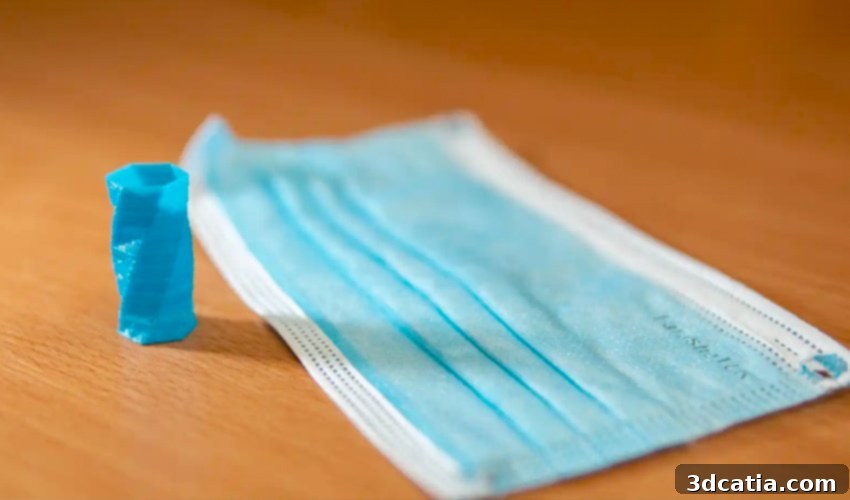
From PPE to Progress: Innovating 3D Printing with Recycled Surgical Masks
The rapid global spread of the recent pandemic dramatically altered daily life across the globe, bringing with it an unprecedented reliance on personal protective equipment (PPE), particularly surgical masks. These essential items quickly became a ubiquitous part of our daily routine, critical for public health and safety. However, their widespread daily use, coupled with the necessary practice of discarding them after single use, has inadvertently created an environmental crisis of significant proportions. The sheer volume of discarded masks presents a monumental challenge, contributing substantially to plastic pollution in oceans, landfills, and natural landscapes worldwide. Addressing this urgent environmental concern while simultaneously exploring sustainable manufacturing practices has become a priority for innovators globally. Fortunately, a dedicated research team at the esteemed University of Bristol in England has emerged with a groundbreaking initiative that offers a potential solution to this dual problem, paving the way for a more sustainable future in both waste management and advanced manufacturing.
The innovative concept behind their project is elegantly simple yet profoundly impactful: intercept defective or otherwise unusable surgical masks before they enter the waste stream. Instead of being discarded, these masks are collected for recycling and subsequently transformed into a valuable raw material for additive manufacturing—specifically, high-quality 3D printing filaments. This pioneering approach is designed with two core objectives. Firstly, it aims to significantly mitigate the detrimental environmental impact caused by the immense quantity of disused PPE. By diverting masks from landfills and natural ecosystems, the project actively reduces plastic pollution. Secondly, it contributes to the development of novel, sustainable filaments for additive manufacturing (AM), thereby fostering a more circular economy within the 3D printing industry. This initiative not only tackles an immediate environmental threat but also champions the creation of sustainable resources for future technological applications, embodying a forward-thinking approach to waste and resource management.
The scale of the surgical mask pollution problem is truly staggering and demands immediate attention. According to sobering statistics reported by National Geographic, an estimated 129 billion face masks were used globally each month during the height of the pandemic. This translates to an alarming daily average of approximately 3.4 billion face masks or face shields being discarded. The vast majority of these items, tragically, do not end up in proper recycling facilities but instead are scattered across our planet—polluting oceans, littering city streets, and contaminating rural landscapes. This unchecked disposal exacerbates environmental degradation, primarily due to the plastic components inherent in these masks. These plastics, crucial for the masks’ protective qualities, become persistent pollutants once discarded. For instance, an in-depth study published in Environmental Advances highlighted that a single face mask has the potential to release up to 173,000 microfibers into the marine environment every single day. These microfibers, along with the larger plastic components, represent a significant threat to aquatic life and ecosystems.
Like countless other everyday plastic objects, face masks are primarily composed of plastic fibers, predominantly polypropylene (PP). Polypropylene is a highly durable polymer known for its resistance to degradation, meaning it can persist in the environment for decades, if not centuries, before finally breaking down into smaller microplastic particles. This longevity makes it a persistent pollutant, accumulating in various ecosystems and posing long-term environmental and health risks. Confronted with this colossal challenge, the innovative team at the University of Bristol embarked on a crucial mission: to thoroughly investigate the viability of transforming the constituent components of these discarded masks into a useful and sustainable material for 3D printing. Their research focuses on not just recycling, but upcycling this pervasive waste into a valuable resource, offering a tangible solution to a pressing global problem.
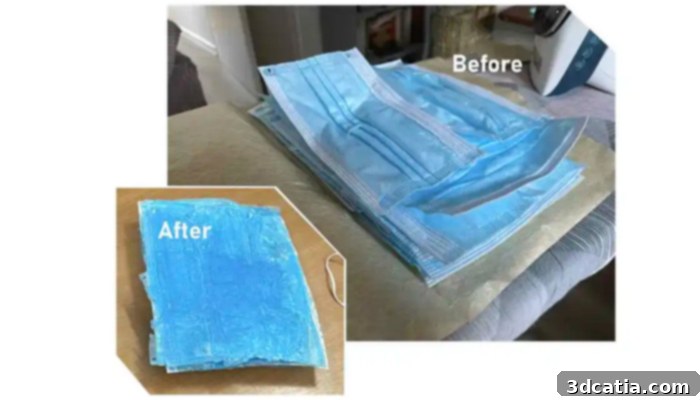
The discarded masks are transformed into sheets through a pressing process
Transforming Waste into Resources: The Mask-to-Filament Process
The initial stages of the University of Bristol’s project involved meticulous experimentation to establish a viable recycling methodology. The team began by collecting a substantial number of defective or unsuitable surgical masks, ensuring that these were items that would otherwise be discarded. A critical first step in the recycling process involved carefully removing non-polypropylene components from each mask, specifically the elastic ear loops and the embedded metallic nose wires. This separation is crucial for maintaining the purity of the polypropylene plastic, which is essential for producing a consistent and high-quality 3D printing filament. Once these foreign elements were successfully removed, the remaining pure mask fabric—primarily polypropylene—was subjected to a thermal pressing process. The masks were heated and then pressed with an iron, often using non-stick paper, a method designed to flatten and densify the material. This transformation resulted in the creation of hard, compact plastic sheets, effectively converting the flimsy, fibrous mask material into a more manageable and sturdy form for subsequent processing.
Following the creation of these compact polypropylene sheets, the next stage involved mechanical processing to prepare the material for extrusion. The hard sheets were meticulously ground down into fine polypropylene pellets. This pelletization process is fundamental, as it creates uniform particles that can be fed consistently into an extruder. The resulting pellets, often retaining the characteristic blue hue of many surgical masks, represent the pure recycled plastic ready for its transformation into filament. The final and arguably most crucial step in this innovative recycling chain involves passing these blue pellets through a specialized wire drawing machine, also known as a filament extruder. This machine melts the polypropylene pellets and forces the molten plastic through a tiny die, shaping it into a continuous strand of filament with a precise diameter. This filament is then cooled and spooled, ready to be used in Fused Deposition Modeling (FDM) 3D printers. An important consideration throughout this process was disinfection. The researchers meticulously noted that since the initial masks had undergone a series of high-temperature processes—from the initial heating and pressing to the melting and extrusion during filament production—they were confident that these thermal treatments were sufficient to effectively disinfect the material, eliminating any possible bacteria or viruses that might have been present on the original masks, ensuring the safety and usability of the final product.
Innovating with Open Source and Envisioning a Circular Future
To successfully achieve the precise characteristics required for a functional 3D printer filament, the University of Bristol team strategically leveraged collaborative innovation. They turned to Filastruder, an acclaimed open-source product specifically engineered by the vibrant maker community to facilitate the recycling of various printed plastic waste into new 3D printing filament. This collaboration proved instrumental in refining the extrusion process and optimizing the properties of the recycled polypropylene. Filastruder’s design and community support offered invaluable insights and practical solutions for extruding a consistent and reliable filament from the processed mask pellets. This partnership underscores the power of open-source initiatives in accelerating research and development, allowing the Bristol team to fine-tune aspects such as filament diameter, melt flow index, and tensile strength—all critical factors for successful 3D printing.
Once the researchers successfully developed a viable and consistent filament from recycled surgical masks, their ambitions expanded beyond the initial proof-of-concept. They immediately set their sights on tackling new, more complex challenges within the field of sustainable additive manufacturing. Among these forward-thinking objectives is the crucial possibility of processing mixed materials. The current process, while effective, requires the manual removal of non-polypropylene components like ear loops and nose wires. Developing a method to treat the entire mask, including these various components, within a single, integrated recycling process would vastly improve efficiency, reduce labor, and make the system more scalable. This advancement would address the heterogeneity of mask materials, a common hurdle in plastic recycling.
Furthermore, the team is actively investigating the potential for large-scale process automation. Scaling up this innovative recycling method from a laboratory setting to an industrial operation requires sophisticated automation solutions. This involves exploring automated sorting, shredding, pelletizing, and filament extrusion systems that can handle massive volumes of discarded masks. The ultimate goal of this pursuit is to foster a robust circular economy for medical equipment. A circular economy fundamentally aims to minimize waste and make the most of resources by keeping products and materials in use for as long as possible. By integrating automated recycling, the project could establish a continuous loop where used masks are collected, processed, and transformed into new products, reducing reliance on virgin plastics and diminishing environmental harm.
A significant aspect of fostering this circular economy involves establishing comprehensive infrastructure to oversee the entire lifecycle of medical equipment. This includes developing efficient systems for the distribution, collection, and recycling of used masks. Such an infrastructure would require collaboration among healthcare providers, waste management companies, local governments, and manufacturing industries to create a seamless pipeline from mask usage to filament production and new product creation. While the progress is promising and the vision is clear, it remains to be seen how this innovative idea, born from the urgent need to combat environmental contamination caused by discarded masks, will evolve and be implemented on a wider scale. The journey from laboratory innovation to widespread industrial adoption presents its own set of challenges, from material consistency and cost-effectiveness to logistical complexities and regulatory hurdles. Nonetheless, the University of Bristol’s pioneering work stands as a beacon of hope, demonstrating the immense potential of applied research in addressing critical global issues through sustainable technological advancement. In the meantime, those interested in learning more about this exciting project can find additional information and updates on the university’s dedicated research website HERE.
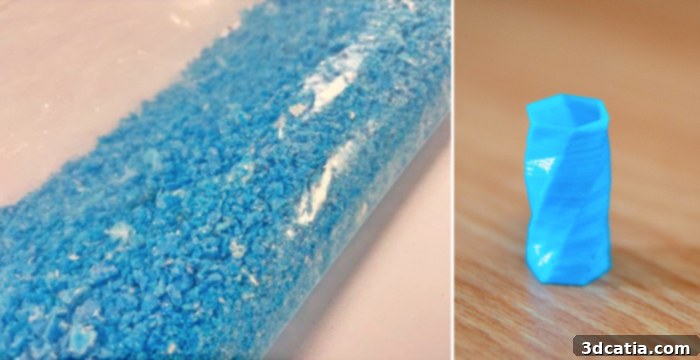
On the left, the granules obtained from the masks. On the right, a 3D printed part with the developed material
The Future of Sustainable Manufacturing
The initiative by the University of Bristol represents a significant step forward in addressing the environmental fallout from the pandemic while simultaneously advancing the field of additive manufacturing. By successfully demonstrating the viability of transforming discarded surgical masks into high-quality 3D printing filament, the project offers a tangible pathway toward mitigating plastic pollution and fostering a more sustainable approach to resource utilization. This innovative solution not only diverts billions of masks from polluting our planet but also introduces a valuable, recycled material into the manufacturing supply chain, proving that waste can indeed be a resource. The ongoing research into mixed material processing and large-scale automation further solidifies the potential for this concept to have a widespread, transformative impact on the circular economy for medical devices and beyond. Such efforts are crucial in demonstrating how scientific ingenuity can convert seemingly insurmountable challenges into opportunities for environmental stewardship and technological progress, inspiring similar initiatives globally.
What are your thoughts on recycling surgical masks into valuable 3D printing material? We invite you to share your perspectives and engage in the conversation by leaving a comment below or by connecting with us on our various social media platforms, including LinkedIn, Facebook, and Twitter! To stay updated with the very latest developments and breakthroughs in the exciting world of 3D printing, don’t forget to sign up for our free weekly Newsletter here, delivering cutting-edge news directly to your inbox. You can also explore all our insightful videos and engaging content on our dedicated YouTube channel for more visual insights into additive manufacturing innovations.
*All Photo Credits: University of Bristol