
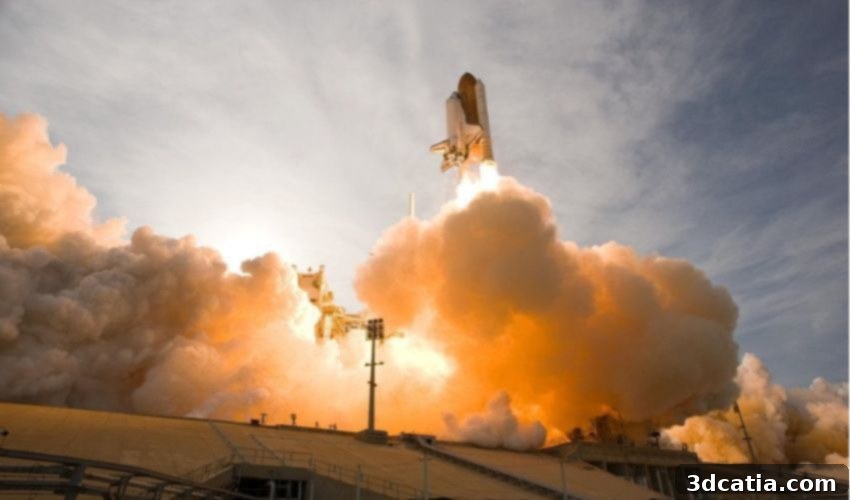
Revolutionizing the Skies and Beyond: The Transformative Power of 3D Printing in Aerospace
As observed at Formnext 2024, the landscape of additive manufacturing (AM) is continuously evolving, offering a clear snapshot of current industry drivers and future trends. While the previous year’s discussions largely centered on automotive applications and sustainability, Formnext 2024 distinctly showcased a surge in 3D metal printing technologies and their expansive potential within the aerospace sector. This shift was evident across the exhibition floor, where leading companies presented innovative 3D printing systems and compelling use cases specifically tailored for aerospace. Furthermore, numerous conferences and expert lectures delved into advanced metal processing techniques and the burgeoning field of aerospace additive manufacturing. Having previously explored the most innovative metal applications at Formnext in a dedicated article, this piece will further elaborate on the compelling reasons behind AM’s increasing adoption in aerospace, the persistent challenges that need to be addressed, and the groundbreaking solutions being developed to harness the full potential of 3D printing in this critical industry.
Additive manufacturing is strategically employed in the aerospace industry for the creation of sophisticated space vehicle components. This includes highly critical parts such as rocket propulsion systems, intricate combustion chambers, advanced injector heads, and high-performance pump systems. Beyond Earth, the production of parts directly in space, often utilizing extraterrestrial materials, represents another significant frontier. Pioneering examples include the proposed construction of runways and foundational building structures using Martian or lunar regolith, demonstrating the technology’s capability to support future space missions and settlements.
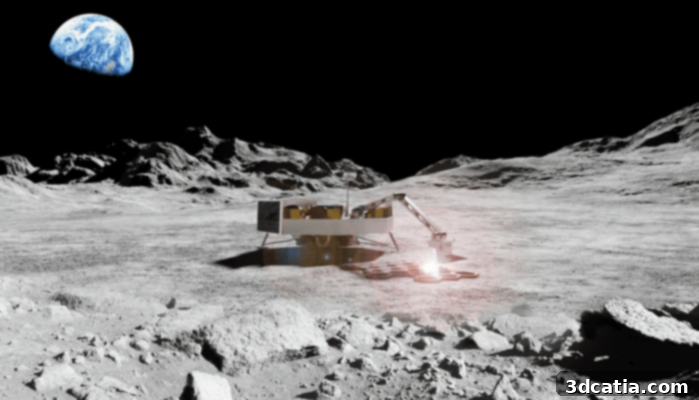
Photo credits: ICON
The inherent flexibility of additive manufacturing allows for the realization of exceptionally intricate and complex designs, a feat often unattainable with traditional manufacturing methods. In the context of rocket engines, for example, AM facilitates the integration of advanced cooling systems directly into the part during a single production step, dramatically simplifying assembly and reducing potential points of failure. These additively manufactured parts frequently deliver enhanced performance characteristics, often due to optimized geometries and the ability to utilize customized materials with specific, tailored properties for extreme aerospace environments. These advantages extend beyond individual components to encompass large-scale in-space structures. AM offers unparalleled flexibility and on-demand production capabilities, ensuring high precision with a relatively low-to-medium energy consumption footprint. Its material efficiency is another highly valued attribute, as highlighted by Mohammad Azami from Concordia Aerospace Robotics Lab in his presentation. However, for components with simpler geometries, conventional processes such as casting and sintering of regolith concrete still remain viable options, primarily due to their established speed and cost-effectiveness for less complex forms.
Advancing AM Processes for Space Travel and Overcoming Current Challenges
Within the realm of additive manufacturing for aerospace, Laser Powder Bed Fusion (LPBF) remains a predominant method, lauded for its ability to produce highly detailed and complex metal parts. However, there is a growing interest and increasing focus on Directed Energy Deposition (DED) technologies. Companies like The Exploration Company, for instance, are currently leveraging powder bed fusion but are actively exploring a transition to DED for their future applications in 2025. DED processes, which typically involve melting material as it is deposited, offer advantages in terms of build size, repair capabilities, and material flexibility. A notable innovator in this space is the German company ponticon, which specializes in industrial high-speed DED systems. Their Dynamic Material Deposition process was instrumental in manufacturing the jacket for the Ariane 6 engine. This advanced technique distinguishes itself by melting the powder while it is still airborne, allowing for remarkable precision and control over the deposition process, which is crucial for critical aerospace components.
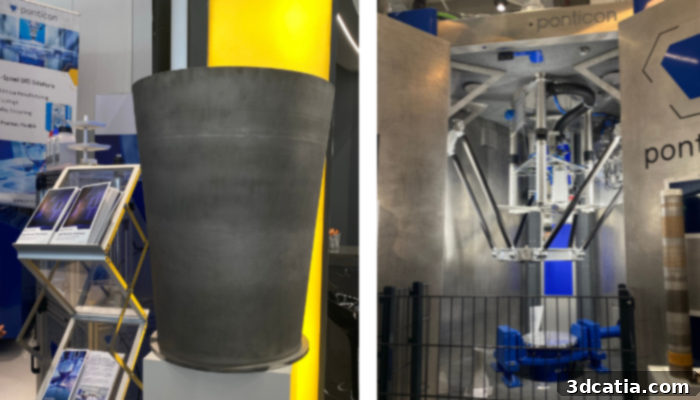
At the ponticon stand at Formnext. (Photo credits: 3Dnatives)
The DED process effectively mitigates one of the most significant challenges encountered with powder bed fusion in the aerospace sector: the complete depowdering of highly complex parts. While AM enables the creation of incredibly sophisticated internal cooling channels and intricate designs, thoroughly cleaning these delicate internal geometries to remove residual powder can be exceedingly difficult. If even small amounts of powder remain lodged in these channels, it can impede the flow of crucial cooling fluids, leading to a serious risk of engine overheating, melting, or catastrophic destruction. Maximilian Strixner from The Exploration Company, developers of the modular and reusable space capsule Nyx, vividly describes this hurdle: “We are printing 100 cooling channels inside a part, with a 4 mm wall thickness. This is a real challenge,” illustrating the precision and cleanliness demanded by such critical applications.
Furthermore, additive manufacturing in space introduces a unique set of conditions and formidable problems compared to terrestrial operations. For instance, the lunar environment lacks a constant temperature, and its extreme temperature fluctuations – ranging from scorching heat to cryogenic cold – pose immense difficulties for stable part manufacturing. Additionally, the presence of low gravity significantly impacts material deposition, solidification, and ultimately the structural integrity and properties of the parts and building structures produced. These environmental factors necessitate innovative approaches to material processing and machine design.
Another pervasive challenge confronting users of additive manufacturing in the aerospace sector—whether operating on Earth or in the harsh environment of space—is the prohibitive cost. This primarily stems from the high material costs associated with specialized alloys and composites possessing specific, high-performance characteristics. Tobias Stiggen from ponticon GmbH, during his presentation, highlighted that approximately two-thirds of the total costs for a specific example, such as the jacket of the Ariane 6 propulsion system, were directly attributable to the cost of the material. In comparison, the investment in the hardware, like a printing system from ponticon, constituted a relatively minor portion of the overall expenditure. This underscores the need for innovations in material development and cost-effective processing.
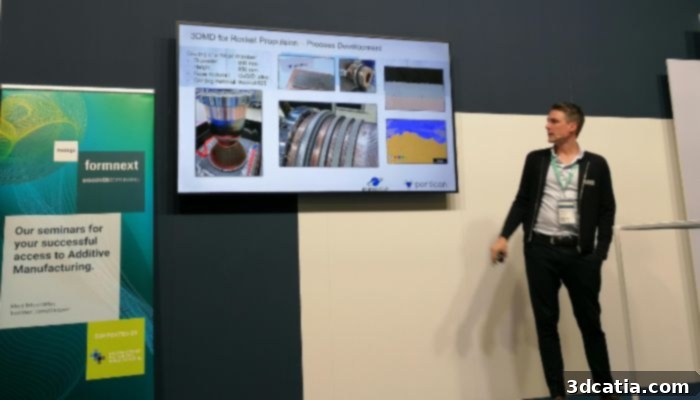
Tobias Stiggen explains the advantages of DED technology for rocket propulsion. (Photo credits: 3Dnatives)
The elevated costs in aerospace AM are also driven by the industry’s unwavering focus on producing high-performance and ultra-lightweight parts. Unlike the automotive industry, which predominantly prioritizes cost optimization per part in high-volume production, the aerospace sector is willing to invest significantly more to reduce the weight of components. Bill Bihlman of SAE International emphasized this distinction in his presentation on “Material Qualification for Aerospace and Automotive AM Serialized Part Production,” noting that aerospace parts can cost approximately ten times more than their automotive counterparts. This premium is justified by the substantial operational savings in fuel and increased payload capacity that lightweighting provides over the lifespan of an aircraft or spacecraft.
High-Performance Material Diversity for Advanced Aerospace Applications
Despite the critical role of cost, material performance and long-term durability remain paramount considerations in aerospace applications. The industry actively explores and employs a diverse range of metals, advanced alloys, and newly developed composite materials. The Exploration Company, for instance, strategically utilizes copper alloys for their exceptional thermal conductivity, vital for heat management in propulsion systems, and nickel-based alloys for their superior mechanical strength and outstanding chemical resistance in corrosive environments. SAE, while also relying on robust alloys, often incorporates aluminum and titanium for smaller series parts where their strength-to-weight ratio is advantageous. These material choices are carefully selected to withstand the extreme temperatures, pressures, and radiation exposure inherent in space travel.
For in-space production, the focus shifts to utilizing local resources and advanced composite materials. Concordia Aerospace Robotics Lab, for example, has pioneered a composite material composed of PEEK (Polyetheretherketone) and lunar or Martian regolith. This innovative blend effectively meets stringent NASA requirements concerning exhaust gas quotas and exhibits remarkable resistance to radiation and chemical degradation, crucial for components exposed to the harsh vacuum of space. Furthermore, the integration of regolith into PEEK offers a significant cost-reduction potential, as evidenced by their research. With a composition of 50% by weight of regolith in PEEK, a corresponding 50% reduction in material costs was achieved, showcasing a sustainable and economical approach to extraterrestrial manufacturing.
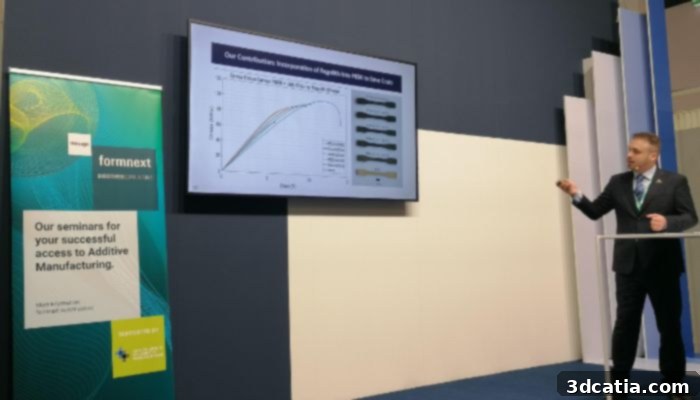
Mohammad Azami from Concordia Aerospace Robotics Lab (Photo credits: 3Dnatives)
Over the past year, there has been a noticeable and increasing trend throughout the additive manufacturing industry towards 3D printing with silicone. This versatile material is now making significant inroads into the aerospace sector, a testament to its unique properties. Formnext 2024 featured a dedicated presentation titled “Transforming Aerospace with Silicone and Soft Composites 3D Printing,” which specifically highlighted these advancements. Julien Barthes from 3DEUS DYNAMICS presented his company’s innovative powder process for silicone, detailing how they develop new soft composite materials directly during the printing process. A key advantage of this approach is its compatibility with conventional injection-molded silicone, expanding the material’s utility for 3D printing. Moreover, this process generates no waste, as recycled powder can be efficiently reused. Barthes emphasized the groundbreaking capability to modify the material composition during the AM process, enabling the production of a single part with two distinct textures, customized mechanical properties, and highly complex geometries. He summarized this by stating, “You can add powder during the printing process, manipulate the material, and create composites during the process.” Barthes further explained how this method allowed 3DEUS DYNAMICS to create a novel flame-retardant and soft composite material, perfectly suited for components exposed to fire, a common and critical requirement in various aerospace applications, such as seals, gaskets, and vibration dampeners in engine compartments or cabin interiors.
A Promising Look Into the Future of Aerospace AM
Given the extensive range of applications and the wealth of technical papers presented on aerospace at Formnext 2024, it is unequivocally clear that additive manufacturing is destined to become even more prevalent and indispensable in this demanding sector. This year has already witnessed remarkable innovations, including the successful launch of Ariane 6 and the unveiling of the world’s largest metal-printed rocket engine by Eplus3D and LEAP 71. These achievements underscore the rapid progress and the increasing maturity of AM technologies. However, as discussed, certain challenges still persist, particularly concerning cost, material qualification, and depowdering for highly complex geometries. Nevertheless, the inherent potential of additive manufacturing in space travel remains vast and largely unexploited. Beyond the well-established benefits of lightweight construction, the ability to create highly complex geometries, and the development of high-performance new materials that make rockets faster, more efficient, and inherently more sustainable, we anticipate hearing much more about the exciting future of 3D printing directly in space, enabling long-duration missions, lunar bases, and even interplanetary exploration with unprecedented flexibility and resourcefulness.
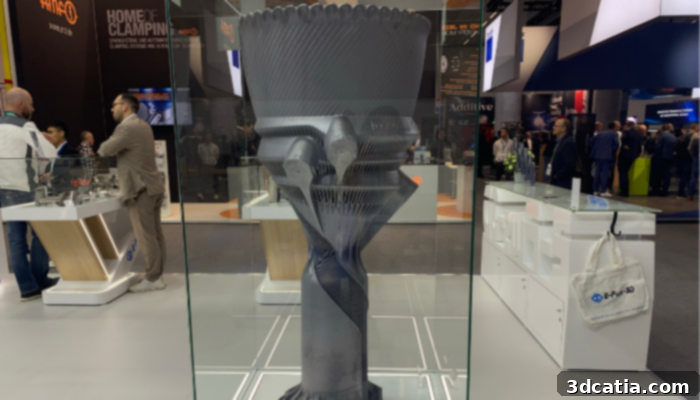
The world’s largest metal-printed rocket engine to date was presented by Eplus3D and LEAP 71 at Formnext 2024. (Photo credits: 3Dnatives)
What are your thoughts on the future of 3D printing for the aerospace sector? We invite you to share your insights in a comment below or engage with us on ourLinkedIn,Facebook, andTwitter pages! Don’t forget to sign up for our free weeklyNewsletter here to receive the latest 3D printing news straight to your inbox! You can also find all our compelling videos on ourYouTube channel.